


Parents in clinic often complain that a child cannot stop eating once snacks begin. Is this simply a deficit of self-control? A prospective neuroimaging cohort study published in JAMA Network Open points in a different direction (Alves et al., JAMA Netw Open 2026;9:e2640252). Habitual intake of ultraprocessed food (UPF), such as crisps, fried chicken and sugary drinks, may be altering the brain’s reward circuitry, producing an irresistible urge to eat when food cues are present.
Article Key Points
• A prospective imaging cohort of 46 children with healthy baseline weight was followed for one year
• A higher proportion of dietary energy from ultraprocessed food was linked to a stronger dorsal striatal food-cue signal
• The same dorsal striatal response was associated with greater gains in BMI and body fat percentage over one year
• Adjusting for the brain response weakened the association between ultraprocessed food intake and adiposity by 31% to 44%
• The study was observational with a small sample and cannot establish a causal effect
In the United States, 67% of the calories consumed by children come from UPF. The traditional view holds that UPF causes obesity mainly because it is energy dense, nutritionally poor and easy to overconsume. As central appetite regulation has become a research focus in endocrinology and metabolism, however, attention has shifted towards the brain. If UPF can influence appetite regulation at the neural level, then the clinical management of obesity may need an additional interventional perspective.
Study Design: Viewing the Brain Response in a Satiated State
To exclude the influence of obesity itself on brain structure, this longitudinal study from the BrainChild cohort deliberately selected 46 children of normal baseline weight, with a mean age of 8.7 years and BMI values within the normal range throughout.
Trained research staff first guided the children and their parents through a detailed 24-hour dietary recall on two consecutive days. The proportion of total daily energy contributed by UPF was then calculated from these records. The children subsequently underwent functional magnetic resonance imaging (fMRI). To remove the influence of hunger, the children were given a weight-adjusted glucose drink before scanning so that all were in a standardised postprandial, satiated state.
During the scan, the children viewed images of highly palatable foods such as biscuits and french fries, and neutral non-food objects such as pencils and benches. The researchers focused on blood-oxygen-level-dependent (BOLD) responses in the striatum, including the dorsal and ventral striatum, and followed the children for one year, measuring BMI, body fat percentage and waist circumference.
Core Findings: An Excessive Response to Food Cues
After one year of follow-up, the data revealed three key findings.
First, the higher the proportion of UPF in the daily diet, the stronger the response of brain regions responsible for habit and reward, the dorsal striatum, when food images were viewed (β=0.34; 95% CI 0.07-0.61). Notably, the ventral striatum, which mediates immediate hedonic pleasure, showed no significant association.
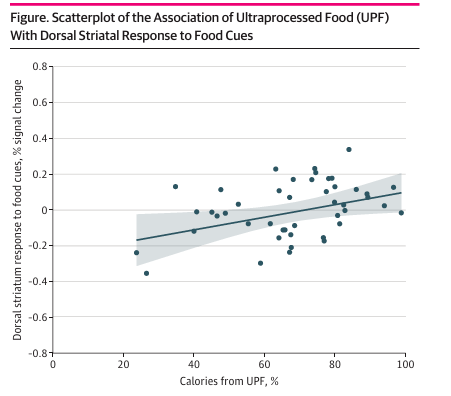
Fig. 1. Scatterplot of the Association Between Ultraprocessed Food Intake Measured as the Percentage of Daily Calories and the Percentage Signal Change in the Dorsal Striatal Response to Food Cues, with the Shaded Band Showing the 95% CI
Second, the high baseline reactivity of the dorsal striatum to food cues was closely associated with significant increases in BMI (β=0.32; 95% CI 0.02-0.62) and body fat percentage (β=0.44; 95% CI 0.15-0.72) one year later.
Third, when the brain reward response was included in the statistical model, the association between UPF intake and obesity was weakened by 31% for BMI and 44% for body fat percentage. This suggests that the habitual reward response of the brain may be one of the pathways through which UPF contributes to weight gain in children.
Mechanism: From Enjoying Food to Habitual Eating
Why would eating more UPF change the brain in this way? One explanation is the incentive sensitisation theory of neuroscience.
UPF is often rich in fat and refined carbohydrate, a combination that produces a supra-additive effect and delivers considerable pleasure to the brain. With repeated intake of such food, the brain’s motivational control shifts, moving from the pursuit of pleasure to cue-based automatic responses, from liking to wanting and habit formation.
This means that even when a child is not hungry, the reward circuitry activates automatically on seeing packaging, smelling an aroma or passing a convenience store, driving the child towards food. This cue-driven habitual eating may be one of the neurological underpinnings of failed dietary interventions and rebound weight gain.
Supplementary analyses in the study also clarified the misconception that added sugar is the only culprit. Although added sugar correlates moderately with UPF, the two do not overlap completely. After adjustment for added sugar, the association between UPF and dorsal striatal response was weakened but remained a trend. This suggests that the specific combination of fat and carbohydrate in UPF may play a key role in reshaping brain reward responses.
Clinical Implications: From Counting Calories to Treating Habit
The study offers a way of thinking about childhood obesity intervention in endocrinology.
Cutting the cues rather than simply counting calories: if UPF can trigger a strong cue response, then the clinical advice to families should extend beyond total energy control to reducing UPF exposure in the home environment. Not buying it, not stockpiling it and not keeping it in plain sight removes the cues that trigger habitual eating at the source.
Attending to tendencies towards food addiction: for children who struggle to control their weight, the issue may not be weak willpower but an oversensitive neural reward system. Psychological intervention or cognitive behavioural therapy can be introduced to help patients rebuild a dietary rhythm.
Optimising dietary structure: when writing dietary prescriptions, particular emphasis should be placed on avoiding processed combinations of high fat and high carbohydrate, and on encouraging intake of less processed whole foods.
Limitations and Outlook
This was an observational cohort study with a small sample (N=46). Although the data show a clear association, they cannot prove a causal relationship, and the possibility that children who are inherently more sensitive to food are simply more likely to prefer UPF cannot be fully excluded. The sample was also limited to children of healthy weight, so the findings do not directly extrapolate to children who are overweight or obese. Larger studies spanning developmental stages are needed for further validation.
In Summary
Telling a child to control their eating may be too demanding a standard to apply to all patients with obesity. This study indicates that under the sustained stimulus of ultraprocessed food, the brain may be reshaped without the patient noticing. For a clinician facing a child whose weight is out of control, understanding what is happening in the brain may matter as much as writing a dietary prescription, and changing the environment and established habits may be what actually helps break the cycle of obesity driven by ultraprocessed food.
References
[1] Alves JM, Morgan J, Angelo B, et al. Ultraprocessed Food Intake, Striatal Response to Food Cues, and Adiposity Gain in Children. JAMA Netw Open. 2026;9(10):e2640252. doi:10.1001/jamanetworkopen.2026.40252

