


Japan is the world’s third largest pharmaceutical market, and for most of the past decade its central industry problem was “drug lag”: medicines approved in the United States or Europe reaching Japanese patients years after approval. That gap has narrowed substantially. The Pharmaceuticals and Medical Devices Agency (PMDA) cut standard review times to levels comparable with those in Europe and the United States, and Japan has now gone further than most regulators in removing procedural barriers to foreign development.
A more serious problem has surfaced in its place. Drug loss describes medicines approved in the US or Europe that never enter Japanese development at all, so that for some patients the treatments that could help them may never become available. Between 2023 and 2026, the Japanese government loosened a series of regulatory and financial rules to try to reverse the pattern, and has written the issue into national strategy.
Article Key Points
• MHLW data: 143 US- or EU-approved medicines unapproved in Japan as of March 2023; 86 with no Japanese development begun
• April 2026 MHLW survey: 28 further products still undeveloped in Japan as of March 2025; 5 with high development need
• FY2025 Japan prescription drug market reached 11.8 trillion yen, but prices are revised down every year
• ENSEMBLExJ, a free MHLW-funded advisory service run by the National Cancer Center, launched in February 2026
• Regulatory easing: full-English CTD filings, priority PMDA consultations and an 80% single-IRB target by 2034
From Drug Lag to Drug Loss
Ministry of Health, Labour and Welfare (MHLW) data published in March 2023 recorded 143 medicines approved in the United States or Europe that were not approved in Japan, of which 86 had no Japanese development begun at all. The composition of that group of 86 is the more consequential detail: 56% originated from venture-backed companies, 47% were orphan drugs, and 37% were pediatric medicines. What Japan is missing is therefore not the blockbusters of large multinational companies, but the products of smaller developers with no Japanese presence and no obvious way to make the economics work.
The gap has not closed. An MHLW rolling survey published in April 2026 examined medicines approved in Europe or the United States between January 2021 and March 2023 and found 28 products for which Japanese development had still not started as of March 31, 2025. Five of those were classified as having particularly high development need and one as having high development need. MHLW has stated that drug-loss surveys will continue periodically.
The wider trend comes from Japan Pharmaceutical Industry Association (JPMA) statistics: global biopharmaceutical R&D investment doubled between 2012 and 2022, while Japan’s share of that investment fell from 12% to 6%. Among the world’s top 100 drugs by sales in 2021, only nine were discovered in Japan, and only two of those were biologics.
The response has been written into national policy. The Cabinet-approved Third Term of the Health and Medical Strategy, adopted in February 2025, sets initiating development for the 86 drug-loss products as one of its key output indicators, alongside expanded targets for pediatric drug development plans and rare disease designations. The scale of the wider package was announced in December 2025, when the government put forward a set of measures worth approximately 330 billion yen spanning drug discovery infrastructure, regenerative medicine, domestic manufacturing and infectious disease preparedness.
The topic was placed in front of an international industry audience in November 2026. At a briefing held with Nikkei Biotechnology & Business, a session on rare diseases was titled “Rare diseases, real urgency: Why Japan needs your drug now.”
What the Market Actually Needs
Breaking the drug-loss list apart shows where demand is concentrated, and the distribution follows the structure of the list itself.
Rare and intractable diseases represent the most urgent segment. Japan maintains a specific medical expense subsidy system for designated intractable diseases, covering 341 diseases as of April 2024 and 348 as of April 2026, and orphan and Sakigake designations carry incentives broadly comparable to those in the US and Europe. Patients also sit within universal health coverage, so once a product is approved, the reimbursement side is largely settled. The bottleneck is at the entrance. The developers of most orphan drugs are small biotechnology companies, and for them Japan functions as a black box. “They do not know what Japanese physicians think, where the clinical need lies, or how a trial runs here,” the head of the new one-stop platform ENSEMBLExJ described the gap.
Pediatric drugs remain a long-neglected weakness, accounting for 37% of the drug-loss list. Japan has established corresponding development incentives, but the combination of orphan and pediatric indications is among the thinnest areas of commercial return worldwide, and few companies initiate a program for it alone.
Anti-infectives and essential medicines expose a supply security problem instead. Japan has designated 762 active pharmaceutical ingredients as drugs for secure supply, with 75 under priority monitoring. Benzathine penicillin, the first-line treatment for syphilis, is a representative case: Pfizer initiated a voluntary recall of certain lots of injectable penicillin G benzathine suspension in July 2025 following contamination by particulate matter, and reported a further equipment failure at the manufacturing site in November 2025. Japan expects shipments of the product to resume in the second half of 2027, while the corresponding US shortage of Bicillin L-A is projected to persist into the fourth quarter of 2027. MHLW’s response, set out in notifications issued on February 27, 2026 and effective May 1, 2026, was to open a priority review route for medicines approved abroad that can fill domestic shortages. Products approved in the United States, United Kingdom, Canada, Germany or France qualify where the active ingredient, dosage form, indication and route of administration match an approved Japanese product and the approved product cannot meet domestic demand; advance consultation with the MHLW review division is required, and exceptions to packaging and labeling rules are permitted in urgent cases.
Oncology and newer modalities show a comparable gap. Japan’s large companies are strong in this area, with Astellas reporting FY2025 oncology revenue of $8.78 billion, of which Xtandi accounted for roughly $6 billion, alongside Padcev and Vyloy, and Daiichi Sankyo recording a contribution of 954 billion yen (about $6.1 billion) from its two alliance antibody-drug conjugates, Enhertu and Datroway, in the same fiscal year. Even so, demand for antibody-drug conjugates, cell therapies and other globally popular modalities remains substantial in Japan, and these are areas where Chinese innovation has advanced quickly. From February 2026, PMDA began offering priority face-to-face consultation for oncology clinical trials from overseas emerging biopharma companies, with consultation materials accepted in English.
One pattern is worth noting: the products Japan is short of overlap considerably with the product types that Chinese biotechnology companies currently hold in greatest number.
Japan Is Opening the Door, and Is in a Hurry
Facing industrial hollowing-out, Japan has dismantled the friction of entry one piece at a time over the past three years.
In December 2023, MHLW issued new principles governing whether a separate Phase I study in Japanese subjects is required before joining a multi-regional clinical trial. A Japanese Phase I study is no longer automatically required, and additional flexibility applies to medicines addressing high unmet need, including rare diseases, serious refractory disease and pediatric indications. The decision remains product-specific, and PMDA can still conclude that Japanese Phase I data or additional safety measures are needed.
On September 6, 2024, MHLW announced a trial measure under which the entire application, including the cover letter and draft package insert, may be submitted in English. It applies only to foreign companies with no Japanese corporation or office, and requires prior consultation with the PMDA review division. Since 2001, CTD modules 3, 4 and 5 had already been accepted in English, so the change extended an existing practice to the whole dossier. PMDA also opened its first overseas office in Bangkok in July 2024 and its Washington, DC office on November 1, 2024, the latter its second overseas office and first in the United States, providing a direct regulatory channel for companies seeking to navigate the Japanese landscape.
Measures became denser in 2026. In February, the free one-stop platform ENSEMBLExJ went live, funded by MHLW and operated by the National Cancer Center, working with PMDA and other national research centers, and providing overseas biotechnology companies with support from unmet-need assessment through matching to investigators and hospitals. Its website opened on July 31, 2026. From its launch in February to the end of July, the platform had received more than 40 consultation requests, with about 20 projects under way.
Also in February, MHLW established formal coordination between the One-Stop Consultation Service for International Collaborative Clinical Trials and PMDA, providing priority access to PMDA face-to-face consultation for qualifying products with high medical need. For certain emerging biopharmaceutical companies without a Japanese entity, the service and PMDA can agree to accept consultation materials in English, with emerging biopharma defined indicatively as companies with global annual sales below $500 million and annual R&D expenditure below $200 million.
On June 22, 2026, government guidance encouraged institutions participating in multi-center trials to use a single institutional review board rather than separate local boards, and asked institutions whose internal rules require their own board to review those rules. MHLW set a numerical target for the implementation status of single-IRB review: 30% of multi-center trials three years after the amended GCP ordinance takes effect, 50% after five years, and 80% after eight years.
On funding, the Ministry of Economy, Trade and Industry (METI) runs the Venture Capital Ecosystem Enhancement Program, or V-ECO, launched about five years ago to accelerate private investment in pre-IPO biotechnology companies. AMED certifies selected venture capital firms, and when a certified firm invests in an eligible company with a qualifying pipeline, that company receives a matching grant from AMED worth twice the investment. Several international venture firms have now been certified.
Is the Market Worth It?
Policy attention is dense, but the commercial question is separate. Japan’s third largest market position breaks down into high payment levels, high unit prices and low growth.
In fiscal year 2025, Japan’s prescription drug market reached a record 11.8 trillion yen at National Health Insurance prices, up 3.1%. On IQVIA’s broader measure, Japan’s drug market passed $73 billion in 2025, ranking third globally after the United States and China. Japan’s population is roughly one tenth that of China, but the market carries blockbusters at a high rate. Eleven products passed $650 million in Japanese sales in 2025, all of them innovative products, against 15 in China.
Individual products show where Japan’s ceiling sits. Merck’s Keytruda recorded $1.425 billion in Japanese sales, while in China the two highest-selling PD-1 inhibitors, BeiGene’s tislelizumab and Innovent’s sintilimab, reached approximately $931 million and $920 million respectively. Novartis’s Entresto posted $772 million in Japan against $746 million in China.
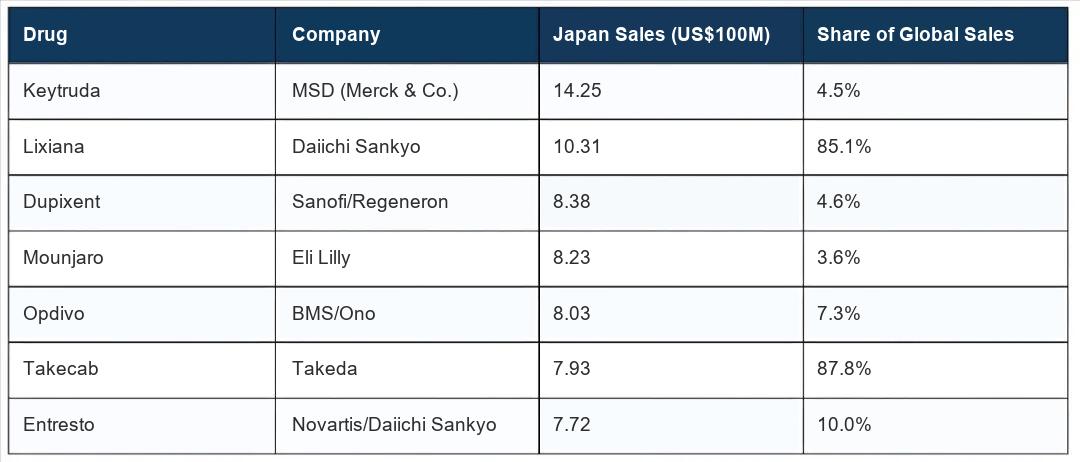 Fig. 1. Selected products, 2025 sales in Japan
Source: IQVIA
What supports these prices is a rigid demand and payment structure. People aged 65 and over account for 29.6% of the population, roughly 1 million new cancer cases are diagnosed each year, screening coverage is mature, and oncology drug spending per capita is about 3.9 times that of China. Japan operates universal health insurance, with patients paying 30% at the point of care as the general rule, 20% for those aged 70 to 74, and 10% for those aged 75 and over, and the High-Cost Medical Expense Benefit system caps monthly out-of-pocket spending. Public funds covered 32.5% of national health expenditure in FY2021 and insurance premiums a further 53%.
The other side of the same coin is an exacting price revaluation mechanism. Prices are adjusted dynamically after launch as competition and market volume evolve. Opdivo, for example, has had its price revised six times since its 2014 Japanese launch, falling to around 20% of its initial level. Prices have been cut for nine consecutive years, and the prospect that US most-favored-nation pricing could turn Japan’s low prices into a reference point for global pricing leaves multinational companies cautious about how they price here.
A Window for Chinese Biotech
The medicines Japan is short of overlap substantially with the products Chinese biotechnology companies currently hold most of them, particularly in antibody-drug conjugates and cell therapy, where Japanese demand is strong and Chinese development has moved quickly.
Competition among domestic Chinese innovators is intensifying, geopolitical uncertainty in the US market is rising, and Japan’s commercial system is mature and its payment system stable, which together have made it a preferred destination for Chinese companies going abroad. Two routes have so far been demonstrated.
The first is the global self-built model exemplified by BeiGene, which established its own research, registration and commercial teams in Japan. Its lead products zanubrutinib and tislelizumab have both been approved and launched there.
The second is self-registration with partner commercialization, exemplified by Haihe Biopharma. Its MET inhibitor savolitinib was approved in Japan in June 2024, the first innovative drug developed and registered by a Chinese company to reach the Japanese market on its own application, and its PI3K-alpha selective inhibitor risovalisib (CYH33) was approved in March 2026. Both products are commercialized in Japan by Taiho Pharmaceutical. The model offers an asset-light route for biotechnology companies with limited resources.
Opening the door while bringing prices down is the full complexity behind the question of why Japan needs global drugs now. The Japanese market looks limited in scale, but its value lies in high unit prices and a long tail. For Chinese innovators the door is open, but between rigorous PMDA review and reimbursement cost control, securing an acceptable payment price in the second half of the journey will determine whether the business succeeds.

