


Recently, The New England Journal of Medicine (Q1, impact factor 84.5) published online the world’s first human study of chemogenetic neuromodulation, as described by the investigators: “Chemogenetic Neuromodulation for Refractory Epilepsy”. The study was completed jointly by the neurosurgery team of Prof. Guoguang Zhao at Xuanwu Hospital of Capital Medical University, the team of Prof. Minmin Luo at the Chinese Institute for Brain Research of the Chinese Academy of Medical Sciences, and GenAns Biotechnology (Beijing) Co., Ltd.
Article Key Points
• The New England Journal of Medicine published the first human study of chemogenetic neuromodulation online
• Three patients with unilateral mesial temporal lobe epilepsy with hippocampal sclerosis were enrolled
• GA002, an AAV vector carrying hM4D(Gi), was infused into the epileptogenic hippocampus by convection-enhanced delivery
• Mean monthly seizure frequency fell from 4.33 to 0.33 over two months, a reduction of 92.59%
• All subjects remain under long-term safety follow-up; EEG, 18F-FDG PET and quality of life also changed
 Fig. 1. Title Page of the NEJM Correspondence Reporting Chemogenetic Neuromodulation for Refractory Epilepsy
The Author Team and the Citation
Author team (# marking equal contribution): Yang Dai#, Quanlei Liu#, Yihe Wang#, Tao Yu#, Huaqiang Zhang, Danwei Weng, Yi Wang, Minmin Shi, Zhiming Li, Yongzhi Shan, Minmin Luo (corresponding author: Prof. Minmin Luo), Guoguang Zhao (corresponding author: Prof. Guoguang Zhao).
Citation format: Dai Y, Liu Q, Wang Y, Yu T, Zhang H, Weng D, Wang Y, Shi M, Li Z, Shan Y, Luo M, Zhao G. Chemogenetic Neuromodulation for Refractory Epilepsy. N Engl J Med. 2026 Nov 5;395(18):1867-1869. doi: 10.1056/NEJMc2606815. PMID: 42981577.
Study Design
This study is the first to validate the complete chemogenetic modulation loop in humans. A total of three patients with unilateral MTLE-HS, confirmed by imaging and electrophysiological assessment, were enrolled.
GA002 and the Delivery Technique
GA002 is an adeno-associated virus (AAV) vector carrying the hM4D(Gi) gene under the control of the CaMKIIα promoter. Under intraoperative MRI monitoring, the research team used convection-enhanced delivery (CED) to infuse GA002 precisely into the head, body and tail of the hippocampus on the affected side, achieving uniform distribution within the target region.
Results and Follow-Up
The study evaluated the preliminary safety, feasibility and clinical effect of GA002 in three patients with unilateral mesial temporal lobe epilepsy with hippocampal sclerosis (MTLE-HS). Within the two-month efficacy assessment period, the mean monthly seizure frequency of the three patients fell from 4.33 to 0.33, a reduction of 92.59%; corresponding changes were also observed in indicators including electroencephalography (EEG), 18F-FDG PET and quality of life. All subjects are currently still receiving long-term safety follow-up.
Funding
The study was supported by the China Brain Initiative (STI2030 Major Projects, 2021ZD0202803), the Science and Technology Innovation Programme of Xiongan New Area (2023XACX0005), the National Natural Science Foundation of China (32541069), the Central Research Institute Fund of the Chinese Academy of Medical Sciences (2024-I2M-ZD-012), the New Cornerstone Investigator Programme and the Ministry of Education (JYB2025XDXM504).
Source and Copyright Notice
This article was published by Shenshou Qianyan, a Chinese neurosurgery news outlet (neurochn.com). Submission enquiries should be addressed to gouxinyu@neurochn.com. The outlet does not accept a manuscript for simultaneous consideration, an author may not revise a manuscript after submission, and Shenshou Qianyan may edit the manuscript itself and publish it at its discretion. Any media organisation, website or other body that wishes to reprint or quote this material must obtain written authorisation.
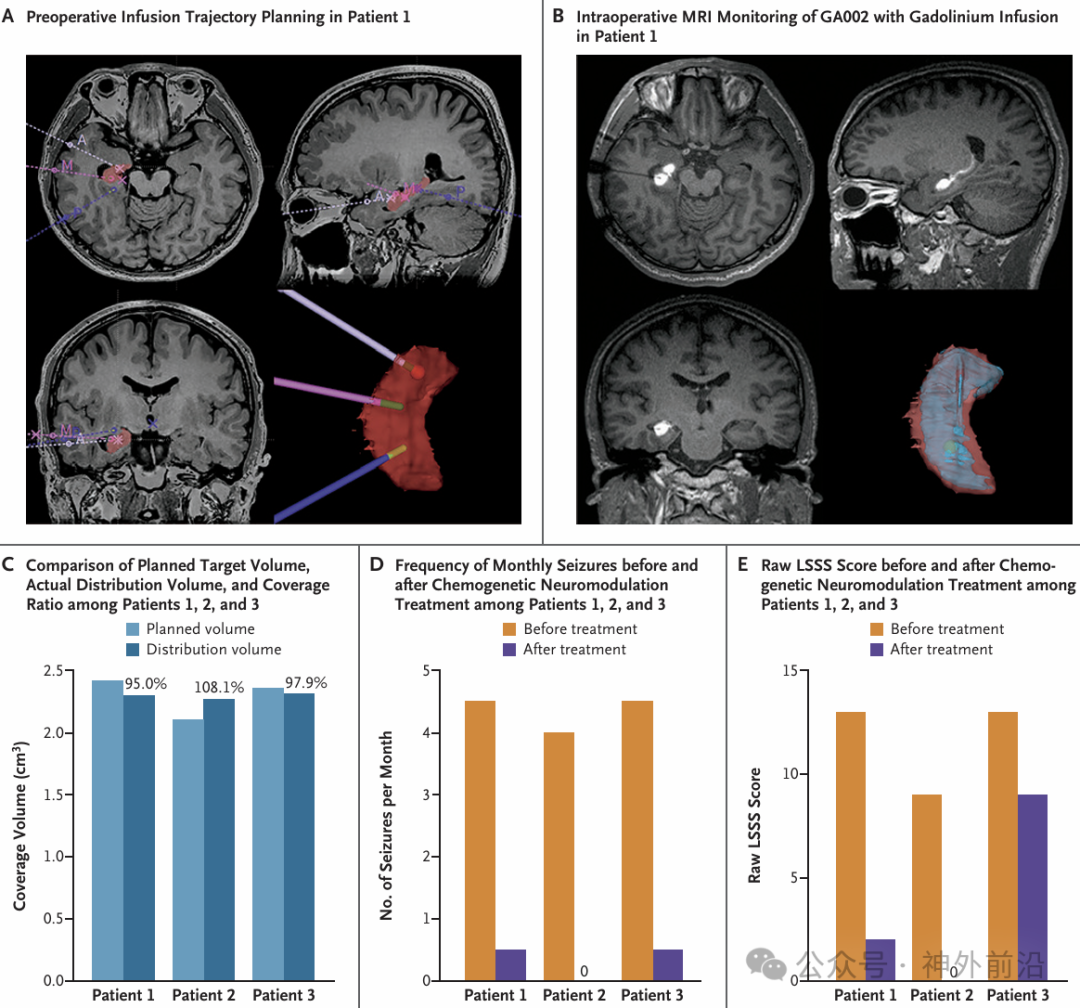 Fig. 2. Multi-Panel Figure from the NEJM Letter Showing Trajectory Planning, Intraoperative MRI Monitoring, Target Coverage, Monthly Seizure Frequency and Raw LSSS Scores

