


Sepsis is the deadliest and most resource-intensive condition treated in the intensive care unit (ICU). More than 11 million people worldwide die from sepsis each year — two million more than from cancer — yet the condition remains unfamiliar to most people outside the medical community. It is not a single disease but a collective term for critical illnesses triggered by infection, with acute onset, poorly understood mechanisms, and marked individual heterogeneity. To date, no disease-specific drug exists.
“That is my goal — to crack it,” says Prof. Ben Lv, President of Central South University’s Xiangya Second Hospital.
Over the past decade, Prof. Lv and his team have pursued sepsis along its pathophysiologic axis: from the systemic inflammatory response triggered by bacterial infection, to the immune response in sepsis, to sepsis-induced disseminated intravascular coagulation (DIC). They have uncovered intrinsic links between coagulation and immunity, and explored the lethal mechanism by which severe heat stroke leads to multi-organ failure. Their findings have appeared in Nature, Science, Immunity, and other leading international journals.
For this body of original breakthroughs, Lv has received the National Natural Science Award (Second Class), Chinese Medical Science and Technology Award (First Prize), the inaugural Xplorer Prize in Medicine, and the Shulan Medical Young Investigator Award. This year he was further honored with the MedJ Value-Based Care Taishan Award “Qinzi” Young Clinical Research Award.
“Whether basic or clinical research, the core must remain anchored to important clinical questions,” Lv told MedJ. “Solving a previously contested problem or one with poor outcomes, ultimately serving life and health.”
A Student Who Stood Up to His Mentor
Lv’s interest in sepsis began in his third undergraduate year, when he joined a university innovation project under Prof. Xiao Xianzhong, then chair of pathophysiology. It was his first systematic exposure to the relationship between systemic inflammatory response syndrome and sepsis.
“Prof. Xiao pointed out then that this was a very promising and important direction, and hoped I would commit to it long-term,” Lv said. He listened. Pursuing a doctorate in internal medicine and frequently participating in ICU consultations deepened his curiosity: sepsis touches too many domains to fit any single discipline.
In late 2008, Lv traveled to the United States under the China-sponsored high-level university graduate program, joining the Feinstein Institutes for Medical Research in New York — one of the birthplaces of sepsis research — to pursue a second doctorate in immunology under Kevin Tracey, one of the founders of the “inflammatory cytokine theory.”
The opening, however, was less than smooth. Kevin Tracey initially refused to take Lv as a student, citing “no time to mentor.” The young Lv did not back down. His reply: “Your lack of top-tier research output in recent years is precisely because you have not admitted a student like me.”
“In hindsight, I was indeed a bit headstrong then,” Lv said, noting the remark was out of character for his typically reserved personality. Beyond self-confidence, his boldness was also driven by the expectations of his country.
“Our country sent us abroad hoping we would seize the opportunity to learn advanced technologies,” Lv told MedJ. “Even though I am reserved by nature, that urgency overrode my caution. I was confident I could rely on diligence and discipline to deliver.” He delivered. Over five years, Lv uncovered key disease mechanisms and potential drug targets in sepsis and related conditions — including the discovery that protein kinase R promotes HMGB1 release. Original findings were published in Nature, PNAS, and other leading journals, breaking the publication record for doctoral students in the greater New York region. Upon graduation, the Feinstein Institutes promoted him directly to Assistant Professor.
The “top-tier research output” he had promised was no longer words. It had become reality.
Overturning the "Mainstream"
During Lv’s years in the U.S., the international mainstream held that multi-organ failure in sepsis stemmed from a “cytokine storm.” Yet anti-inflammatory drugs repeatedly failed in clinical trials.
“At conferences the topic was discussed again and again; I sat in the back rows and learned,” Lv recalled. He realized that sepsis is mechanistically far more complex than inflammation alone, and that deeper causes must be sought.
Lv’s mentor Kevin Tracey had led the international discovery of HMGB1’s extracellular function — a delayed, lethal inflammatory mediator involved in sepsis. But why HMGB1 exits the cell, and what pathogenic role it plays upon release, remained unclear.
Lv’s new finding: HMGB1 release is regulated by its acetylation and by the proteins controlling that process. “Time in the U.S. was limited, and once the breakthrough was in sight, it was time to go home,” he said. He returned to China in 2013 and continued his work, collaborating widely with domestic colleagues.
A clearer answer emerged in 2018. In sepsis, hepatocytes release a wave of HMGB1 proteins that act as “porters,” continuously ferrying bacterial endotoxin from the blood into the cytoplasm, where it overactivates the cytosolic receptor caspase-11 and triggers large-scale programmed cell death.
Clinically, Lv had long observed that sepsis patients often present serious coagulopathy: microvasculature filled with thrombi, vessels occluded or even diffusely hemorrhagic, inadequate perfusion, and ultimately multi-organ failure.
Bringing the two threads together, Lv and his team elucidated how overactivation of caspase-11 in sepsis induces DIC, driving organ failure and death, and identified potential drug-intervention targets.
“We first proposed this mechanism in 2019, essentially back-to-back with a U.S. lab, but we pushed further afterward — moving from running alongside to leading in certain dimensions,”Lv said.
Wolfram Ruf, a leading authority in international thrombosis research, commented in a review: “This discovery is an unexpectedly important breakthrough that deeply illuminates the intrinsic link between coagulation and immunity.”
Severe heat stroke, in its most extreme form heatstroke, is a sepsis-like condition. The prevailing view was that high body temperature causes direct “physical damage” to tissue cells. But Lv found that the proportion of severe heat stroke patients with DIC is even higher than in sepsis.
Building on the thread from his earlier sepsis work, Lv and his team identified a new molecular mechanism: hyperthermia activates the protein ZBP1, triggering programmed cell death, which in turn drives DIC and multi-organ injury. This work, published in Science in 2022, overturned the long-standing view that severe heat stroke is best explained by physical injury alone.
“This is a completely new and very important discovery that reveals a new mechanism driving the course of severe heat stroke,” the peer reviewer noted.
“Many things are too easy to take for granted because they appear simple, and that tempts us into habitual thinking. Research requires breaking convention,” Lv said.
Repurposing an Old Drug: Heparin
For heparin, a decades-old anticoagulant, the story is more one of “accident.”
After confirming the lethal pathway by which HMGB1 drives caspase-11 activation, the team was screening blockers and discovered that heparin — a widely used anticoagulant — could independently and potently inhibit caspase-11 activation, separable from its anticoagulant effect.
“It was largely an accidental discovery,” Lv said. The team subsequently used chemical modification to separate heparin’s anticoagulant activity from its anti-inflammatory activity, synthesizing a low-anticoagulant heparin that retains efficacy while lowering the bleeding risk of traditional heparin. Preliminary real-world data suggest heparin has marked efficacy in many sepsis patients, and Lv sees clinical translation as “within reach.”
What moves Lv even more is the drug’s economics: “Heparin can be extracted in large quantities from pigs, is inexpensive, and has no patent barriers. With modest investment it can be translated rapidly. We have to consider not only curing disease but also easing the burden on society and families — a key aspect of value-based care.”
“Curing an untreatable disease with new technology is value. Curing a treatable disease more economically is even more value,” Lv said.
In his view, medical research broadly falls into two streams. The first is theoretical work in untrodden territory, willing to sit through long cold periods; its value may not be immediate but can be disruptive. The second is problem-oriented applied research, solving real-world “bottleneck” problems. “Both are important. But the second is, at certain moments, more urgent.”
Both Striker and Coach
Ten years after returning to China, Lv became President of Xiangya Second Hospital, making him one of the youngest presidents among the 44 large tertiary hospitals directly administered by the National Health Commission (NHC). In 2025, he took on an additional role as Vice President of Central South University, overseeing graduate education — the first “post-1980s” vice president in CSU’s history.
Multiple roles bring multiple questions. How does one balance clinician, research-team leader, and hospital/university administrator?
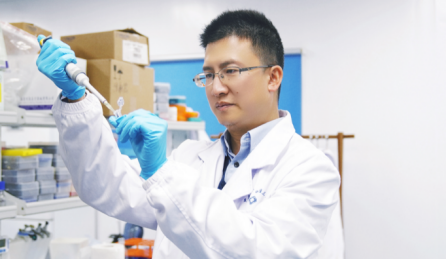 Fig.1. Ben Lv Conducts Scientific Research in the Laboratory
Lv groups these into two categories: management roles and expert roles — and argues that the two are not in conflict.
He draws a football analogy. A team has strikers, defenders, and goalkeepers; every position is equally important. “But a striker is somewhat different — he is problem-oriented. A good striker also needs midfield and defensive skills — coordination, tackling, individual ability. But the goal is to solve the problem: how to put the ball in the net. The physician-scientist should occupy a position closer to that of a striker, humbly and actively learning to cooperate in every direction, but with the goal of helping the team score and solving the problem.”
The administrator’s role, in his view, is playing a different position — coach. “The coach doesn’t take the field directly, but he sees the team’s coordination as a whole, not just individual technique. He knows how to bring out the team’s explosive power. Some teams without stars still win.”
From this “head coach” perspective comes a more holistic view: it is not just his own research output, but whether more scholars and young researchers can grow well. “Each of us contributes only a small molecule to research. Good management helps more scientists and more outstanding young people — and that broadens the horizon.”
From this vantage point, Lv finds the two roles reinforce rather than contradict each other: “As a researcher, you also begin to consider the whole chain — not just whether a single dribble succeeds, but the entire line: how to ultimately reach the patient, how to help upgrade China’s biopharmaceutical industry. As coach, you think about how to direct play. As player, you follow the team.”
Lv acknowledges that no role comes with abundant leisure time. “Clinical work and research are professional work, and time will be tight. One must have self-awareness, balance professional development and personal interests within limited hours, and keep curiosity alive.”
Multiple management roles do consume real energy. “Whether in education or healthcare, doing management well is part of holding this responsibility for the people,” Lv said. The Xiangya Second Hospital anthem, “Aprapels Bloom on People’s Road,” carries a double meaning — People’s Road is the hospital’s address, and aprapels are a central element of the hospital’s emblem, symbolizing a thriving institution on the road of serving the people. “People first” is, in Lv’s framing, both culture and working method.
Even now, with multiple roles, Lv continues to see outpatients for half a day each week.
“Medicine is a real-world discipline. If you stay only in the lab, you may see only one scientific problem after another,” Lv said when asked about value-based care. “We must keep focused on patient needs and solve problems around those needs.”
References
[1] Kevin J. Tracey et al. Identification of HMGB1 as a late mediator of lethal systemic inflammation. Nature. (HMGB1 reference series)
[2] Ben Lv et al. ZBP1-driven programmed cell death in heat stroke. Science. 2022.
[3] Ben Lv et al. Caspase-11 activation in sepsis-induced DIC and organ failure. 2019.

