


Dr. Tucker died on December 22. His life spanned two World Wars, witnessing the advent of penicillin, the dawn of the antibiotic era, and the birth and widespread clinical application of Magnetic Resonance Imaging (MRI) technology.
His life was remarkably rich. He earned his law degree at 67, learned to ski in his 80s, was still seeing patients and filming a documentary at 100, and was doing live streams at 102. Concurrently, he served as a consultant on medical-legal cases and lectured on "Medicine and Law" at a university.
In April of this year, Dr Tucker posted on social media, hoping his journey would inspire people to ponder "what's possible at 22, 42, and 102," and to reflect on the meaning of growth throughout their lives. His family wrote in the obituary: "Dr. Tucker truly embodied what it means to live each day to the fullest. His extraordinary 103-year life touched countless people. We are filled with gratitude and profound sorrow."
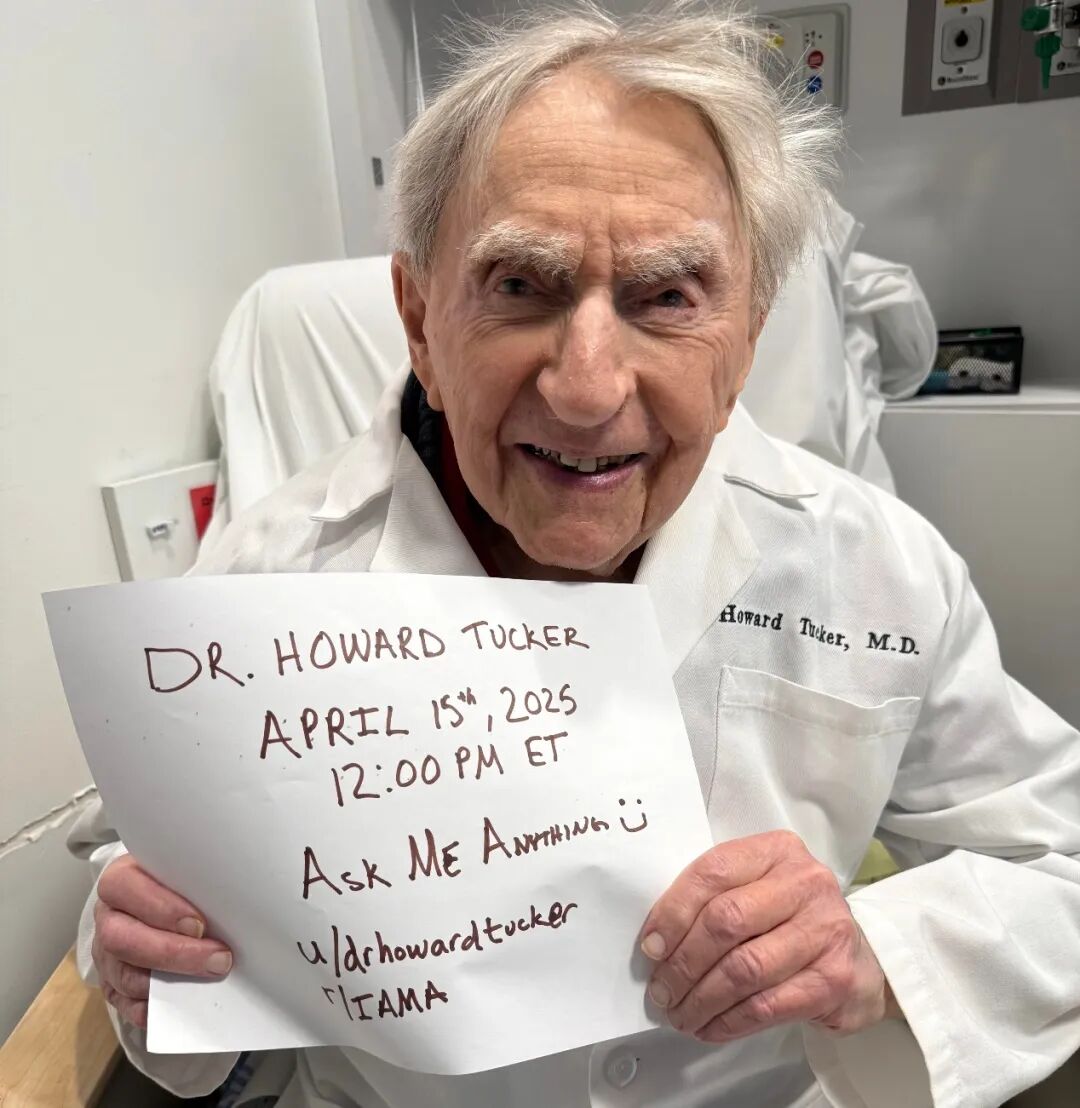
On April 15 of this year, Dr. Tucker interacted with netizens online. / Image source: Reddit@drhowardtucker
Seeing Patients Weekly at 100 Years Old
Reflecting on his decades in medicine, Dr. Tucker described it as "taking one step at a time" and called his life "ordinary," a characterization his circle of friends, family, the media, and the public strongly disagreed with.
Aspiring to be a doctor from a young age, he enrolled at The Ohio State University after high school in 1940, earning a bachelor's degree in chemistry in 1944. After serving in the U.S. Navy during World War II, he entered medical school at The Ohio State University, obtaining his M.D. in 1947.
Fascinated by the human brain during his studies, he pursued neurology. After completing his neurology residency at the Cleveland Clinic in Ohio, he undertook a fellowship at the New York Neurological Institute, finishing his specialty training in 1953.
The media noted that Dr. Tucker witnessed the global development of neurology; when he started, CT and MRI were mere science fiction. For a long time, his diagnosis relied primarily on patient history, physical examination, and deductive reasoning. During this period, he solved several difficult cases, garnering media attention. For instance, reports from 1960 detail how he diagnosed barbiturate poisoning in two young girls found in a deep, "Sleeping Beauty"-like coma, based on meticulous history-taking and investigation.
"People can easily develop illusions, thinking they are highly capable," Dr. Tucker once said. "I constantly remind myself not to become arrogant because of individual cases. Medicine is like an iceberg floating in the sea; we only see a small part."
In February 2021, at age 98, Dr. Tucker was certified by Guinness World Records as the "World's Oldest Practicing Doctor." At that time, he worked five to six days a week, seeing patients from 9 to 5. "I thoroughly enjoy my working hours. Every time I meet a patient, especially with complex cases, I get very excited," Dr. Tucker said with a smile. His strong sense of duty even led him to sneak out during the COVID-19 pandemic to treat cancer patients, despite being in the high-risk age group himself.
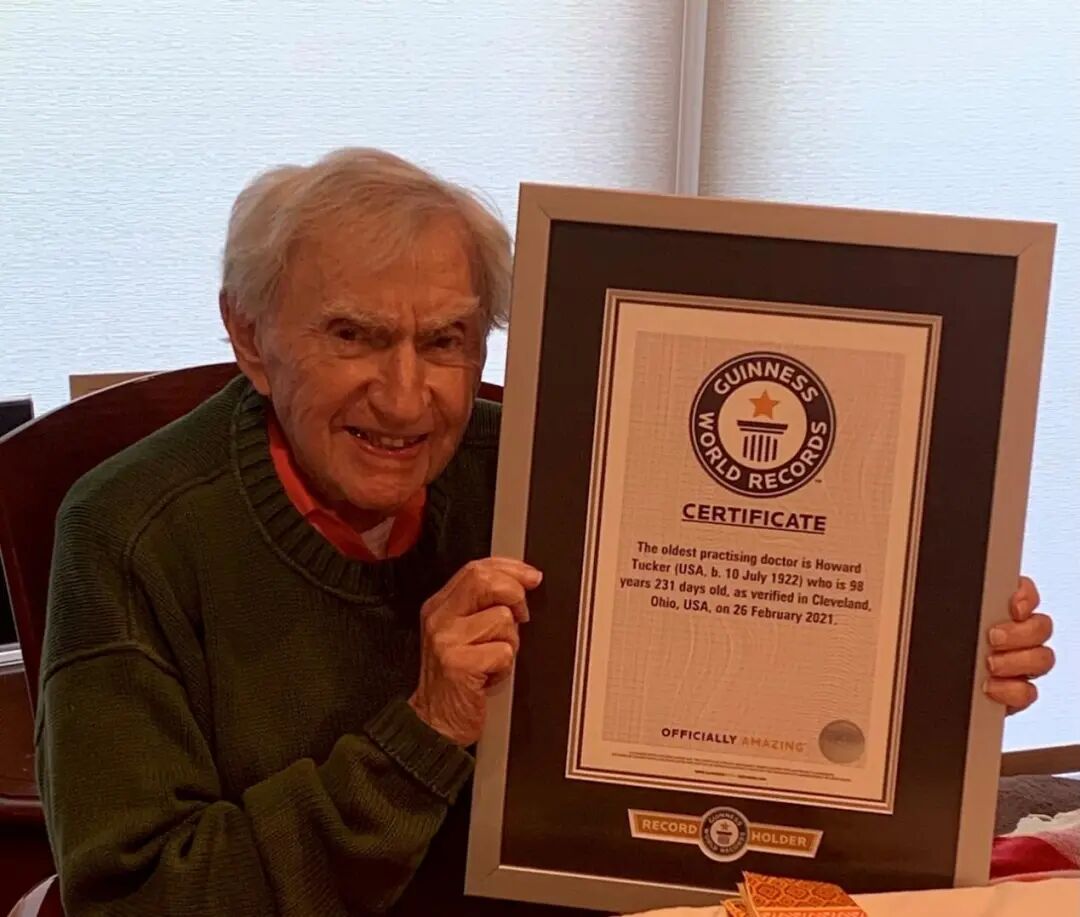 In February 2021, Dr. Tucker was certified by Guinness World Records. / Image source: Guinness World Records
He finally stopped clinical practice in November 2022, at the age of 100, when the medical institution he worked for ceased operations. Thus ended a 75-year career in clinical practice and teaching, during which he worked at institutions including Mount Sinai Hospital, Cleveland Clinic, Hillcrest Hospital, and St. Vincent Charity Medical Center.
He told the media he continuously learned new technologies, understanding it was essential for medical progress. "However, I feel uneasy not being able to see and physically examine the patient. Young doctors today rely too much on imaging technology, neglecting communication with patients, which is detrimental to building a good doctor-patient relationship."
"To be a good doctor, you don't necessarily need to be brilliant, but you must be meticulous and thorough, and you must get close to the patient. Intelligence is beneficial, but being detailed and having real contact with the patient is key," Dr. Tucker said.
Even after retiring from medicine, he did not fully retire. At 67, he earned his Juris Doctor and became the oldest person to pass the Ohio Bar Exam. He then worked as a medical-legal reviewer and consultant while teaching at Case Western Reserve University in Ohio. In recent years, he taught a general education course, "Law and Medicine," where his over 70 years of medical experience still resonated with students. As recently as October this year, Dr. Tucker was a guest speaker at a United Nations event for the International Day of Older Persons.
"People are eager to hear the voices of those who have truly lived, loved, and struggled," Dr. Tucker's grandson said. "He subverted society's perception of aging. He represents a group of older people who are eager to contribute to society."
Responding to Doubts and Sharing Longevity Secrets
His practice at 100 also drew professional skepticism. In 2022, a cardiologist, after reading about his centenarian practice, expressed concern, noting Dr. Tucker represented a significant trend of an increasing number of older doctors in the U.S.
"Aging inevitably brings physical and mental decline, which can affect a doctor's ability to work and endanger patients' lives. Air traffic controllers must retire at 56, airline pilots must stop flying at 65. Doctors face no such restrictions, even though their decisions are equally matters of life and death," the cardiologist wrote. The expert suggested mandatory retirement ages or, better yet, regular competency assessments for doctors wishing to continue past a certain age (e.g., 65 or 70).
In his response, Dr. Tucker stated that the increase in older practicing physicians was due both to advances in modern medicine allowing doctors to live longer and to many doctors having quit smoking. "The incidence of cognitive impairment is generally lower among physicians because dementia is more prevalent in socioeconomically disadvantaged populations. However, statistics do not predict any individual's condition," he said. He added he felt no burnout and, after 75 years, still enjoyed patient contact and the challenges and stimulation it brought.
As for his longevity secrets, Dr. Tucker attributed it first to "genetics." His mother lived to 84, his father to 96, and his brother just celebrated his 100th birthday. He maintained a healthy lifestyle: seasonal fruit and skim milk for breakfast, a Mediterranean diet rich in healthy fats and protein for dinner. He never smoked and drank only occasionally at social events. He broke his neck skiing in his 80s but recovered quickly. He contracted COVID-19 on his 100th birthday but recovered swiftly without sequelae.
Doctors believe his fitness routine also contributed; he exercised throughout his life, regularly swimming and jogging. "There are many 'biohacker' therapies now, including taking supplements, trying unproven gene therapies. These are not the ultimate answer to longevity. Medical research is constantly changing our understanding."
Summarizing his advice for a long life, Dr. Tucker offered five key suggestions: Stay active, don't retire; Maintain your health; Don't smoke; Don't limit yourself to just a few activities; Don't let the vast knowledge and changes you witness go to waste.
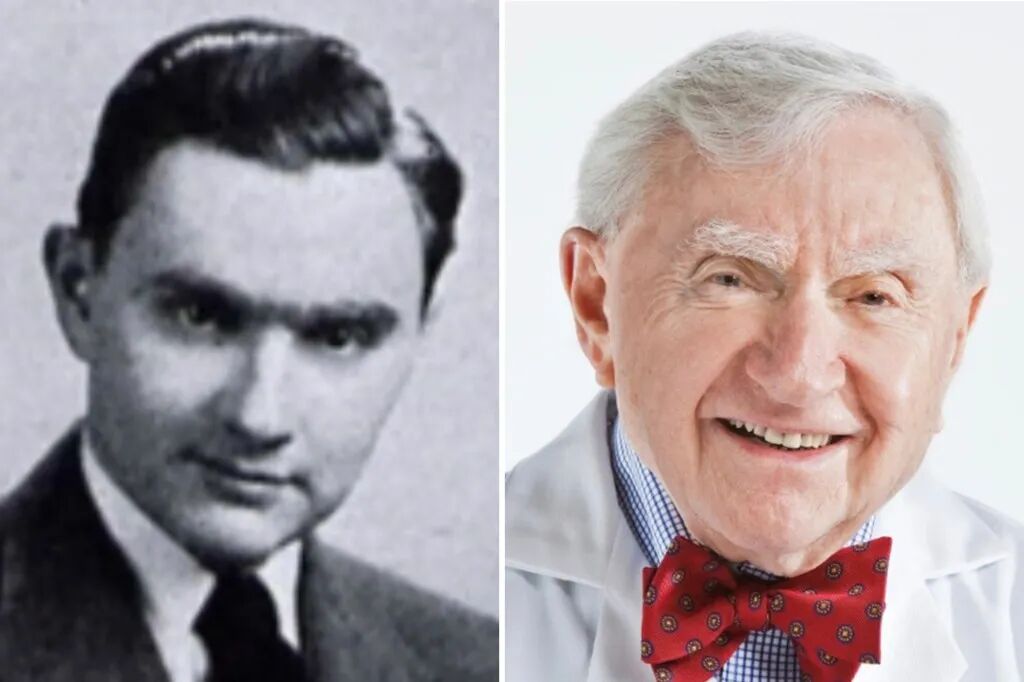
Image source: Guinness World Records
His curiosity extended far beyond medicine. He was also a sailor, hiking and camping enthusiast, and violinist. In Dr. Tucker's view, these were just nodes or episodes in his life. "My greatest achievement in this life is actually spending 67 years with my wife."
His wife, Dr. Sara Tucker, is a psychiatrist. They met during his neurology fellowship in New York and married in 1957. Now in her 90s and recently retired, they had four children together. When asked how to keep a family happy, Dr. Tucker would quote American poet Ogden Nash: "To keep your marriage brimming, with love in the loving cup, whenever you’re wrong, admit it; whenever you’re right, shut up."
"His legacy will live on forever," his family said.

