


A pair of lungs carrying the human immunodeficiency virus (HIV) was transplanted into another HIV-positive person.
On March 21 of this year, NYU Langone Health in New York completed the world's first lung transplant from an HIV-positive donor to an HIV-positive recipient. On the same day, doctors also replaced the patient's liver with a new one. After the surgery, for the first time in four years, the patient was able to remove his oxygen tube and breathe on his own again.
The recipient of this transplant was 56-year-old American Bertrand Nelson, who has been living with HIV for nearly 26 years.
The lead surgical team called it a "watershed moment." It has overturned the long-standing ban on using HIV-positive lungs for transplantation and opened a previously non-existent path to survival for HIV patients with end-stage organ failure.
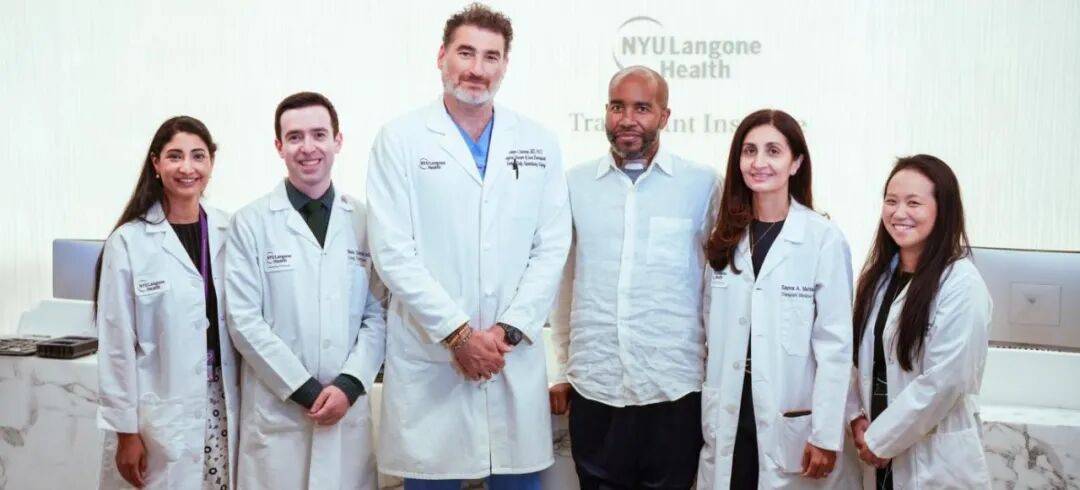
Fig. 1. Patient Bertrand Nelson (third from right) with the medical team at NYU Langone Health. Source: NYU Langone
A Surgery Without Precedent
In 2000, Bertrand was simultaneously diagnosed with HIV and sarcoidosis.
More than twenty years ago, this was almost the equivalent of a death sentence. However, thanks to modern antiretroviral therapy (ART), the life expectancy of most people with HIV is now close to that of the general population. Their viral load can be suppressed to an undetectable level, and they are no longer infectious.
According to the World Health Organization, by the end of 2024, there were approximately 40.8 million people living with HIV globally.
As the deadly infection has become a manageable chronic disease, new problems have emerged. Due to the long-term effects of HIV, patients are at a higher risk for various chronic diseases and are more likely to suffer from heart, liver, lung, and kidney failure, leading to a growing demand for organ transplants. Yet under the old transplant rules, their chances of receiving an organ and surviving through transplantation were minimal.
Bertrand's disease progression followed this exact trajectory towards a dead end. Shortly after his diagnosis, his sarcoidosis went into remission, remaining stable for nearly two decades.
The turning point came in 2021 when he contracted Legionnaires' disease and was hospitalized for several weeks with severe pneumonia. This caused his dormant sarcoidosis to become active again, severely damaging his lungs and liver.
By 2024, his lung function was severely impaired, requiring a constant oxygen supply for daily breathing, and his liver function was also failing. Doctors referred him to the Transplant Institute at NYU Langone Health to assess whether he could undergo a combined lung and liver transplant.
In front of him was a nearly insurmountable barrier—HIV positivity has long been considered an absolute contraindication for lung transplantation.
The reason is not hard to understand. Unlike other organs, lungs are constantly exposed to environmental pathogens due to continuous respiration, resulting in the highest infection rate among all solid organ transplants after surgery. Rejection is also a significant challenge; about half of all lung transplant patients experience chronic rejection within five years.
For HIV-positive individuals, the need for immunosuppression and infection prevention presents a direct conflict. They need to maintain a stable CD4 cell count, but the corticosteroids used to prevent rejection can cause significant fluctuations in this count. Moreover, many common ART drugs are metabolized by the liver and can have strong interactions with immunosuppressants.
The combination of immunosuppression and HIV infection theoretically increases the risk of lung infections—and if such an infection occurs, the patient's lung function can deteriorate rapidly, leaving a very narrow window for intervention.
It was for this reason that, after being turned down by a transplant center in Pennsylvania, Bertrand found his way to NYU Langone Health. This center is one of the few in the U.S. authorized to perform lung transplants in HIV-positive individuals under a research protocol. On October 2, 2024, he was placed on the organ transplant waiting list.
A few months later, an opportunity arrived: a pair of lungs and a liver became available from a donor who was also HIV-positive.
Prior to this, the boundaries of transplantation had been slowly shifting. In November 2024, U.S. health authorities lifted the requirement that kidney and liver transplants between HIV-positive individuals must be performed under a research protocol, allowing them to become standard practice. However, heart and lung transplants were still classified as "research" procedures.
Bertrand's surgery was precisely one of those without precedent.
On March 21, he was taken to the operating room. The lung transplant was performed by Dr. Stephanie H. Chang, Director of Lung Transplantation at the center, and on the same day, Dr. Karim J. Halazun, Director of Liver Transplantation, performed his liver transplant.
During the surgery, Bertrand's breathing stopped temporarily, but the team successfully resuscitated him. After approximately 67 days, he was discharged from the hospital. At a recent press conference, he removed his oxygen tube, said he was in good spirits, and looked forward to starting rehabilitation.
"I want my mother to see that I'm doing well," Bertrand said. His mother will be 82 in August and has been with him through his toughest times.
Medical Evidence Supports the Procedure
In 2013, the HIV Organ Policy Equity (HOPE) Act was signed, allowing for the first time HIV-positive individuals to donate organs to other HIV-positive recipients. Heart and abdominal organ transplants under the HOPE framework had been performed before, but lung transplants had not.
"To do something that no one has ever done before, you need a special patient," said Dr. Mark A. Sonnick, a pulmonologist at the NYU Langone Transplant Institute and a co-author of the research protocol.
A growing body of evidence is supporting such surgeries. Previously, multiple countries have reported cases of HIV-positive patients successfully receiving organs from negative donors.
Research in the field of transplantation has found that survival rates after lung transplantation in HIV-positive patients are similar to those of other patients, with no statistically significant differences in one- and three-year survival.
In 2024, a study published in the New England Journal of Medicine provided further evidence that using kidneys from HIV-positive donors is safe and effective, showing no significant difference in one- and three-year survival and organ rejection rates compared to standard transplants.
However, actually using lungs from an HIV-positive donor was a first. "This will be an important step towards transplant equity for HIV-positive individuals and will also help to expand the donor pool," said Dr. Sapna Mehta, Clinical Director of the NYU Langone Transplant Institute and co-designer of the research protocol.
The severe shortage of donor organs is another critical factor driving this breakthrough. In the U.S., over 100,000 people are waiting for transplant organs, with an average of more than ten people dying each day because an organ is not available. A new name is added to the waiting list about every eight minutes. Repurposing donors that were previously categorically ruled out is a shared goal of the global transplant community.
The most mature precedent is hepatitis C (HCV). Today, HCV-positive individuals can both donate organs and receive transplants, covering various types including kidneys, livers, and hearts.
This has been made possible by the availability of highly effective direct-acting antiviral (DAA) agents. Studies show that when DAAs are used around the time of transplant, recipients can achieve a sustained virologic response rate of over 90%.
Transplantation between HIV-positive individuals follows the same logic: to transform a once "unthinkable" restricted area into a "safe and manageable" source of new donor organs through rigorous management.
Following the implementation of the HOPE Act, in 2016, the Johns Hopkins University School of Medicine completed the first HIV-positive-to-HIV-positive kidney and liver transplants in the U.S. In 2022, the first HIV-positive-to-HIV-positive heart transplant was completed.
Now, Bertrand's surgery fills the final piece of the puzzle for the lungs.
"Modern therapies have transformed the survival of people with HIV, and the standards for organ donation and transplantation should be updated based on the current evidence," commented Dr. Cameron Wolfe, a transplant infectious disease expert at Duke University School of Medicine.
Duke University is another institution authorized to perform lung transplants under the HOPE protocol. In his view, this helps address the long-standing organ shortage, improves healthcare equity for HIV patients, and presents a valuable opportunity to deepen our understanding of HIV and move closer to a "durable cure."
The research team at NYU Langone stated they will continue to monitor Bertrand's viral control, rejection, immunosuppression, and organ function over the long term to determine when HIV-positive-to-HIV-positive lung transplantation can transition from the research phase to broader clinical practice.
Bertrand repeatedly expressed his gratitude to the donor and their family, whom he never knew. He said he is willing to share his story to challenge the stigma associated with the disease.
"We who receive transplants never forget the donors," he said. "There are so many people waiting for a cure. The more organs available, the greater the chance for everyone to get a match and live a good life."

