


Lifelong blood transfusions were once the fate of many beta-thalassemia patients. Now, a gene-editing therapy independently developed in China has enabled multiple patients to completely abandon transfusions, achieving clinical cure.
Regarding this milestone achievement published in Nature, "MedJ" (Medical Community) consulted multiple scientists involved in the research project.
After a Decade of Transfusions, He Was Cured
Achieving lifelong cure of a "rare disease" through gene modification. Yesterday evening, China's gene-editing field reached another landmark milestone.
On April 8 (local time), the top journal Nature published clinical trial results for the base-editing therapy CS-101 injection for beta-thalassemia. Five patients who previously required regular lifelong transfusions achieved complete clinical cure after treatment and returned to normal life.
CS-101 injection, developed by Correctsequence Therapeutics, is the world's first base-editing therapy to cure a hemoglobin disorder. The clinical research results, published jointly by Correctsequence Therapeutics, the First Affiliated Hospital of Guangxi Medical University, ShanghaiTech University, Fudan University, and Shanghai Clinical Research Center, demonstrated excellent efficacy.
Nature reviewers commented that CS-101 sets a "new high-water mark" for global beta-thalassemia treatment in the field.
"This result is incredibly exciting. It means that both basic research and clinical application in our country have achieved a leapfrog development," said Professor Lai Yongrong, the principal investigator (PI) at the First Affiliated Hospital of Guangxi Medical University.
This is the first time since Nature's founding that it has published clinical trial results of a Chinese gene-editing drug. Professor Chen Jia, the primary inventor of CS-101 and Director of the Gene Editing Center at ShanghaiTech University, told "MedJ" that the team is now pushing full speed to the next development phase, striving to achieve the world's first base-editing drug approval to cure more beta-hemoglobin disease patients.
A Next-Generation Gene Editing Tool
Base editing, simply put, involves precisely and permanently modifying a single DNA base to correct monogenic disease-causing mutations, with the goal of achieving a one-time lifetime cure. It represents the most promising direction for conquering monogenic inherited diseases.
Dr. Mou Xiaodun, CEO of Correctsequence Therapeutics, told "MedJ" that hemoglobin disorders including beta-thalassemia and sickle cell disease are the world's most prevalent monogenic inherited diseases. Approximately 400,000 infants worldwide are affected annually. In China, there are approximately 30 million beta-thalassemia gene mutation carriers and about 300,000 patients with severe and intermediate forms.
Professor Lai Yongrong explained that due to genetic defects preventing normal hemoglobin production, severe beta-thalassemia patients develop anemia within three to six months of birth and require lifelong monthly transfusions — without which they typically do not survive past age 10. Previously, the only curative approach was hematopoietic stem cell transplantation, generally suitable only for patients under 16, with associated complication risks.
CS-101 works by modifying two bases in the gamma-globin coding gene, reactivating it to produce fetal hemoglobin (HbF) that functionally replaces deficient adult hemoglobin.
Professor Chen Jia described the development journey: starting R&D at ShanghaiTech University in 2016, the team developed several base-editing tools, with early versions struggling to balance on-target efficiency with off-target risk. The breakthrough came in 2019 when the lab discovered a naturally occurring deaminase inhibitor. By adding a specific "cleavage site" between the inhibitor and deaminase, they created the tBE (transformable base editing) system — which activates only upon encountering the target gene, otherwise remaining inactive. The tBE system received U.S. patent authorization in 2022, becoming the first Chinese-developed platform-level base-editing tool to obtain overseas patent rights.
Results published in Nature showed that all 5 treated patients achieved neutrophil and platelet engraftment within a mean of 16 and 25 days respectively; became transfusion-independent within an average of 16 days post-treatment; reached a mean fetal hemoglobin of 115 g/L and total hemoglobin of 124 g/L at 3 months, further stabilizing at 129 g/L and 134 g/L at 15 months.
As of November 2025, all patients remained transfusion-independent for over one year with no relapses. During a median follow-up of 23 months, base-editing efficiency remained stable with no detectable off-target editing and no product-related adverse events.
"This is an exhilarating result," Professor Chen Jia told "MedJ." "In terms of both onset speed and final hemoglobin levels, current data appear significantly superior to other products using similar technical approaches internationally, with the potential to become a global best-in-class gene-editing drug for beta-hemoglobin disorders."
The Enormously Promising Prospect of "Lifetime Cure"
Professor Lai Yongrong believes that if this therapy is ultimately fully validated and brought to clinical practice, its significance will be "revolutionary."
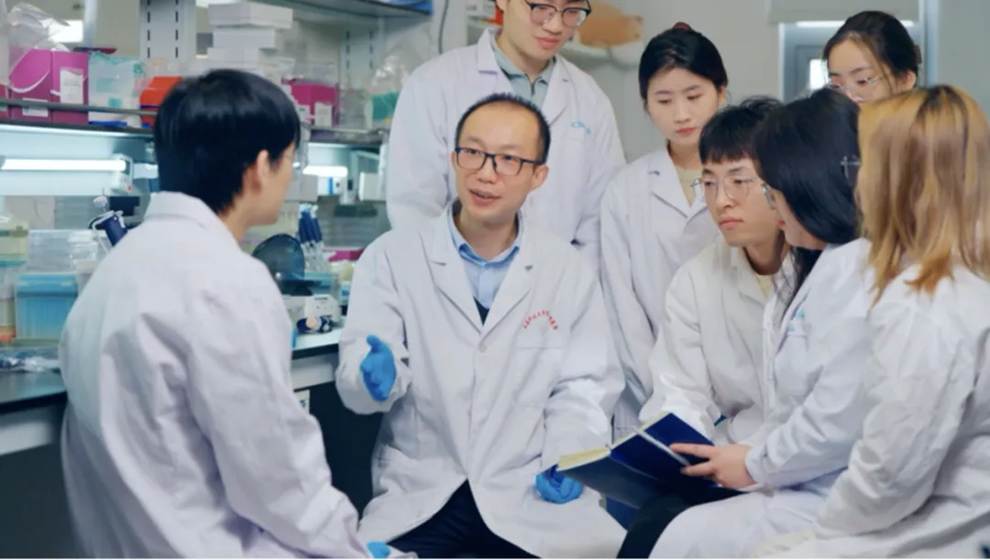
Lai Yongrong's center at the First Affiliated Hospital of Guangxi Medical University is one of China's largest thalassemia transplant centers, having performed bone marrow transplants for over 1,200 patients. Transplant success approaches 90%, but the remaining 10% risk, plus limited donor matching and graft-versus-host disease, continue to pose challenges.
"The development of gene editing may fundamentally change the treatment landscape for beta-thalassemia, especially for patients aged 16 and above who have never found a transplant opportunity. It offers a more convenient way to completely break free from the disease," Lai Yongrong said.
Notably, gene-editing therapy shows "lifetime cure" potential not only for beta-hemoglobin disorders but also for metabolic diseases, cardiovascular diseases, and other conditions. Correctsequence Therapeutics is advancing chronic disease treatment R&D. In December last year, using the tBE tool in collaboration with the First Affiliated Hospital of Anhui Medical University, the team treated a patient with severe hypertriglyceridemia, with fasting TG levels declining significantly within just three days at the lowest dose.
Chinese Academy of Sciences member Chen Runsheng has noted that China continues to explore original innovations in gene editing, from overall system design to specific protein applications across disease types.
Returning to beta-thalassemia, Lai Yongrong told "MedJ" that hematopoietic stem cell transplantation, with over 40 years of clinical practice, remains the first-line curative therapy — its position cannot be displaced in the short term. "Gene-editing therapy fills the gap left by transplantation in clinical treatment, but this technology has been applied for less than 5 years. Its long-term efficacy and safety — whether patients' hematopoietic stem cell function will decline after several more years, and whether there are undiscovered side effects — still requires long-term follow-up and research."
"As research continues to advance, we hope to receive more positive feedback," Lai Yongrong said.

