


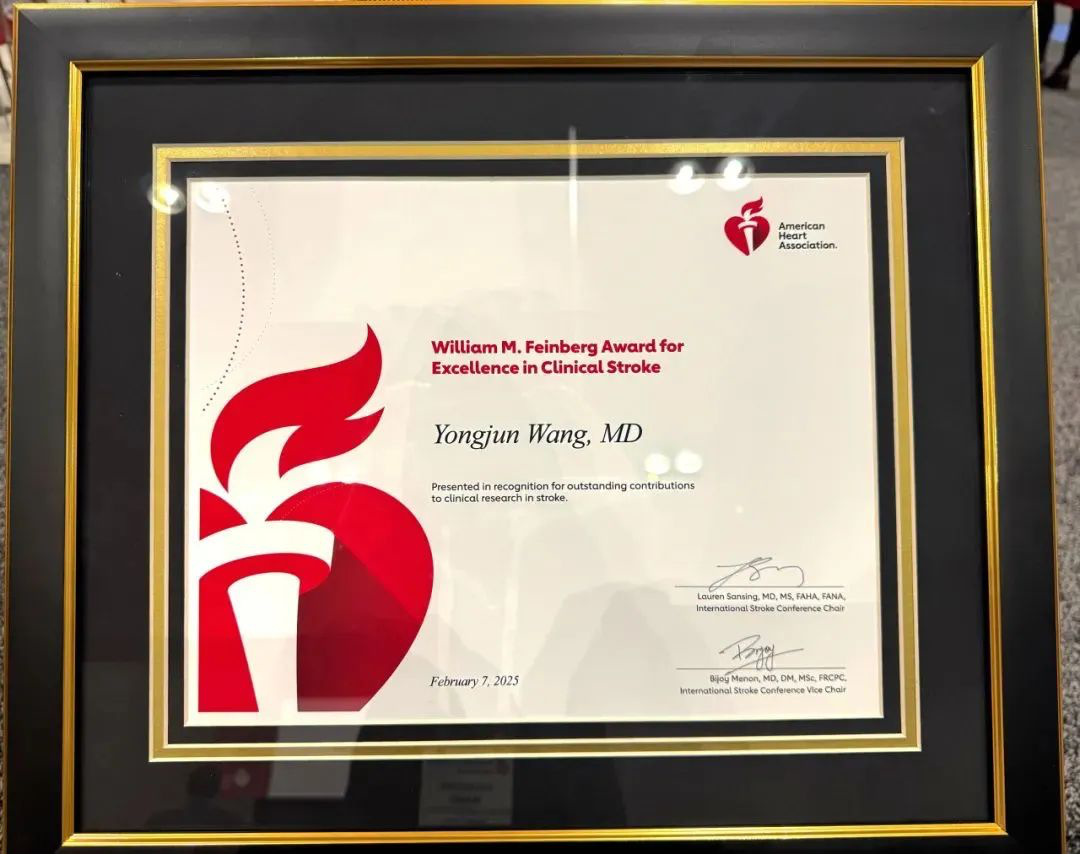
On February 5th, local time, at the 2025 International Stroke Conference held in Los Angeles, USA, Chinese clinical scientist Dr. Wang Yongjun was awarded the William M. Feinberg Award for Excellence in Clinical Stroke.
This award honors his global contributions to research and clinical practice in the field of stroke. Established by the American Heart Association/American Stroke Association, the award is nominated by renowned experts and academic institutions worldwide and reviewed by an authoritative panel of experts from different countries and regions. It is considered the highest clinical medical award in the international stroke field.
This is the first time an Asian scientist has won this award in its 34-year history.
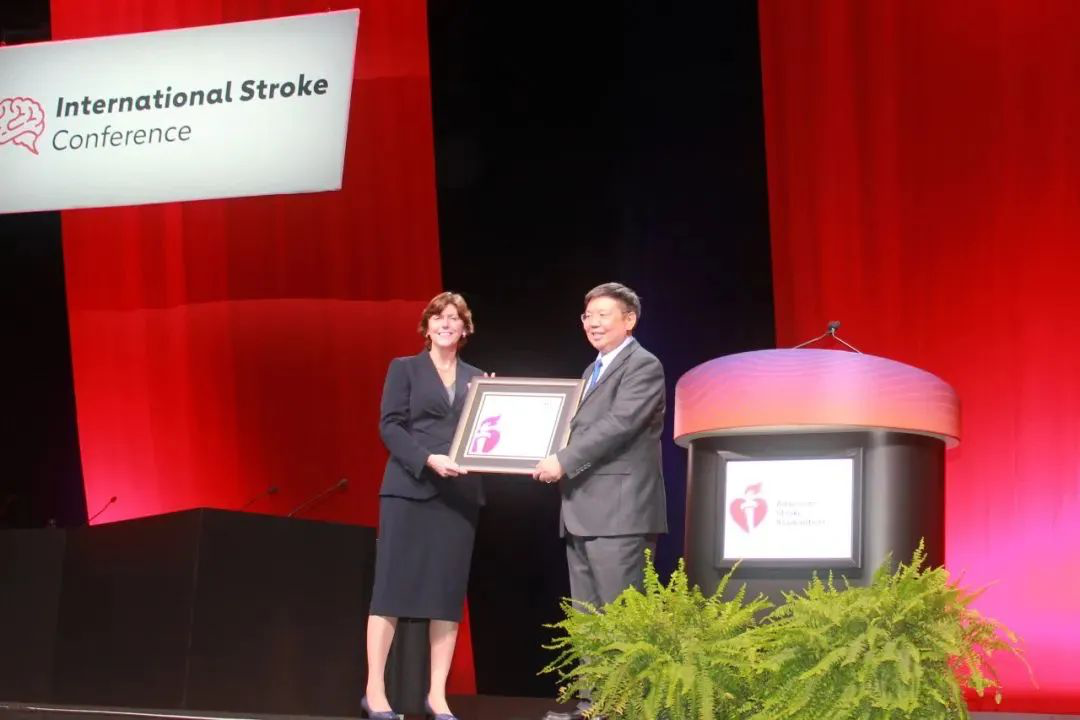
Dr. Wang Yongjun, who has been engaged in stroke clinical practice and research for over 40 years, is an Academician of the Chinese Academy of Medical Sciences, the Chairman of the Neurology Branch of the Chinese Medical Association, the founder and president of the Chinese Stroke Society, the President and Chief Scientist of Beijing Tiantan Hospital affiliated with Capital Medical University, and the Chief Scientist of the National Key Research and Development Program on Cerebrovascular Disease and Major Chronic Disease Prevention and Control. He is also responsible for promoting the "Five-Year Plan" for diseases like stroke in the "Healthy China 2030" initiative.
In 2022, Dr. Wang Yongjun received the "Clinical Research Award" at the third "Value-Based Healthcare Taishan Award" for his work in rewriting global cerebrovascular disease guidelines and amplifying China's voice in disease diagnosis and treatment.
At the opening ceremony of the conference, Lauren Sansing, the 2025 International Stroke Conference Chair and President of the American Stroke Association, announced Dr. Wang Yongjun's award. In her citation, she said, "Professor Wang's research focuses on reperfusion therapy and secondary prevention strategies for ischemic stroke. As the Chief Scientist, he has led the influential CHANCE and TRACE series of clinical trials, with fruitful academic achievements."
"I am honored to stand here on behalf of Chinese scientists," Dr. Wang Yongjun said in his speech, titled "Thirty Years of Treatment for Acute Ischemic Cerebrovascular Events: The Power of Evidence."
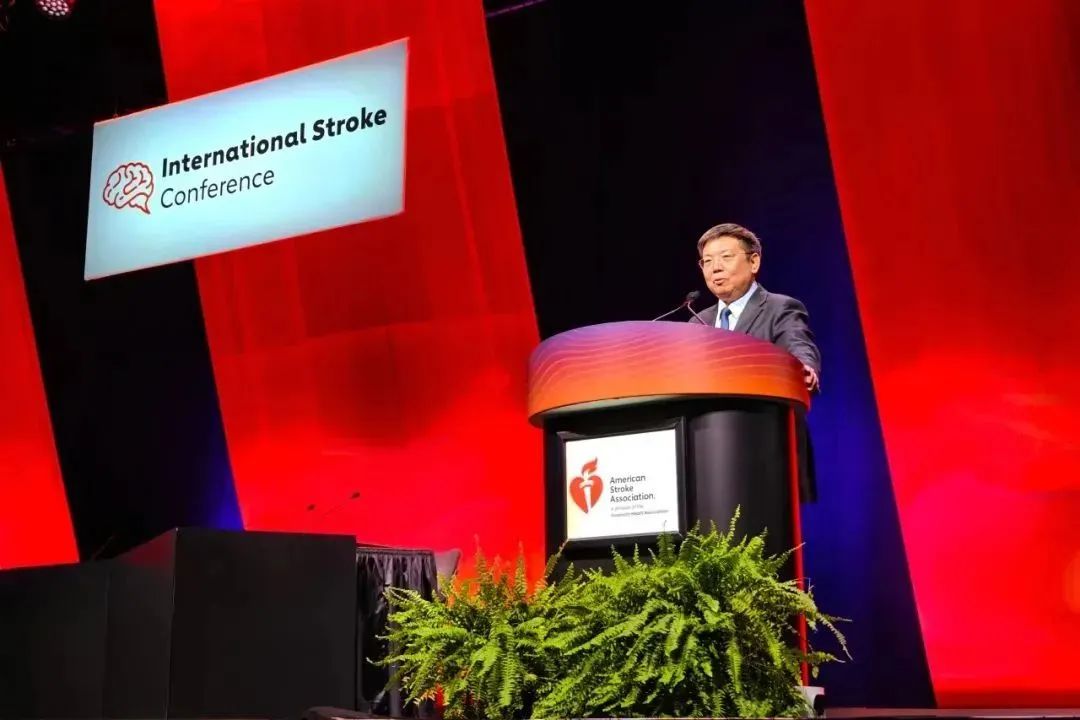
He said, "Over the past 30 years, the treatment of cerebrovascular diseases, especially acute ischemic cerebrovascular events, has undergone tremendous changes. My team and I have been fortunate to witness and participate in this important historical transformation."
Over the past 30 years, clinical scientists worldwide have generated 12 milestone pieces of evidence in the field of stroke reperfusion therapy, five of which were contributed by Dr. Wang Yongjun and his team.
China is one of the countries with the heaviest stroke disease burden in the world. Over the past 40 years, Dr. Wang Yongjun has led his team to conduct many groundbreaking studies on a series of global challenges in the prevention and treatment of this disease:
"Methodology." In stroke treatment, the inability to achieve a "1+1=2" effect with the combination of two antiplatelet drugs has been a decades-long dilemma worldwide.
Through the CHANCE series of studies, Dr. Wang Yongjun identified the "sweet spot" for the combination of aspirin and clopidogrel, two antiplatelet drugs, rewriting global treatment guidelines. He further discovered the "bypass gene" that causes poor response to clopidogrel in some individuals and proposed an alternative solution.
This research reduced the recurrence rate of ischemic stroke patients from 11% to 6%. The "CHANCE" protocol from China has been recognized by multiple authoritative medical institutions and journals as a significant breakthrough in the international stroke field, propelling global ischemic stroke treatment into the "dual antiplatelet era."
"Medication." For patients with acute ischemic stroke, intravenous thrombolysis is the first choice of treatment. The traditional intravenous thrombolytic drug alteplase, due to its complex manufacturing process and limited production capacity, has led to a worldwide shortage of the drug.
Dr. Wang Yongjun and his team clinically developed new thrombolytic drugs such as tenecteplase, reteplase, and pro-urokinase, confirming the efficacy and safety of these three drugs in stroke treatment.
Currently, these three more convenient-to-use and lower-cost drugs have successively been approved by drug regulatory authorities in China and Europe and America, and are gradually being applied in clinical practice. This breakthrough has completely resolved the drug shortage in thrombolytic treatment for cerebrovascular diseases, solved the "bottleneck" problem of thrombolytic drugs, and can support China's contribution to more than 50% of the global thrombolytic drug production capacity, breaking the international monopoly of thrombolytic drugs in the stroke field.
"Time." For patients with acute ischemic stroke, "time is brain." For many years, the traditional intravenous thrombolysis time window has been "locked" at 4.5 hours. However, in a large country like China with vast territory and uneven medical resources, about 67%-75% of patients cannot receive thrombolytic treatment within this time window.
To solve this problem, Dr. Wang Yongjun and his team comprehensively applied imaging and artificial intelligence technologies to design and verify for the first time internationally a new thrombolysis treatment plan that expands the intravenous thrombolysis time window to 24 hours. This means that 90% of patients with acute ischemic stroke have the opportunity to receive thrombolytic treatment, with a disability rate reduced by 8.8% without increasing the risk of intracranial hemorrhage. This has also been considered by the authoritative journal The New England Journal of Medicine to have a "profound impact on global clinical practice."
In the traditional acute stroke diagnosis and treatment model, the average time from patient admission to thrombolytic treatment is about 60 minutes. Dr. Wang Yongjun and his team integrated domestic proprietary low-field MRI, artificial intelligence systems, and new-generation thrombolytic drugs to highly organize each link of the traditional model. They innovatively designed the "Emergency Stroke Unit," reducing this time to less than 20 minutes and creating more treatment opportunities for patients.
This series of studies is also considered to have propelled intravenous thrombolysis for ischemic stroke into the "new reperfusion treatment era."
"Model." As a leading figure in this field in China, Dr. Wang Yongjun fully leveraged the advantages of the new national system. Relying on the only National Clinical Research Center for Neurological Diseases in the country, he created a three-level national stroke clinical research network covering the entire nation, consisting of "national-provincial-local centers," as well as an operational model for project teams combining "academic PI + methodology + management." By establishing a national medical quality control network for neurological diseases, he achieved uniform clinical treatment standards for neurological diseases nationwide and rapid and efficient translation of clinical research results.
He also pioneered a new paradigm for reverse translation in cerebrovascular disease drug development. By establishing the high-quality Chinese population stroke multi-omics and multimodal database STROMICS, he identified multiple targets related to ischemic cerebrovascular disease, obtaining 13 related invention patents. This shifted the new drug development model from "knowledge-driven" to "data-driven," reducing the time from target discovery to drug marketing from nearly 20 years in the traditional model to 3-7 years.
Through the construction of a series of systems, Dr. Wang Yongjun's team effectively unblocked the most congested link in the translation of basic research to clinical practice, forming a replicable "Tiantan Model" for clinical research. Over the past decade, Dr. Wang Yongjun's team has completed more than 50 multicenter clinical studies nationwide, with 14 studies providing a "Chinese solution" for stroke prevention and treatment worldwide.
Over the past 40 years, he has published 11 papers in top-tier international clinical medical journals, been awarded the highest achievement award "Chairman's Award" by the World Stroke Organization, and received two second prizes for national scientific and technological progress, the National Innovation and Excellence Award, the Wu Jieping Medical Innovation Award, the Tan Jiazhen Life Science Clinical Medicine Award, and the Ho Leung Ho Lee Foundation Award for Science and Technological Progress, among other honors.
"However, the story continues, and our mission is not yet fully accomplished," Dr. Wang Yongjun said in his speech. "We look forward to the results of more trials."
"Few other individuals' research has led the way in changing global vascular neurology practice like Dr. Wang's. It is worth mentioning that his highly influential work is not limited to one area of stroke treatment but covers multiple aspects, including acute treatment (intravenous and endovascular reperfusion) and imaging," commented Tudor G. Jovin, former chair of the International Stroke Conference and professor of neurology and neurosurgery at Cooper Medical School of Rowan University.
The William M. Feinberg Award for Excellence in Clinical Stroke is named after Dr. William M. Feinberg, a neurologist who made outstanding contributions to stroke prevention and treatment. It aims to recognize outstanding physicians and clinical scientists who have made milestone contributions to the development of stroke clinical medicine.

