


Background and Unmet Clinical Need
Hormone receptor-positive (HR+) breast cancer accounts for the majority of breast cancer diagnoses in postmenopausal women. After definitive treatment, most patients receive adjuvant endocrine therapy with tamoxifen or aromatase inhibitors (AIs) for 5-10 years. A common but under-recognized consequence of these therapies, particularly in older patients, is genitourinary syndrome of menopause (GSM), which presents as vaginal dryness, dyspareunia, vulvovaginal irritation, and recurrent urinary tract infections.
Low-dose vaginal estrogen therapy (VET), delivered as cream, tablets, inserts, or rings, is one of the most effective treatments for moderate to severe GSM. Its use in breast cancer survivors, however, has long been debated. The concern is biologically plausible: even low systemic absorption could, in theory, stimulate residual breast tissue or interfere with endocrine therapy, raising the risk of recurrence. As a result, many clinicians avoid VET in this population, often at the cost of untreated symptoms, impaired sexual health, and reduced adherence to endocrine therapy.
Robust, large-cohort evidence on survival outcomes associated with VET use in breast cancer survivors has remained limited. The new analysis by Mitchel and colleagues, published in JCO Oncology Practice, draws on linked SEER-Medicare data to address this question.
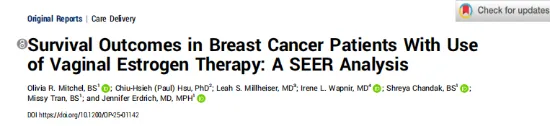 Fig. 1. Study Screenshot
Study Design
The investigators used the SEER-Medicare Health Outcomes Survey (SEER-MHOS) database, which links cancer registry data with Medicare claims and patient-reported outcomes. The cohort included 25,874 women aged 65 years or older diagnosed with breast cancer between 2007 and 2017. Patients were followed for overall survival (OS) and breast cancer-specific survival (BCSS).
Of the 25,874 patients, 1,053 (4.06%) had at least one filled prescription for vaginal estrogen after diagnosis (the exposed group), and 24,821 (95.94%) had no such prescription (the unexposed group). VET products captured in the analysis included conjugated estrogen cream, estradiol cream, estradiol vaginal tablets, estradiol vaginal inserts, and estradiol vaginal rings. Patients who used VET only before their breast cancer diagnosis were classified as unexposed.
The analysis adjusted for demographic characteristics, comorbidities, socioeconomic factors, tumor stage, receptor subtype, type of surgery, radiotherapy, chemotherapy, endocrine therapy regimen, and health-related quality of life scores. Pre-specified subgroup analyses were conducted in HR+ patients, tamoxifen users, AI users, and Black patients. Because prescription timing is critical in this kind of observational comparison, the authors used a time-dependent Cox model to address immortal time bias, a well-known methodological pitfall in pharmacoepidemiology.
Key Findings: Time-Dependent Analysis Changes the Story
In a fixed (time-fixed) Cox model, VET appeared to be associated with better survival, a pattern that the authors interpret as a likely artifact of immortal time bias and healthy user bias rather than a true protective effect.
After applying a time-dependent covariate analysis, the apparent survival advantage disappeared. In the full cohort, VET use was not associated with increased all-cause mortality or breast cancer-specific mortality. The authors conclude that low-dose VET does not appear to raise mortality risk in older breast cancer survivors, and that earlier signals of benefit should be interpreted with caution.
Table 1: Survival Outcomes - Full Cohort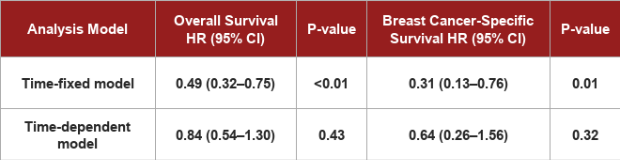
This finding suggests: the apparently significant survival advantage seen in the fixed model arises from immortal-time bias and healthy-user bias, and is NOT a tumor-protective effect of vaginal estrogen.
Core conclusion: vaginal estrogen does not increase the risk of all-cause mortality<br/>(including breast cancer-specific death) in elderly breast cancer patients.
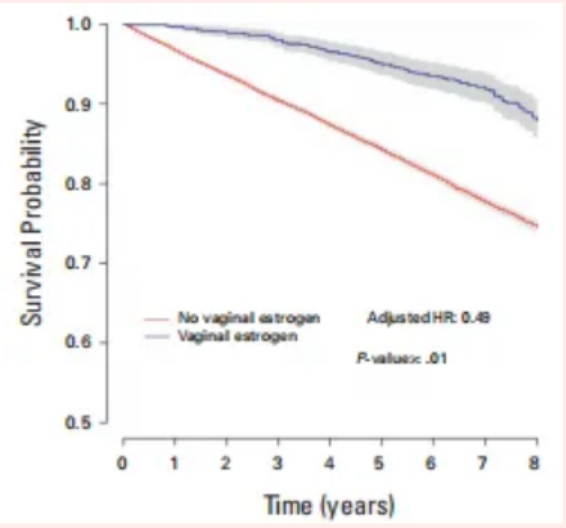
Fig. 1. Conceptual Summary of the SEER-Medicare Cohort and Time-Dependent Analysis
Subgroup Analyses
HR+ subgroup. The HR+ population is the group in which clinicians most often hesitate to prescribe VET. In this analysis, VET use was not associated with worse OS or BCSS in HR+ patients. Similar null results were observed in both tamoxifen users and AI users when analyzed separately, suggesting that the survival signal is not modified by class of endocrine therapy.
Black patient subgroup. Among 3,582 Black breast cancer patients, only 76 had used VET. In a time-dependent analysis, the adjusted hazard ratio for all-cause mortality was 0.79 (95% CI 0.11-5.79, P=0.82). The wide confidence interval reflects the very small event count, and the result should be considered hypothesis-generating rather than definitive.
Table 2: Survival Outcomes -HR+ Breast Cancer Subgroup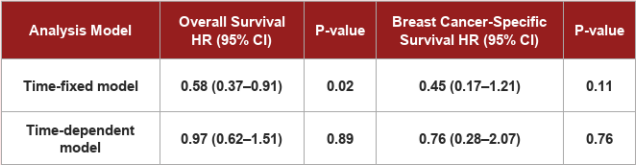
HR+breast cancer patients are the population of greatest clinical concenThis study shows: no trend of increased mortality risk,alleviating the central concen about topical estrogen use in the HR+ population.
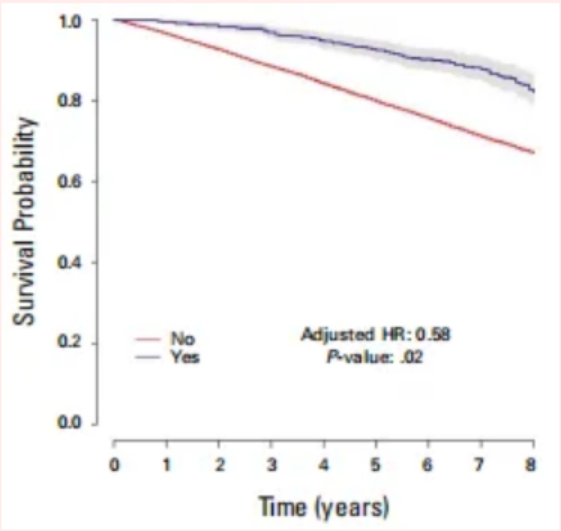 Figure.2.Kaplan-Meier Curve of Overall Survival in HR+Breast Cancer Patients by Vaginal Estrogen Use
Clinical Implications
For clinicians managing GSM in older breast cancer survivors, three practice points emerge from this analysis.
First, low-dose VET should not be categorically excluded on oncologic grounds alone for patients in whom GSM substantially affects quality of life and in whom non-hormonal options, including lubricants and moisturizers, have been insufficient. Current guidance from the American College of Obstetricians and Gynecologists and the North American Menopause Society supports an individualized approach, and the new SEER data are consistent with that position.
Second, treatment selection should remain individualized. In patients on AIs with mild symptoms, a non-hormonal strategy is often reasonable as a first step. In patients on tamoxifen, the systemic absorption from low-dose VET is generally considered modest, but shared decision-making and close follow-up remain appropriate.
Third, the data point to substantial undertreatment. Only about 4% of patients in this large cohort used VET, despite the high prevalence of GSM in older survivors on endocrine therapy. This pattern suggests that clinicians should screen for GSM symptoms during routine endocrine therapy follow-up rather than waiting for patients to volunteer the complaint. Active screening may also indirectly support adherence to endocrine therapy by addressing a common but unspoken driver of treatment discontinuation.
Limitations and Next Steps
The study has several important limitations. The cohort is restricted to patients aged 65 years or older, so the findings cannot be directly extrapolated to younger postmenopausal or premenopausal survivors. Recurrence was not assessed; only mortality endpoints were available, leaving open the question of whether VET influences disease-free survival. Dose information was limited, so a clear safety threshold for cumulative or peak exposure cannot be defined. Subgroup analyses, particularly in Black patients, were constrained by small numbers and wide confidence intervals. As with any observational study, residual confounding cannot be excluded.
The authors appropriately call for prospective randomized trials to validate these findings and to address the recurrence question, dose response, and applicability to younger survivors. For now, the SEER-Medicare analysis provides reassuring, large-scale, real-world evidence that low-dose vaginal estrogen does not appear to increase mortality in older breast cancer survivors, while leaving the more granular clinical questions to be answered by future studies.
Reference:
Mitchel OR, Hsu CP, Millheiser LS, Wapnir IL, Chandak S, Tran M, Erdrich J. Survival Outcomes in Breast Cancer Patients With Use of Vaginal Estrogen Therapy: A SEER Analysis. JCO Oncol Pract. 2026 Jun 26:OP2501142.

