


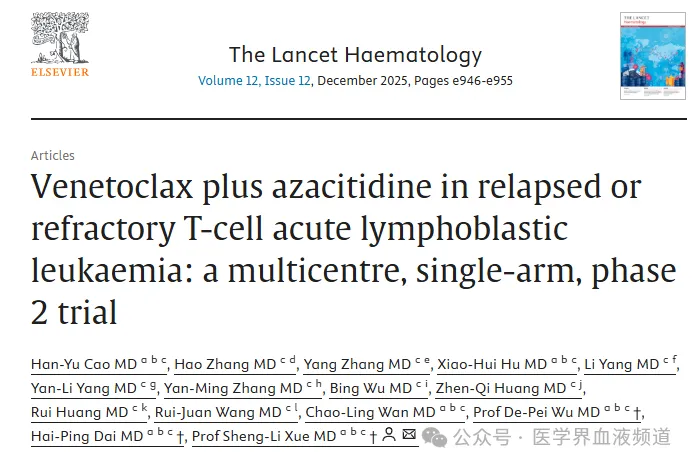
Relapsed or refractory T-cell acute lymphoblastic leukemia is one of the most difficult hematologic malignancies to treat. Even when adult patients receive conventional chemotherapy followed by allogeneic hematopoietic stem cell transplantation, overall survival remains low, response rates to salvage therapy after relapse are poor, and there is a lack of specific targeted agents. Recently, a phase II clinical trial led by teams headed by Prof. Depei Wu and Prof. Shengli Xue from the First Affiliated Hospital of Soochow University was formally published online in The Lancet Haematology. For the first time, the study prospectively and systematically confirmed the breakthrough efficacy and safety of venetoclax plus azacitidine, or the VA regimen, in this setting and created a valuable opportunity for patients to bridge successfully to transplantation. MedJ invited Prof. Haiping Dai from the Department of Hematology at the First Affiliated Hospital of Soochow University, an important participant in the study, to explain the clinical value and future application of this innovative regimen.
Clinical Pressure Driving Innovation: The Pain Points in R/R T-ALL
Although T-ALL is relatively uncommon, it still accounts for an important share of adult acute leukemia. Its treatment difficulties have long troubled hematologists. Prof. Haiping Dai noted that adults with relapsed or refractory T-ALL respond poorly to traditional regimens and continue to face a very high risk of relapse even after successful bridging to allogeneic transplantation. Once relapse or refractoriness occurs, survival shortens dramatically.
The situation is made even worse by the marked heterogeneity of T-ALL, the lack of specific molecular targets, and the very slow progress of cellular immunotherapy in this disease. Prof. Dai added that some newer agents for T-ALL, such as nelarabine, are still unavailable in China and therefore have extremely poor clinical accessibility. Many of these patients also have immune defects and, after multiple prior chemotherapy regimens, profound marrow suppression, making them unable to tolerate traditional chemotherapy and leaving them effectively without drugs to use.
Against this background, finding a new treatment strategy that is both effective and low in toxicity became the key to breaking the R/R T-ALL impasse. Based on years of clinical practice and basic research, the team at the First Affiliated Hospital of Soochow University turned to the VA regimen, which had already shown success in acute myeloid leukemia, and began exploring a chemotherapy-free combination strategy for T-ALL.
From Basic Research to Clinical Translation: The Logic Behind the VA Regimen
The VA regimen has already been widely used as induction therapy in elderly patients with acute myeloid leukemia or in those unfit for intensive chemotherapy. Its extension into T-ALL was not a chance experiment, but was grounded in strong preclinical evidence and early clinical exploration.
Prof. Dai explained that as early as 2014, Cancer Discovery published work showing that a substantial proportion of T-ALL cell lines, especially those arising from earlier developmental stages, had high BCL-2 expression and were highly dependent on BCL-2 for survival. In vitro drug-sensitivity assays and mouse models both showed that these cells were relatively sensitive to BCL-2 inhibition, providing the core theoretical basis for use of the VA regimen in T-ALL.
Genomic studies then found that some patients with T-ALL, especially those with early T-cell precursor disease and ETP-like T-ALL, have gene-expression profiles highly similar to acute myeloid leukemia and often carry myeloid-related mutations. Prof. Dai emphasized that this molecular feature provided crucial scientific support for translating a regimen originally used in AML into T-ALL.
On the basis of these findings, the team first performed a real-world exploratory study in five patients with relapsed or refractory T-ALL, all of whom responded, with four achieving complete remission and treatment showing good safety. These early results revealed the potential of the VA regimen and laid a solid clinical foundation for a prospective trial. The team therefore designed a single-arm, prospective phase II study to systematically evaluate the efficacy and safety of VA in R/R T-ALL.
A 76% Response Rate with Low Toxicity: The Clinical Advantages of VA
The publication of this study brought genuinely breakthrough data to the field. The objective response rate of the VA regimen in R/R T-ALL reached 76%, and the composite remission rate consisting of complete remission, complete remission with incomplete hematologic recovery, and complete remission with incomplete platelet recovery was markedly better than with conventional salvage regimens. Even more importantly, median overall survival was extended to 24.1 months, representing a qualitative leap over historical outcomes.
Prof. Dai said such efficacy is highly significant in the salvage setting. Nelarabine-based combination chemotherapy abroad has reported objective response rates below 40%, whereas a 76% response rate means many more patients can achieve disease control. More importantly, most patients reached composite remission within two cycles, creating a window for subsequent allogeneic transplantation.
Another major advantage was the quality of remission. The high composite remission rate suggested deeper recovery and more complete hematopoietic restoration. This not only reduces complications such as infection, but also provides a better foundation for long-term survival after transplantation. In the cohort that underwent bridging transplantation, overall survival was clearly superior to historical data, underscoring the value of VA as a transplant-bridging regimen.
Safety was also a major strength. The rate of grade 3 to 4 infection in the study was only 12%, far below that seen with traditional intensive chemotherapy. Prof. Dai explained that the VA regimen has relatively little impact on immune function. Even when neutropenia or agranulocytosis occurred, infection rates remained comparatively low. This is especially important in R/R T-ALL, where patients often come directly from multiple lines of chemotherapy with incomplete marrow recovery and sometimes with existing infection. A lower-toxicity regimen makes treatment safer and avoids interruption or death caused by severe infection.
Subgroup analysis further broadened the potential applicability of the regimen. Response rates did not differ significantly between ETP-ALL and non-ETP-ALL, and the objective response rate reached 86.7% in patients carrying epigenetic mutations. Prof. Dai said this finding overturned the team’s initial assumption that only early-stage immunophenotypic subsets might benefit and showed that VA can work well across different immune subtypes and molecular profiles. Patients with no prior exposure to venetoclax, as well as those with only limited prior exposure, may both benefit.
Clinical Implications and Future Directions
The success of the VA regimen has not only provided a new treatment option for patients with R/R T-ALL, but has also begun to reshape the treatment landscape. Prof. Dai noted that, as an effective, low-toxicity, low-intensity regimen, VA has already become the preferred salvage strategy at many centers in China, especially for patients who fail first-line therapy and have not previously received venetoclax. Its broad applicability and safety have given treatment opportunities to patients who previously had virtually no options, and in some cases have allowed successful bridging to transplantation and the possibility of cure.
In the study, 64% of patients were successfully bridged to allogeneic transplantation through the VA regimen, strongly supporting its central role before transplant. For patients with R/R T-ALL, allogeneic transplantation remains the only potentially curative approach, but only if disease can first be controlled and hematopoiesis restored. VA provides that critical support through a high remission rate and a high quality of remission.
Looking ahead, Prof. Dai said the team will focus on combination strategies built on VA in order to further improve efficacy and overcome resistance. Planned approaches include combining VA with epigenetic drugs such as chidamide, with conventional chemotherapy, or with other targeted agents, so as to create new pathways for patients who respond poorly to VA or develop resistance. At the same time, the group intends to carry out basic studies on venetoclax resistance in order to clarify mechanisms and support individualized therapy.
When discussing a phase III trial, Prof. Dai also gave a realistic assessment of the challenges. Because T-ALL is relatively rare and represents only a limited proportion of adult acute leukemia, a randomized phase III study would require a large sample size that may be difficult to achieve quickly, even through multicenter collaboration. The more practical next steps may therefore be phase II or expanded phase II studies to accumulate stronger evidence and consolidate the position of VA.
Conclusion
From the theoretical support of basic research, to exploratory validation in the real world, to rigorous confirmation in a prospective clinical trial, the development of the VA regimen reflects the deep clinical insight and persistent effort of Chinese investigators. This research, led by Chinese scholars, has not only brought hope of survival to patients with R/R T-ALL, but also marked an important step forward for China in precision treatment of refractory hematologic malignancies. As the regimen is further optimized and more widely adopted, it may allow more patients to benefit from this chemotherapy-free combination strategy and help move T-ALL treatment into a new era of precision, safety, and efficiency.

