


The US most-favored-nation (MFN) drug pricing policy links prices paid in selected foreign markets to what US payers and government programs pay. For pharmaceutical companies, the policy has created a side effect that sits outside the usual pricing file: the sequence in which new medicines are launched, the reimbursement channel chosen for each market, and the timing of any price negotiation now carry consequences for revenue in the largest single market in the world. Three companies have set out three different responses, and together they show launch order becoming part of global pricing strategy rather than a scheduling detail.
Article Key Points
• US MFN pricing ties foreign prices to US reimbursement, turning launch sequence into a global pricing variable.
• Roche delayed the European filing for giredestrant, citing a need for more mature clinical evidence.
• Novartis said private and self-pay European launches are not off the table; no decision has been made.
• CMS cut projected GLOBE savings from $11.9 billion to about $440 million after exemptions narrowed the model.
• Modeled savings rely on exemptions not holding; 71% of projected savings vanish if side deals are permitted.
One Policy, Two Price Transmission Pathways
In May 2025, President Trump signed the executive order establishing MFN prescription drug pricing. Since then, the administration has reached voluntary agreements with manufacturers covering state Medicaid prices, direct purchases through TrumpRx, MFN pricing on new products, US domestic investment commitments, and tariff arrangements. The commitments differ from company to company. As of August 31, 2026, the White House said 26 companies had signed such agreements, covering 89% of the US branded drug market; the nine companies added that day, including Alcon, Astellas, BeOne Medicines, BridgeBio, CSL, Kyowa Kirin, Sun Pharma, Teva and UCB, jointly committed to invest at least $19.6 billion in US manufacturing.
A second pathway runs through the Centers for Medicare and Medicaid Services (CMS). The Global Benchmark for Efficient Drug Pricing (GLOBE) model was finalized on September 30, 2026 as a mandatory Center for Medicare and Medicaid Innovation demonstration under Section 1115A of the Social Security Act. For certain separately payable Medicare Part B drugs, GLOBE replaces the inflation rebate with a rebate triggered when the US price exceeds an international benchmark. The rule covers roughly 25% of Original Medicare Part B beneficiaries in randomly selected geographic areas, and applies to high-spend single-source drugs and sole-source biologics in seven therapeutic categories, with Part B spending above $100 million over the applicable 12-month period. The final rule takes effect November 30, 2026; the model begins January 1, 2027 with voluntary manufacturer data collection, with performance years running from April 1, 2027 to March 31, 2032 and a seven-year payment period through March 31, 2034. The companion model for Part D, the Guarding US Medicare Against Rising Drug Costs (GUARD) model, remains a proposed rule and was still under review at the Office of Management and Budget when checked.
Both pathways transmit the same underlying signal. Voluntary agreements constrain launch pricing for signing companies, while GLOBE and GUARD apply international benchmarks and manufacturer rebates in specific Medicare payment scenarios. How far an overseas price reaches into US revenue depends on the product, the payment channel, the reference country, and the individual terms, which means companies have to model filing dates, list prices, discounts and reimbursement arrangements together rather than market by market.
Roche Waits, Novartis Steps Back, Sanofi Presses for More
Roche: Waiting for Data and for Pricing Room
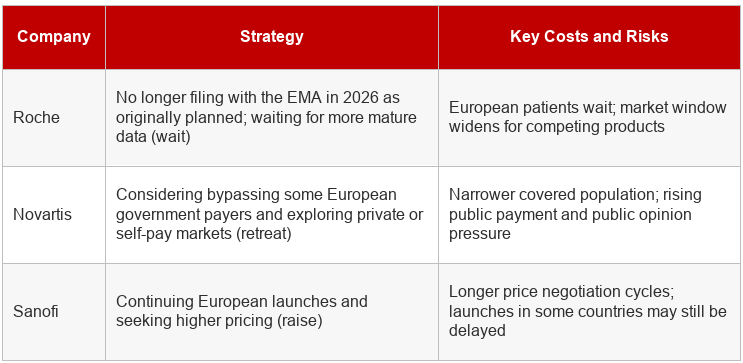
In October 2026, Roche confirmed that it would submit giredestrant, an oral selective estrogen receptor degrader for ER-positive, HER2-negative breast cancer, to the European Medicines Agency later than previously planned, without giving a new filing date. Roche previously expected to seek European approval in 2026 and now plans to begin discussions with European regulators in 2027. The company said it wants more mature clinical evidence to support its application and to improve its prospects for sustainable reimbursement. Roche did not attribute the change to MFN pricing, and no public evidence establishes that the policy caused the decision. Attributing the delay entirely to MFN would go beyond what is documented; what has changed is that the commercial weight of filing timing has risen in an environment where overseas prices may feed back into US revenue.
The underlying evidence position is consistent with that framing. The phase III evERA study of giredestrant plus everolimus in advanced disease reported a positive progression-free survival result (median 8.8 vs 5.5 months; hazard ratio 0.56; 95% CI 0.44-0.71), with overall survival still immature at analysis (hazard ratio 0.69; 95% CI 0.47-1.00). Giredestrant is not yet approved in any market; US Prescription Drug User Fee Act goal dates are set for November 30, 2026 in early-stage breast cancer and December 18, 2026 in advanced disease.
Novartis: Putting Private and Self-Pay Markets on the Table
On the third-quarter 2026 earnings call on October 27, Novartis Chief Executive Officer Vasant Narasimhan said that launching new drugs in the private market or in a self-pay market in Europe is not off the table. He named ianalumab, an investigational antibody that would be the first approved targeted treatment for Sjögren’s disease, as the first asset whose European launch strategy is genuinely in question, and said the company could not launch it in the public sector in Europe if European governments did not reward innovation, because the effect on its US business would be too large. He also warned investors to expect European access delays from 2027 and said the MFN policy is set rather than temporary.
The statement remains an option under discussion rather than an announced change of channel, and Novartis has not said it will adopt private or self-pay launches across Europe. The company has signed an MFN agreement. Arrangements listed by the White House include the TrumpRx direct purchase price for the multiple sclerosis drug Mayzent falling from $9,987 to $1,137, a reduction of about 88.6%, and a commitment to invest $23 billion over five years to expand US research and manufacturing infrastructure.
In Canada, Novartis decided not to pursue reimbursement for Vanrafia (atrasentan) after Health Canada approval for IgA nephropathy. The company did not cite MFN as the reason, stating instead that the likelihood of securing reimbursement was limited under the current Canadian access environment. A separate survey commissioned by Innovative Medicines Canada and conducted by Ernst and Young across 31 pharmaceutical and life sciences companies found 16 Canadian launches cancelled and 32 delayed, with about 64% of the cancelled products being oncology treatments.
Sanofi: Continuing to Launch and Seeking Higher European Prices
Sanofi took a different route. Chief Financial Officer François-Xavier Roger said in late October 2026 that the company will continue launching new medicines in Europe and may seek higher European prices, rather than using a pause in launches to absorb MFN pressure. The approach shifts negotiation pressure onto European payers, and whether it succeeds will depend on clinical value, budget impact and available alternatives.
The Risk Trade-Off Across Three Strategies
Price Pressure Passes Through Licensing Deals to R&D
When multinational companies reorder their launch sequences, the pressure travels into licensing agreements with biotechnology companies. Legal advisers and industry reports have focused on whether overseas partners can set prices independently, whether the licensor holds consultation or approval rights, how launch order in reference countries is arranged, and how MFN rebate payments are settled against net sales, royalties and milestone payments.
For Chinese developers, the pricing rights and launch sequence in an out-licensing agreement warrant the same negotiating attention as the upfront and milestone payments. If a commercialization partner accepts a low price to enter one market and then passes the resulting US revenue reduction back to the licensor under the contract, the gap between the headline total deal value and actual proceeds widens.
Revenue From Low-Price Markets May Not Offset US Reductions
A cohort study published in The Lancet in September 2026 modeled the GLOBE and GUARD models across 195 brand-name drugs accounting for $87.9 billion of Medicare spending. In the initial phase covering 25% of beneficiaries, the estimated reductions in net Medicare spending were $5.2 billion (16.1%) under GLOBE and $6.4 billion (17.6%) under GUARD. Among the 138 drugs for which international sales data were available, the median ratio of estimated US reductions to annual sales in the binding lowest-price reference country was 3.8 (interquartile range 1.0-22.8), and for 101 drugs (73.2%) the estimated US reduction would exceed a full year of sales in that reference country.
Those figures require two qualifications. First, the study modeled the rules as proposed in December 2025, before the final rule added exclusions for orphan drugs, approved cell and gene therapies and plasma-derived products, and before the waiver for manufacturers participating in the GENEROUS Medicaid model. CMS now projects GLOBE savings of about $440 million over seven years, roughly $80 million a year, down from $11.9 billion estimated under the proposed rule, and estimates that only about four manufacturers would remain subject to mandatory participation once the exemptions apply. Second, the study’s own scenario analysis found that savings would fall by 12.2% if the reference basket were narrowed to the G7 countries, and by 71.3% if manufacturers with separate agreements with the Department of Health and Human Services were exempt from participation. With 26 companies now covered by side agreements, the study authors and other commentators have noted that most of the projected savings may not be realized. The estimates are modeled from historical data and public databases, which the authors noted may not capture confidential discounts or recently approved products.
European Launch Activity Has Declined
An analysis of GlobalData’s POLI database found that 27% fewer new active ingredients, counted as new single-source brands priced for the first time, were launched in the European reference countries used by GLOBE and GUARD during the 17 months following the MFN executive order than in the preceding 17 months. The count fell 17% in the countries referenced under the Medicaid GENEROUS model and 14% across European markets as a whole. The analysis used the 17-country GLOBE and GUARD basket and the six-country GENEROUS basket as proposed, with 14 of the 17 GLOBE and GUARD reference markets located in Europe, which is where GlobalData expected the effects to be largest.
GlobalData linked the decline to companies avoiding international reference pricing, and explicitly noted that reimbursement negotiations, supply chains, clinical value assessment and the number of US first launches also affect the result, so the data cannot attribute the entire reduction to a single policy. Its withdrawal data point in the opposite direction for the reference markets: the average number of brands with at least one presentation withdrawn was 26% higher across Europe as a whole and 9% higher in the GENEROUS reference countries, but fell by 2% in the GLOBE and GUARD reference countries, which GlobalData attributes to the two models not yet being in effect. Separately, and on a different statistical basis, Endpoints News reported that 44 new medicines entered European regulatory review during the first nine months of 2026, compared with 51 in the same period of 2025.
The European Union’s regulatory and reimbursement environment is changing in parallel. The Joint Clinical Assessment (JCA) framework under the Health Technology Assessment Regulation has applied to oncology products and advanced therapy medicinal products since January 2025. JCA produces a single joint clinical value report, and member states are required to take it into account, while pricing and reimbursement decisions remain national. The first joint report, for Ipsen’s Ojemda (tovorafenib), was approved by the Health Technology Assessment Coordination Group on April 30, 2026, ten days after the European Commission granted conditional marketing authorization on April 20, 2026 and well inside the 30-day regulatory deadline.
Intergovernmental arrangements are also moving. On December 1, 2025, the Office of the United States Trade Representative announced an agreement in principle with the United Kingdom requiring the National Health Service to raise the net price of new medicines by 25%, alongside US exemptions from Section 232 tariffs for UK-origin drugs, drug ingredients and medical technologies, and a commitment not to initiate Section 301 investigations into UK drug pricing during the president’s term. UK media described it as the first increase in NHS drug spending in more than two decades.
China Assets Draw More Attention and Deal Terms Grow More Complex
Chinese innovative drug assets already carry substantial weight in global licensing. Multiple datasets place the share of China-originated transactions at record levels in 2026. Financial Times data reported in October 2026 counted Chinese companies behind eight of the ten largest business development deals, with China’s share of licensor location rising from under 20% in 2023 to close to 60% in the third quarter of 2026. VBInsight statistics for the first half of 2026 put Chinese companies behind eight of the ten largest global licensing deals, all as sellers. On DealForma’s third-quarter 2026 counts, which cover large-cap companies of at least $50 billion in market capitalization making global in-licensing and asset purchase deals with upfronts of at least $50 million, Chinese projects accounted for 51% of deals and 65% of upfronts through September 30, 2026, against 39% and 36% respectively for full-year 2025.
Against that backdrop, MFN raises the buyer’s need to manage global prices and launch order. For Chinese developers, the contract details that matter extend further: which party sets prices in each market, when reference countries launch, whether confidential net prices can be used, and how terms are renegotiated if the policy changes. Whether sales shares adjust to MFN rebates, and which party bears the rebate payments, also belong in the economic terms to avoid later disputes.
Price portfolios must also be recalculated. Evaluating an overseas market requires estimating local revenue, reference price spillover and US market impact together, rather than looking at sales in one country at a time. China is not among the 19 reference countries specified for these models, so domestic reimbursement prices do not automatically enter US calculations under GLOBE or GUARD; what requires active management is the risk that the policy scope changes and that individual commercial agreements transmit effects through other routes.
Chinese companies have gained more opportunity in asset transactions, and they also need to hold their position on pricing and revenue allocation in the contracts. Which country a new medicine enters first, and through which payment pathway, has become a decision that sits outside discovery and development but carries similar strategic weight.

