


A disease the United States declared eliminated is causing a wide outbreak again. Data updated by the US Centers for Disease Control and Prevention (CDC) on October 16 show 4,410 confirmed measles cases nationwide as of October 15, close to double the 2,289 cases reported in all of 2025 and the highest since 1991.
Pennsylvania, which has reported the most cases, is still adding to its count. The state health department reported on October 19 a cumulative 1,286 confirmed cases, 247 hospital admissions, and 5 confirmed measles-related deaths, with one further death still under investigation. The same day, a CDC Epidemic Intelligence Service officer arrived locally to help with the response.
Those who need protection now include children not yet born. New clinical guidance from the state notes a rise in measles during pregnancy and the reappearance of congenital measles after decades. An outbreak that vaccination could have prevented is placing sustained pressure on US clinical care and public health.
Article Key Points
- 4,410 confirmed US measles cases as of October 15, 2026, versus 2,289 in all of 2025; highest since 1991
- Pennsylvania: 1,286 cases across 42 counties, 247 hospitalizations, 5 confirmed measles-related deaths
- Two deaths were infants below the routine first MMR dose at 12-15 months; all 5 decedents were unvaccinated
- Kindergarten MMR coverage fell from 95.2% in 2019-2020 to 92.4% in 2025-2026
- About 96% of 2026 US cases were unvaccinated or of unknown vaccination status
- Congenital measles has reappeared after decades; MMR is live attenuated and cannot be given in pregnancy
- Susceptible pregnant women exposed to measles should receive IVIG within 6 days of first exposure
- New York State declared a measles disaster emergency on October 5, effective until November 4
- US elimination, declared in 2000, requires 12 months without continuous local transmission
A Disease Declared Eliminated in 2000
Measles has reached 42 counties in Pennsylvania. The 247 hospitalized patients reported most recently represent about 19% of the state’s cumulative confirmed cases.
Two of the deaths were in infants. Under the routine US immunization schedule, the first dose of measles-mumps-rubella (MMR) vaccine is usually given at 12 to 15 months, so these infants had not reached the routine vaccination age. All 5 measles-related deaths previously confirmed by the state health department were in unvaccinated people.
On October 12, the Franklin County coroner reported the death of a 39-year-old woman with multiple underlying conditions who had confirmed measles. The state health department later said it was still investigating that death; as of October 19, the state-level confirmed figure remained 5.
State and federal death counts are not yet aligned. The CDC page currently lists 2 measles deaths nationally and states that the figure will be updated as information is completed and reviewed, while the agency works with the Council of State and Territorial Epidemiologists on a uniform death case definition.
Pennsylvania explained on October 14 that its measles-related death count requires clinical evidence of infection, a positive laboratory test, death within 30 days of symptom onset, and that the death cannot be attributed to an unrelated cause. Establishing whether a death is linked to infection remains part of this outbreak investigation.
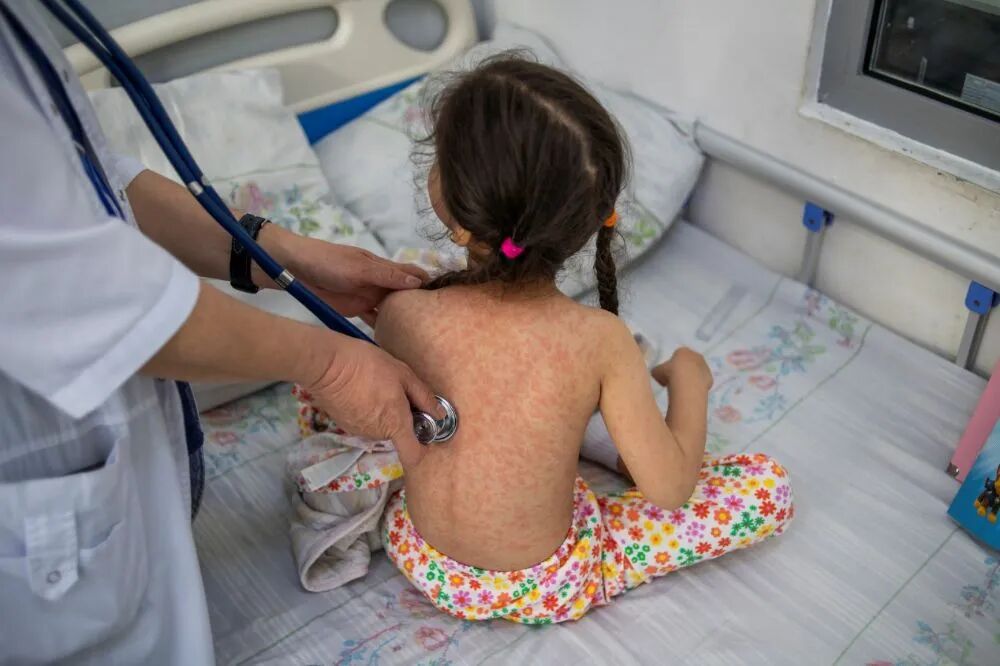 Fig. 1. Measles Reference Image
Source: WHO
Changes in case numbers also need to be read with onset dates in mind. Pennsylvania recently added an epidemic curve to its outbreak dashboard, plotting cases by rash onset date where available and by test or report date otherwise. The health department hopes this will show whether transmission is accelerating, stabilizing, or declining, and reduce the effect of delayed reports on judgments about the trajectory.
Risk Now Extends to Pregnant Women and Newborns
The danger of measles is not confined to rash. Complications such as pneumonia and encephalitis can lead to hospitalization and death, and infection during pregnancy carries risks of miscarriage, preterm birth, and low birth weight.
On October 19, Pennsylvania issued guidance for clinicians on measles in pregnancy and congenital measles. The document states that as infections during pregnancy increase, congenital measles has been identified locally again after decades without cases, and it asks clinicians to focus on assessment, testing, and isolation of infected pregnant women and of newborns after exposure.
These infants may not present typically. The guidance notes that rash in a newborn may be delayed or may differ from the usual measles pattern, and that delayed neurological and other complications still require attention after acute infection. For obstetrics, paediatrics, and infectious diseases, asking promptly about the mother’s infection history and exposure history determines whether risk can be identified early.
Because MMR is a live attenuated vaccine, it cannot be given during pregnancy. The local guidance emphasizes establishing immune protection before pregnancy. For pregnant women who have no evidence of measles immunity and have already been exposed, intravenous immunoglobulin should be given within 6 days of the first exposure to reduce the risk of infection and its severity.
Technical support for the response is also increasing. The CDC officer who started on October 19 will help with modelling of case trends, disease burden, and local vaccination impact. The state health department says about 300 staff are involved in control efforts, including 60 epidemiologic investigators.
Why Elimination Was Lost
The United States declared measles eliminated in 2000. Elimination does not mean zero cases; what matters is whether transmission from imported cases can be interrupted promptly enough that the virus does not circulate continuously within the country.
Under the relevant assessment criteria, measles elimination means continuous local transmission has been interrupted for at least 12 months under high-quality surveillance. What needs to be judged now is therefore not only the national cumulative case count, but also whether outbreaks in different places are linked and whether a single chain of transmission has continued for more than a year.
The Kaiser Family Foundation has summarized that the Pan American Health Organization is expected to review US measles elimination status this November. Last November, Canada lost the status after transmission continued for more than 12 months; the US assessment at that time concluded that elimination was maintained but that major vulnerabilities existed.
Rising case numbers have accompanied falling vaccination coverage. CDC data show that MMR coverage among US kindergarten children fell from 95.2% in the 2019-2020 school year to 92.4% in 2025-2026. Below the national average, coverage in some communities is lower still.
According to ABC News, about 96% of measles cases confirmed in the United States this year were in people who were unvaccinated or whose vaccination status was unknown. Once the virus enters a population with insufficient coverage, it has room to keep spreading.
The CDC notes that community coverage above 95% helps protect most people through herd immunity. A national average does not show conditions in each community; even where statewide coverage is relatively high, there may be areas where unvaccinated people cluster. Control therefore requires finding gaps in specific populations rather than relying on national figures.
Measles is particularly effective at exploiting such immunity gaps. The virus spreads through the air, and virus in the air can remain infectious for up to two hours after an infected person has left an area. Among susceptible contacts, as many as 90% may become infected.
Prof. Lisu Huang, director of the Department of Infectious Diseases at the Children’s Hospital, Zhejiang University School of Medicine, told MedJ that vaccination is the most effective way to prevent measles and that two doses of MMR provide about 97% protection. Raising community coverage also protects people who are too young to be vaccinated and those who should not be vaccinated because of immune compromise.
To expand vaccination and testing services, New York State declared a measles disaster emergency on October 5, with the temporary measures in effect until November 4. Eligible personnel such as midwives may vaccinate, pharmacists may vaccinate children aged 2 years and older, and registered nurses have been authorized to order relevant tests.
Demand for vaccination has also risen in Pennsylvania. The state health department says about 25,000 MMR doses are usually given each month; in September the figure exceeded 56,000, and in the first two weeks of October it exceeded 23,000. Whether vaccination services reach communities with sustained transmission in time will directly affect how the outbreak develops.
For infants aged 6 to 11 months living in or travelling to areas with sustained community transmission, Pennsylvania also recommends an early dose of vaccine. This dose does not replace the two routine doses that follow. Temporary vaccination arrangements adjusted to local risk give infants who are not yet in the routine immunization schedule earlier protection.
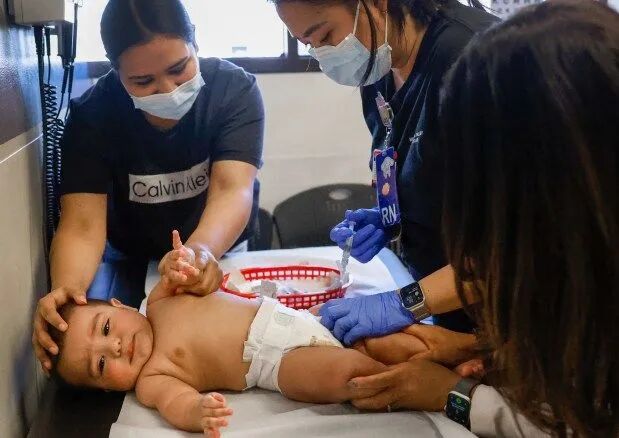 Fig. 2. MMR Vaccination Reference Image
Source: Bay Area News Group
What Other Countries Should Watch
The course of the US outbreak also indicates that other countries need to keep watching importation risk.
The Chinese Center for Disease Control and Prevention notes that measles incidence in China has remained low in recent years and that MMR coverage among age-eligible children has stayed high. Yet several countries and regions worldwide have seen resurgence or outbreaks, and of the 10 countries with the most reported measles cases in 2025, 6 share a border with China, so the risk of imported transmission persists.
The low domestic incidence reflects long-standing immunization planning and surveillance. China began using measles vaccine in 1965, incorporated it into the childhood immunization programme in 1978, subsequently established a two-dose schedule, and gradually moved the age of the second dose earlier. Since June 2020, children have received one dose of MMR at 8 months and one at 18 months.
Vaccination history should also be part of routine consultation. For children who have not completed the two-dose MMR schedule, the Chinese CDC recommends catch-up vaccination as soon as possible; where two doses are needed, the interval should be at least 28 days. Checking records promptly helps identify gaps in protection.
For clinicians, low case numbers create a different practical problem: whether measles still comes to mind during a consultation.
Prof. Huang noted that measles remains an infectious disease taught during residency training for young physicians. In areas with few cases, regional training in infectious diseases is needed so that physicians can recognize and manage it.
Early measles can present with fever, cough, coryza, and conjunctivitis, followed by rash. The CDC advises that measles should be considered in patients with fever and rash and a compatible clinical picture, particularly with international travel history or relevant contact history, and that laboratory testing should confirm the diagnosis.
For suspected cases, commonly used laboratory confirmation includes serum measles-specific IgM antibody testing and nucleic acid testing of respiratory specimens. Viral genotyping can also help analyse links between cases, determine the source of importation and the route of transmission, and connect clinical diagnosis with outbreak investigation.
Recognition, Reporting, and Isolation
Once a case is recognized, reporting, isolation, and contact management need to follow promptly. China’s current measles and rubella prevention and control programme requires medical institutions with direct network reporting capacity to report surveillance cases, suspected cases, clinically diagnosed cases, and confirmed cases within 24 hours of identification.
For patients with measles, the programme specifies isolation until 5 days after rash onset for those without respiratory complications, and until 10 days after rash onset for those with pneumonia; close contacts are monitored for 21 days from the date of last close contact with the case. Respiratory isolation in waiting areas, during examination, and during admission also affects the safety of other patients and of health care workers.
Treatment remains mainly supportive, with management of complications. Prof. Huang said care should be tailored to the child’s condition, with prompt correction of hypoxia and attention to complications. Vitamin A can be used as supportive treatment in children with measles, but it should be assessed and guided by a physician and cannot replace vaccination.
In this US outbreak, infants who have not reached the routine vaccination age and women who cannot be vaccinated during pregnancy depend on the immunity of those around them. Completing vaccination on time, recognizing cases early, and linking contact investigation with necessary post-exposure intervention are what can reduce infections and severe cases that need not occur.

