


Background
Nearly half of patients with gastric cancer and gastroesophageal junction cancer (GC/GEJC) are diagnosed with locally‑advanced disease at initial consultation and have a poor prognosis. Although perioperative chemotherapy based on S‑1 plus oxaliplatin (SOX) or capecitabine plus oxaliplatin (XELOX) constitutes standard‑of‑care treatment, patients still achieve unsatisfactory 5‑year overall survival (OS) rates. In recent years, immune‑checkpoint inhibitors (ICIs) represented by PD‑1 inhibitors have yielded encouraging outcomes in first‑line therapy for advanced GC/GEJC. Nevertheless, their benefits in the perioperative setting are hampered by the absence of reliable predictive biomarkers.
Recently, Professor Cheng Xiangdong’s research team from Zhejiang Cancer Hospital published the Mountain‑02 study in *Cancer Cell*. For the first time, the study validated tumour‑specific MHC‑II (tsMHC‑II) as a novel predictive biomarker independent of PD‑L1, which enables accurate screening for candidates likely to benefit from perioperative immunotherapy.
Fig. 1. Study Screenshot
What the Study Found
In the Mountain-02 phase 2 trial, perioperative tislelizumab plus chemotherapy significantly improved pathological response rates over chemotherapy alone in patients with locally advanced gastric or gastroesophageal junction adenocarcinoma — but only in those whose tumors expressed tumor-specific MHC-II (tsMHC-II).
Among tsMHC-II-positive patients, the major pathological response (mPR) rate was 61.8% in the combination arm versus 26.5% in the chemotherapy-alone arm (p=0.003). The pathological complete response (pCR) rate was 32.4% versus 11.8%. By contrast, tsMHC-II-negative patients showed no benefit from the addition of tislelizumab: mPR rates were 23.5% and 26.5% in the combination and chemotherapy arms, respectively (p=0.787). A formal interaction test confirmed that treatment effect was significantly associated with tsMHC-II status (interaction p=0.031).
Notably, PD-L1 combined positive score (CPS) — the most widely used biomarker for immune checkpoint inhibitor therapy in gastric cancer — showed no significant correlation with pathological response in this study. Among patients with PD-L1 CPS ≥1 or ≥5, those who were tsMHC-II-positive achieved substantially higher mPR rates than those who were tsMHC-II-negative, suggesting an independent predictive role for tsMHC-II.
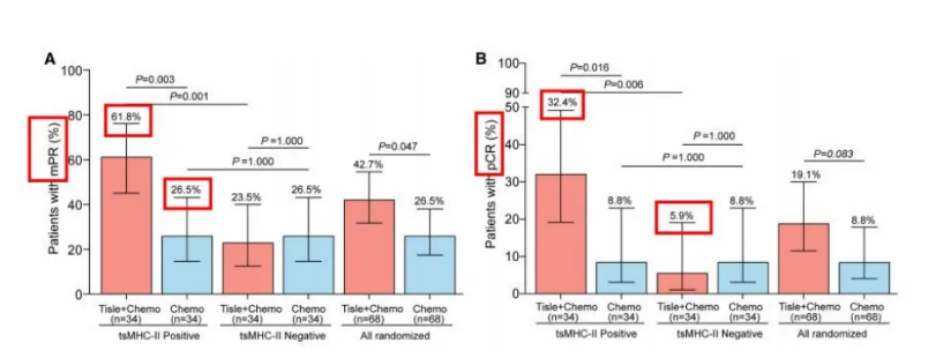
Fig.2.(A) Proportion of Patients Achieving Major Pathological Response (mPR) across Treatment Groups Stratified by tsMHC-II Expression Status
(B) Proportion of Patients Achieving Pathological Complete Response (pCR) across Treatment Groups Stratified by tsMHC-II Expression Status
Why It Matters
Current perioperative immunotherapy strategies for locally advanced gastric cancer largely rely on PD-L1 expression to select patients. However, the predictive value of PD-L1 in this setting has been inconsistent across trials, and a substantial proportion of PD-L1-negative or low-expressing patients may still derive benefit — while some PD-L1-positive patients do not. The Mountain-02 findings suggest that tsMHC-II may offer a more precise biomarker for identifying true responders, potentially sparing patients without tsMHC-II expression from ineffective immune checkpoint inhibitor exposure and its associated toxicities and costs.
Mechanistic Insights
Single-cell sequencing and multiplex immunohistochemistry analyses from the trial revealed distinct immune microenvironment features associated with response. Responders were characterized by infiltration of Mac-CXCL9 macrophages and effector T cells — a phenotype consistent with an immunologically “hot” tumor microenvironment capable of mounting an antitumor immune response upon checkpoint blockade. Non-responders showed enrichment of Mac-SPP1 macrophages and immunosuppressive populations including regulatory T cells (Tregs), suggesting a microenvironment dominated by immune exclusion or suppression.
These findings provide a mechanistic rationale for why tsMHC-II — a molecule involved in antigen presentation to CD4+ T cells — may serve as a functional biomarker reflecting tumor-intrinsic immunogenicity, rather than merely the presence or absence of an immune infiltrate as measured by PD-L1 staining.
Translational Potential
If validated in larger trials, tsMHC-II testing could reshape patient selection for perioperative immunotherapy in gastric cancer. Patients with tsMHC-II-positive tumors could be prioritized for checkpoint inhibitor-containing regimens, while those with tsMHC-II-negative tumors could be directed toward alternative strategies, potentially including chemotherapy alone or investigational approaches targeting immune-suppressive microenvironment components.
Clinical Evidence Status
The Mountain-02 trial was a randomized, open-label, biomarker-stratified phase 2 study conducted at four clinical centers in China. Between May 2024 and February 2025, 136 patients with resectable cT3-4aN+M0 gastric or gastroesophageal junction adenocarcinoma were enrolled. Patients were stratified by tsMHC-II status and Lauren classification and randomly assigned (1:1) to receive either three preoperative cycles of tislelizumab (200 mg, Q3W) plus SOX or XELOX chemotherapy, followed by three postoperative cycles of the same combination and up to 11 cycles of tislelizumab maintenance, or chemotherapy alone.
Grade 3-4 treatment-related adverse events (TRAEs) occurred at comparable rates across arms: 23.5% in the tsMHC-II-positive combination arm versus 26.5% in the positive chemotherapy arm. Immune-related adverse events (irAEs) were mostly grade 1-2, with four grade 3 events (myocarditis, hepatitis, pneumonitis, and colitis) reported in tsMHC-II-negative patients. The safety profile was consistent with that expected for this regimen, with no new safety signals identified.
As of the data cutoff on May 30, 2025, with a median follow-up of 16.3 months, event-free survival (EFS) and overall survival (OS) data remain immature (22 events total), precluding definitive conclusions about long-term benefit at this stage.
Limitations and Next Steps
This is a phase 2 study with a relatively small sample size (approximately 34 patients per arm), conducted entirely in Chinese centers. Key limitations include immature EFS and OS data, the need for standardization of tsMHC-II detection and scoring across laboratories, and the requirement for independent external validation. The authors acknowledge that these results support further evaluation of tsMHC-II as a predictive biomarker in larger, multicenter phase 3 trials before it can be considered for clinical adoption.
The study, led by Xiangdong Cheng and colleagues at Zhejiang Cancer Hospital, was published in Cancer Cell (Xu Z, Hu C, Yang L, et al. Perioperative tislelizumab plus chemotherapy for locally advanced gastric cancer: A randomized, prospective phase 2 trial. Cancer Cell. 2026;44(8):1-13.e5).
Reference
1.Xu Z, Hu C, Yang L, et al. Perioperative tislelizumab plus chemotherapy for locally advanced gastric cancer: A randomized, prospective phase 2 trial. Cancer Cell. 2026;44(8):1-13.e5.

