


The 2025 European Society for Medical Oncology (ESMO) Congress is being held in Berlin, Germany, bringing the latest clinical research advances and academic achievements to oncology experts, scholars, and healthcare professionals around the world.
On the morning of October 19th (local time), Dr. Rebecca A. Dent from the National Cancer Centre Singapore presented the latest results of the TROPION-Breast02 study in a late-breaking oral presentation. The study evaluated the efficacy and safety of datopotamab deruxtecan (Dato-DXd) versus investigator’s choice of chemotherapy (ICC) — including paclitaxel, nab-paclitaxel, capecitabine, carboplatin, or eribulin — as first-line therapy for patients with previously untreated, inoperable locally recurrent or metastatic triple-negative breast cancer (TNBC) who were not eligible for PD-1/PD-L1 inhibitor treatment.
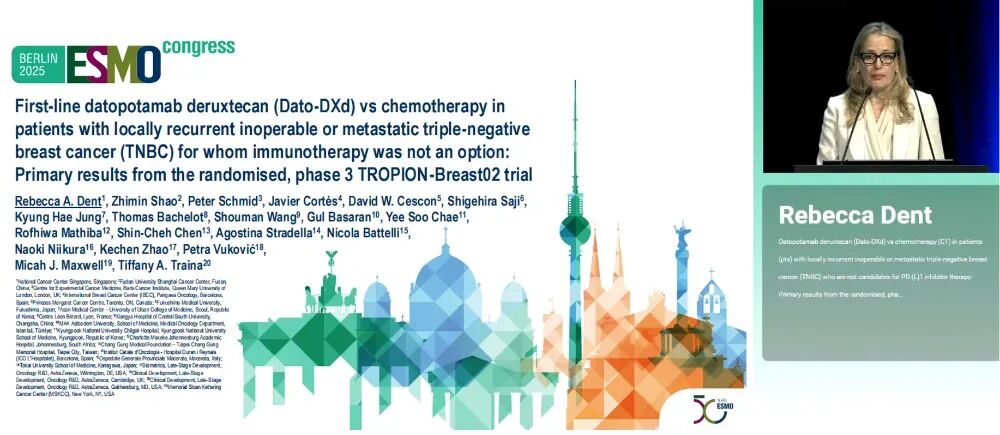
A Promising First-Line Option: Dato-DXd Brings New Hope for TNBC Patients Ineligible for Immunotherapy
TROPION-Breast02 is an open-label, randomized, Phase III trial that enrolled adult patients with inoperable locally recurrent or metastatic TNBC who were ineligible for immunotherapy and had not received prior treatment for advanced disease. Participants were randomized 1:1 to receive either Dato-DXd (6 mg/kg IV Q3W) or investigator’s choice of chemotherapy (ICC) — nab-paclitaxel, capecitabine, eribulin mesylate, or carboplatin.
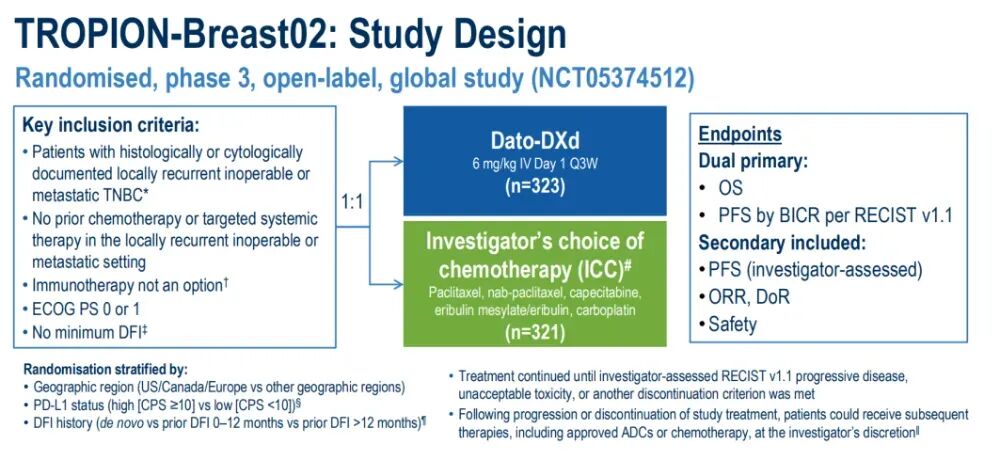
Figure 1: TROPIONBreast02 Research Design
The dual primary endpoints were overall survival (OS) and progression-free survival (PFS), assessed by blinded independent central review (BICR) according to RECIST v1.1.
Efficacy Results
A total of 644 patients were randomized (Dato-DXd, n=323; ICC, n=321). As of the data cut-off on August 25, 2025, the median follow-up was 27.5 months.
Compared with ICC, Dato-DXd achieved statistically significant and clinically meaningful improvements in both median OS and BICR-assessed median PFS, with an improvement of more than five months in both endpoints:
-
Median PFS: 10.8 months (95% CI, 8.6–13.0) with Dato-DXd vs. 5.6 months (95% CI, 5.0–7.0) with ICC (HR = 0.57; 95% CI, 0.47–0.69; P < 0.0001)
-
Median OS: 23.7 months (95% CI, 19.8–25.6) with Dato-DXd vs. 18.7 months (95% CI, 16.0–21.8) with ICC (HR = 0.79; 95% CI, 0.64–0.98; P = 0.0291)
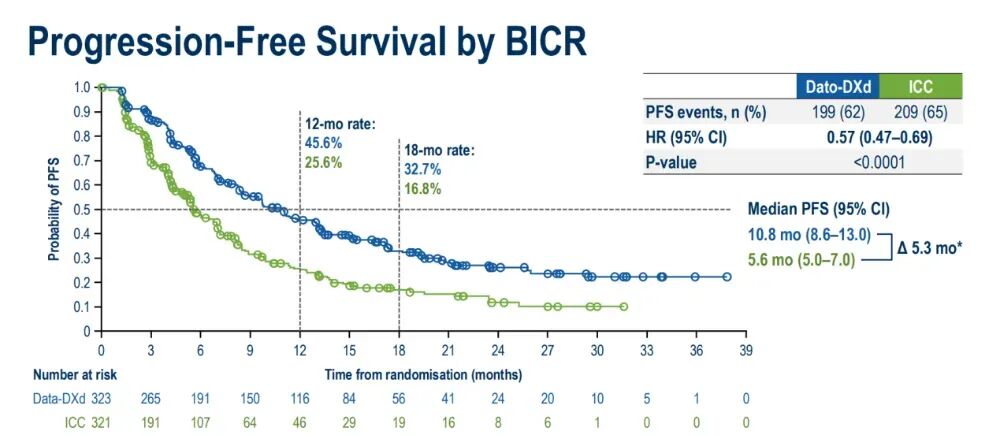
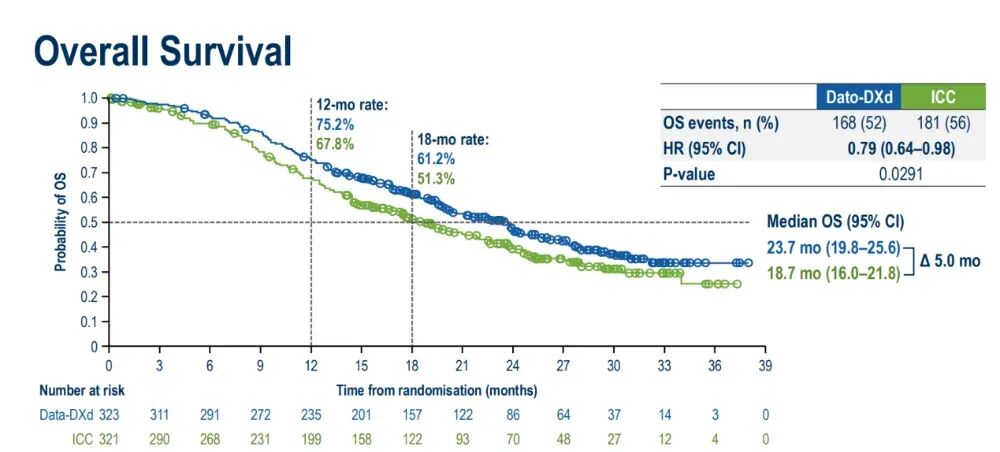
Figure 2: Research Main Result
Both primary endpoints were met, demonstrating a consistent and durable clinical benefit across key subgroups.
Safety Profile
The safety profile of Dato-DXd was manageable and consistent with its known characteristics. Notably, although the median treatment duration in the Dato-DXd group was more than twice as long as that in the ICC group (8.4 vs. 4.1 months), the incidence of Grade ≥3 treatment-related adverse events (TRAEs) was comparable between groups, and treatment discontinuations due to TRAEs occurred less frequently with Dato-DXd.
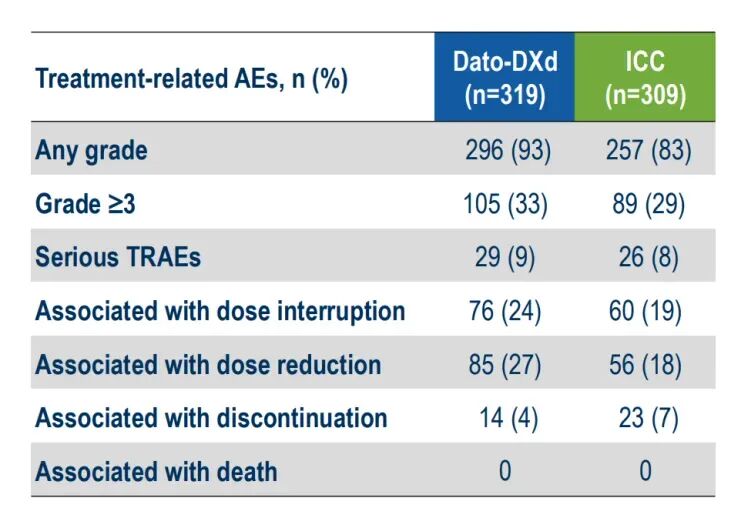
Figure 3: Data of Safety
Dr. Rebecca A. Dent stated during her presentation: “The TROPION-Breast02 study met both primary endpoints. First-line Dato-DXd showed statistically significant and clinically meaningful improvements in both overall and progression-free survival compared with investigator’s choice of chemotherapy. These results support Dato-DXd as a new standard of care for patients with inoperable locally recurrent or metastatic TNBC who are not eligible for immunotherapy.”
Previously, at the ESMO 2023 Breast Cancer Congress, the TROPION-Breast01 trial first reported positive results for PFS in a late-breaking abstract. Dato-DXd significantly improved BICR-assessed median PFS versus ICC (6.9 vs. 4.9 months; P < 0.0001), reducing the risk of disease progression or death by 37%. The objective response rate (ORR) was also higher with Dato-DXd (36.4% vs. 22.9%).
Reference:
-
Rebecca A. Dent et al.First-line (1L) datopotamab deruxtecan (Dato-DXd) vs chemotherapy in patients with locally recurrent inoperable or metastatic triple-negative breast cancer (mTNBC) for whom immunotherapy was not an option: Primary results from the randomised, phase III TROPION-Breast02 trial 2025 ESMO, LBA21.

