


Recently, a research team led by Prof. Li Zhang and Prof. Wenfeng Fang from the Sun Yat-sen University Cancer Center published online in the prestigious international journal Cancer Cell a study titled “Targeting TROP2 on Drug-Tolerant Persister (DTP) Cells Delays Resistance to EGFR Tyrosine Kinase Inhibitors (EGFR-TKIs) in Non-Small Cell Lung Cancer (NSCLC).” This study, for the first time, elucidates at the mechanistic level the molecular basis underlying the synergistic enhancement of TROP2-ADC and EGFR-TKI in overcoming TKI resistance. It also marks the fifth time that Chinese researchers have reported findings on datopotamab deruxtecan in top-tier international journals. This achievement signifies China’s continued global leadership in translational research across the entire spectrum of EGFR-mutated non-small cell lung cancer.
EGFR-TKIs are the first-line standard of care for advanced EGFR-mutant NSCLC, rapidly shrinking tumors and significantly prolonging patient survival. However, after long-term use, most patients still develop acquired resistance leading to disease progression—a clinical challenge that remains unsolved. Recent studies have confirmed that drug-tolerant persister (DTP) cells are the key subpopulation driving resistance evolution: these cells do not develop drug resistance through genetic mutations, but rather enter a reversible dormant or low-metabolic state under drug exposure, evading chemotherapy or targeted therapy attacks, and gradually forming a stable resistant phenotype as a "seed reservoir". When drug pressure is removed, DTP cells re-enter the cell cycle and resume proliferation, leading to tumor recurrence. How to precisely intervene in DTP cell survival and delay resistance from the source has become the key to breaking through current efficacy bottlenecks.
The research team approached the problem through three progressive layers: mechanistic understanding, strategic innovation, and clinical validation, unraveling the mystery of targeted therapy resistance in EGFR-mutant NSCLC.
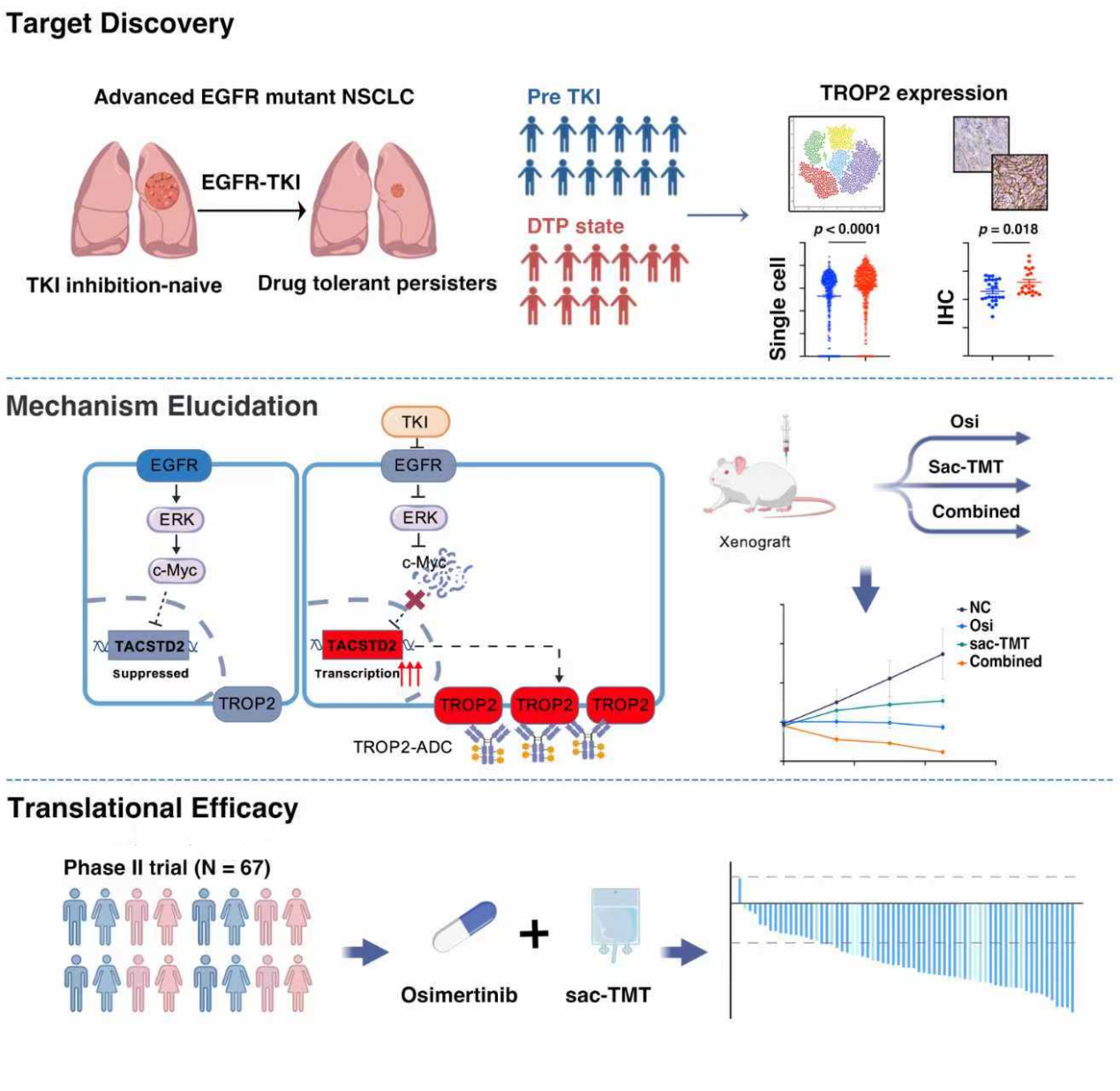
Target Discovery: TROP2 Is a Potential Therapeutic Target in EGFR-TKI-Induced DTP Cells
To explore potential therapeutic targets in EGFR-TKI-induced DTP cells, the research team integrated transcriptomic data from DTP cells derived from H1975, PC9, and PDX models, cross-referenced with the human membrane protein database, and confirmed through multi-model cross-validation and multi-algorithm joint analysis that EGFR-TKI-induced DTP cells commonly exhibit high TROP2 expression, suggesting that this target holds promise for clearing residual tumor lesions.
Mechanistic Understanding: The Molecular Basis for Synergy Between EGFR-TKI and TROP2-ADC
The research team discovered that under normal conditions, the transcriptional repressor c-Myc directly binds to the TROP2 promoter region to suppress its transcription. EGFR-TKI, by inhibiting the MEK/MAPK signaling pathway, downregulates c-Myc expression and relieves c-Myc-mediated transcriptional repression of the TACSTD2 gene (which encodes TROP2), resulting in consistent and dynamic high expression of TROP2 on the surface of DTP cells. This means that TKI treatment itself creates a "surface marker" on residual resistant cells that can be targeted by ADC—a previously unrecognized vulnerability and the theoretical premise for subsequent combination therapy.
Strategic Innovation: Building an "Induce–Target–Kill" Therapeutic Strategy
Osimertinib, while exerting its antitumor effects, actively elevates TROP2 expression levels on DTP cells, and sacituzumab tirumotecan follows closely to efficiently eliminate these cells through ADC mechanisms. This strategy differs significantly from previous intervention approaches targeting intracellular kinases such as AXL and FGFR, which tend to induce compensatory resistance in tumors. In contrast, this approach does not directly inhibit intracellular signaling pathways but instead targets the surface antigens induced by therapy, theoretically circumventing classical compensatory mechanisms. Both in vitro and in vivo preclinical models have confirmed that the combination regimen effectively clears DTP cells, significantly delays post-withdrawal recurrence, and has manageable combination safety.
Clinical Validation: Phase II Study Demonstrates Potent Synergistic Antitumor Potential
In 67 previously untreated patients with advanced EGFR-mutant NSCLC, osimertinib was administered orally daily combined with sacituzumab tirumotecan intravenously every two weeks (at three dose levels: 3, 4, and 5 mg/kg). The overall response rate (ORR) for the entire cohort reached 73.1%, with a disease control rate (DCR) of 97.0%, and the median progression-free survival (PFS) has not yet been reached—representing a significant survival improvement compared with historical data for osimertinib monotherapy. Regarding safety, no unexpected adverse events were observed; grade 3–5 adverse events were predominantly neutropenia and stomatitis, with no treatment-related deaths.
To further solidify high-level evidence and establish the first-line treatment value of combination therapy, the team has initiated a Phase III randomized controlled clinical trial (NCT06670196) directly comparing the efficacy and safety of lurotuzumab mertansine combined with osimertinib versus osimertinib monotherapy as first-line treatment for locally advanced or metastatic EGFR-mutated NSCLC. This trial aims to definitively clarify the clinical utility of the combination regimen. Concurrently, a Phase II study (NCT07329322) evaluating neoadjuvant lurotuzumab mertansine combined with osimertinib or lurotuzumab mertansine monotherapy in resectable EGFR-mutated NSCLC has also commenced.
In summary, this study achieves a comprehensive and robust set of findings—from mechanistic breakthroughs to clinical trial implementation—fully embodying the translational medicine principle of from clinic to clinic.Moreover, it pioneers a novel paradigm for overcoming drug resistance by targeting therapy-induced surface antigens, opening up entirely new avenues for global research on tumor drug resistance and demonstrating the international impact of China-developed diagnostic and therapeutic strategies. It also holds promise for offering more effective and safer treatment options for lung cancer patients worldwide.
Dr. Jun Liao (Sun Yat-sen University Cancer Center), Prof. Wenxiu Yao (Sichuan Cancer Hospital), Prof. Yu Yan (The Tumor Hospital Affiliated to Harbin Medical University), Dr. Anlin Li (Sun Yat-sen University Cancer Center), and Dr. Jie Huang (Sun Yat-sen University Cancer Center) are co-first authors of this paper. Prof. Li Zhang, Prof. Wenfeng Fang, Chief Physician Yunpeng Yang, and Associate Chief Physician Shaodong Hong (all from Sun Yat-sen University Cancer Center) are co-corresponding authors of this paper.

