


Background and Unmet Need
Recently, the updated 39.4‑month long‑term follow‑up data from the phase‑II TRAILBLAZER study led by Wu Yilong’s research group was published in *Signal Transduction and Targeted Therapy*. This marks the world’s first three‑year long‑term survival evidence for initially unresectable stage‑III non‑small‑cell lung cancer (NSCLC) adopting neoadjuvant dual‑target immune induction followed by risk‑stratified selection between surgery or radiotherapy.
Approximately one-third of patients with non-small cell lung cancer (NSCLC) present with Stage III disease, and a substantial fraction of these tumors are classified as unresectable at diagnosis. The current standard of care, concurrent chemoradiotherapy followed by consolidation PD-L1 blockade as established by the PACIFIC regimen, provides durable benefit for many patients, but long-term survival remains limited, particularly among those with high-risk features such as squamous histology, advanced nodal disease, or contraindications to radiotherapy. Sequential refinements, including concurrent chemoradiation plus immune checkpoint inhibition (PACIFIC-2, CheckMate 73L), have so far not produced consistent additional survival gains, leaving the management of unresectable Stage III NSCLC an area of active investigation.
Key Findings From TRAILBLAZER
The Phase II TRAILBLAZER trial, led by Yi-Long Wu and colleagues, evaluated an alternative paradigm: neoadjuvant induction with retlirafusp alfa, a bifunctional fusion protein that simultaneously targets PD-L1 and TGF-β, followed by multidisciplinary team (MDT)-guided local therapy and consolidation treatment. The trial enrolled 74 patients with initially unresectable Stage III NSCLC at multiple Chinese centers; 74% had squamous histology and 74% had Stage IIIB or IIIC disease. EGFR- and ALK-driven tumors were excluded.
Patients with PD-L1 expression below 50% received retlirafusp alfa plus platinum-based chemotherapy, while those with PD-L1 expression of 50% or higher received retlirafusp alfa alone (n=10). In the main chemotherapy-combination cohort, at a median follow-up of 39.4 months, the 3-year event-free survival (EFS) rate reached 50.5% and the 3-year overall survival (OS) rate reached 68.3%, exceeding historical PACIFIC benchmarks by approximately 10.8 and 11.6 percentage points, respectively, in the authors' indirect comparison. Survival curves appeared to plateau after roughly two years, a pattern not typically seen with definitive chemoradiotherapy. In the small PD-L1 ≥50% monotherapy cohort, 3-year OS reached 87.5%.
The most striking finding is that 25% of patients initially judged to have unresectable disease achieved R0 (complete, margin-negative) surgical resection following dual-target immune induction. Among resected specimens, major pathological response (MPR) was observed in 44% and pathological complete response (pCR) in 26%. Patients who underwent conversion surgery had substantially higher 3-year EFS and OS than those who proceeded to radiotherapy, and their survival outcomes were comparable to those reported in resectable Stage III NSCLC treated with frontline neoadjuvant chemoimmunotherapy in the authors' analysis.
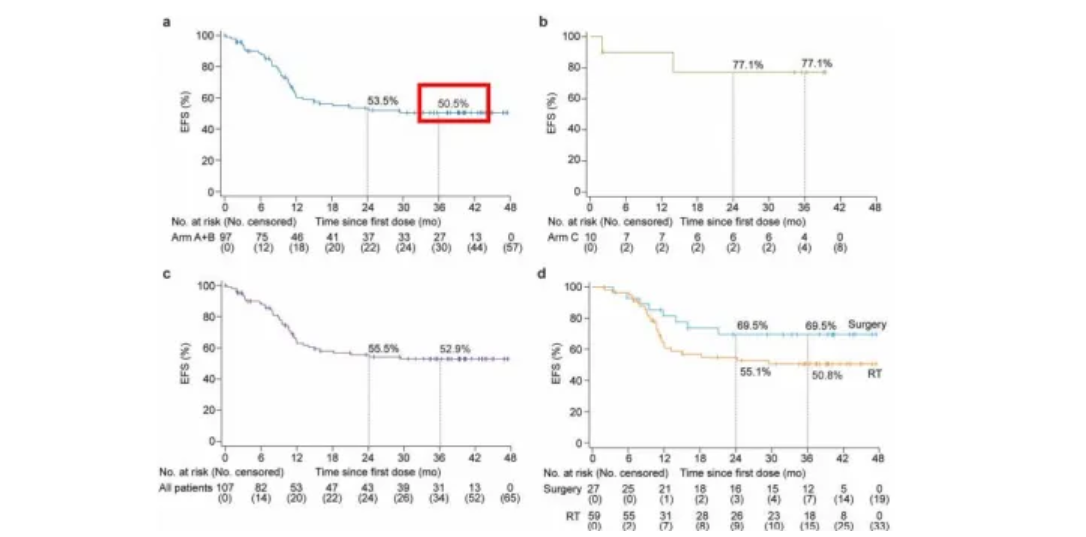
Figure.1.Kaplan Meier Analysis of Event Free Survival (EFS) for the Primary Cohort Receiving Immunotherapy Combined with Chemotherapy (a), the Neoadjuvant Group Treated with Retifanlimab α Monotherapy (b), All Enrolled Patients (c), and Patients Who Underwent Local Therapy (d)
Mechanistic Rationale
Retlirafusp alfa is a bifunctional fusion protein that pairs an anti-PD-L1 antibody with a TGF-β trap. TGF-β is a pleiotropic cytokine frequently enriched in the NSCLC tumor microenvironment and is known to promote immune exclusion, stromal fibrosis, and resistance to PD-(L)1 blockade. Co-targeting PD-L1 and TGF-β is designed to address the principal mechanisms of immune escape and primary resistance that limit single-agent PD-(L)1 inhibitors in locally advanced disease.
Sequencing immune induction before any local therapy preserves lymphatic drainage architecture and may permit broader systemic priming of tumor-specific T cells, in contrast with concurrent or sequential chemoradiotherapy approaches. In the small PD-L1 ≥50% monotherapy cohort, the 3-year OS of 87.5% suggests that chemotherapy may be dispensable in biomarker-defined subsets, although the limited sample size constrains the strength of this observation.
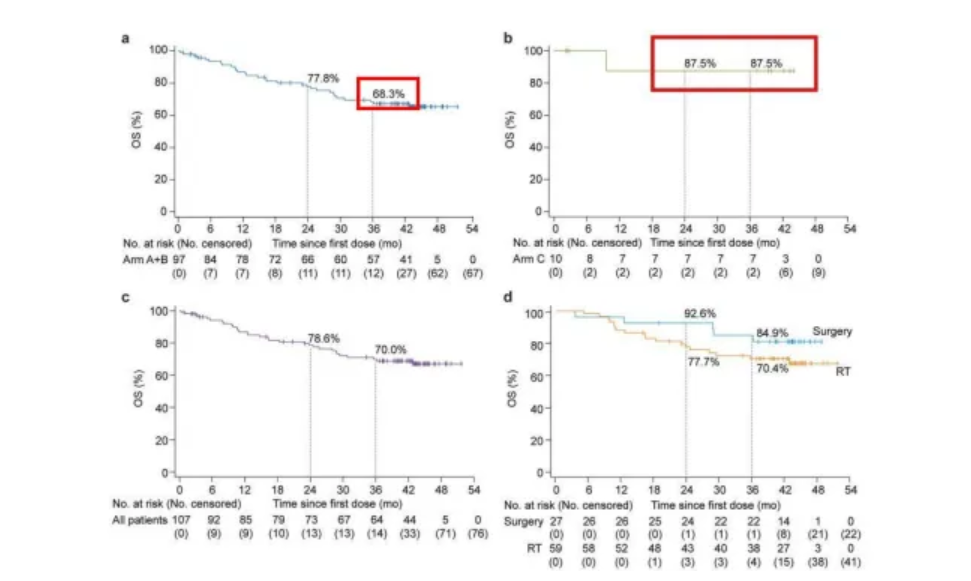
Figure.2.Kaplan Meier Analysis of Overall Survival (OS) for the Primary Cohort with Immunotherapy Chemotherapy Combination (a), the Neoadjuvant Retifanlimab α Monotherapy Group (b), All Patients (c), and Patients Receiving Local Therapy (d)
Translational Implications
If validated, biomarker-stratified neoadjuvant induction followed by dynamic MDT-based local treatment decisions could constitute a third treatment paradigm for locally advanced NSCLC, complementing PACIFIC-style chemoradiation consolidation and direct surgery. The concept of converting initially unresectable disease to surgery, long applied in oligometastatic and select locally advanced settings, has not previously been supported by prospective data in unresectable Stage III NSCLC. TRAILBLAZER provides an initial prospective signal that this approach may be feasible in a meaningful minority of patients, and it may support a rationale for further evaluation in larger studies.
Current Clinical Evidence
The data derive from a single-arm, non-randomized Phase II trial conducted exclusively at Chinese centers. There is no concurrent comparator arm, and the apparent survival gains relative to PACIFIC are based on indirect, historical comparisons. Standardized biomarker analyses, including TGF-β pathway activity, T-cell infiltration, and resistance signatures, were not reported in this update. The PD-L1 ≥50% monotherapy cohort enrolled only 10 patients, and the apparent survival benefit in this subgroup should be considered hypothesis-generating.
Safety was generally consistent with the known profile of PD-(L)1 inhibitors. No new-onset grade 3-5 immune-related pneumonitis was observed, no treatment-related deaths occurred, and serious adverse events were predominantly hematologic and considered manageable.
Limitations and Next Steps
Several caveats deserve emphasis. First, the single-arm, non-randomized design limits attribution of clinical benefit to retlirafusp alfa specifically, and unmeasured confounding cannot be excluded. Second, local treatment allocation was determined by individual center MDTs rather than by a uniform protocol, introducing heterogeneity into comparisons between surgical and radiotherapy arms. Third, biomarker analyses, particularly of the TGF-β pathway, were not performed in this update, leaving the proposed mechanism incompletely characterized. Fourth, the trial enrolled only patients from China, and the high prevalence of squamous histology (74%), the absence of EGFR- and ALK-driven tumors, and the limited representation of adenocarcinoma restrict generalizability to Western populations, in which adenocarcinoma and oncogenic drivers are more common. Finally, with only 10 patients in the PD-L1 ≥50% monotherapy arm, biomarker-defined subgroup conclusions require confirmation.
These findings warrant validation in a randomized Phase III trial with an active comparator, such as concurrent chemoradiotherapy followed by consolidation durvalumab, together with prospective biomarker integration. Until such data are available, the role of neoadjuvant retlirafusp alfa in unresectable Stage III NSCLC should be considered investigational.
Reference
1.Pan Y, Yang X, Zhou Q, et al. Neoadjuvant retlirafusp alfa (anti-PD-L1/TGF-β bifunctional fusion protein) with or without chemotherapy in unresectable stage III non-small cell lung cancer: updated results from the phase 2 TRAILBLAZER trial. *Signal Transduction and Targeted Therapy*. 2026;11:239.

