


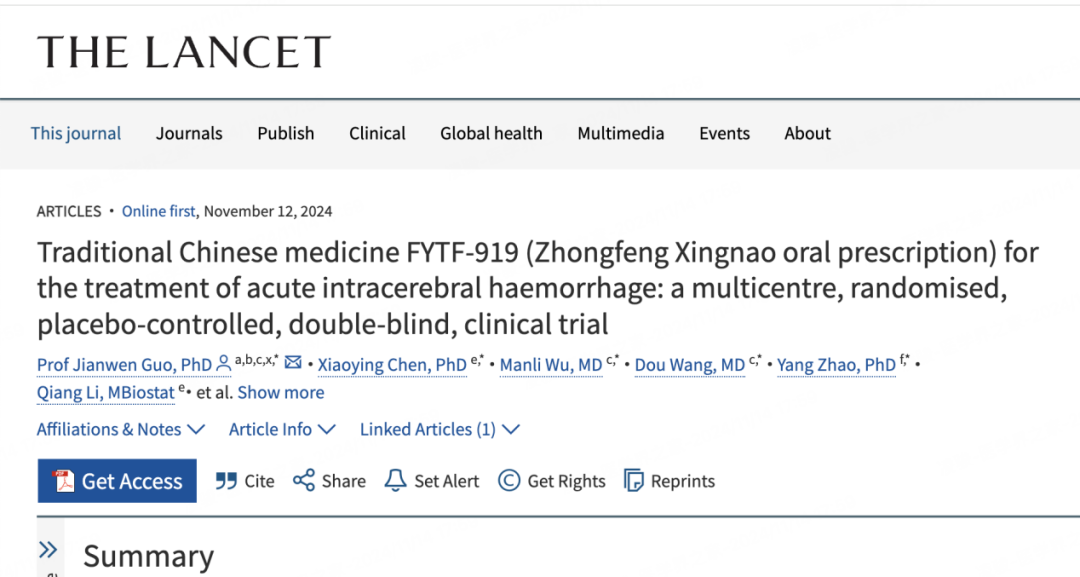
On November 13th, The Lancet, an international top-tier journal that has been published for 201 years, published a multicenter clinical study of a traditional Chinese medicine for the first time. The subject of the study was the traditional Chinese medicine compound, stroke awakening liquid (FYTF-919), developed by Professor Chen Shaohong, a national medical master, which has been used clinically for the treatment of acute cerebral hemorrhage for over 20 years.
To study its safety and efficacy, the team led by Guo Jianwen from Guangdong Provincial Hospital of Traditional Chinese Medicine, Song Lili and Craig Anderson from Fudan University, conducted a randomized double-blind controlled trial. Starting from 2021, they selected 1,648 patients with acute cerebral hemorrhage from 9,000 cases in 26 hospitals across the country.
The study results showed that, compared to the placebo group during the follow-up period, the stroke awakening liquid did not improve the functional recovery, survival rate, and health-related quality of life of patients with moderate to severe cerebral hemorrhage.
Multicenter Clinical Trial of Traditional Chinese Medicine
Stroke awakening liquid is a traditional Chinese medicine preparation composed of four types of traditional Chinese herbs, with the main ingredients including red ginseng, Sanqi, Chuanxiong, and Dahuang.
In this trial, the researchers recruited 1,648 patients with an average age of 67.1 years. They were diagnosed with symptomatic spontaneous intracerebral hemorrhage within 48 hours of symptom onset, leading to moderate to severe neurological dysfunction, manifested as a score of at least 8 on the National Institutes of Health Stroke Scale (NIHSS) or a score between 7 and 14 on the Glasgow Coma Scale (GCS).
After controlling for variables such as age, gender, and whether they had undergone surgery, and with all patients receiving standard treatment and medical care, 817 patients were treated with stroke awakening liquid, while another 831 were assigned to the placebo group. The main index examined was the utility-weighted mRS score of the patients at 90 days. mRS is a scale used to assess the recovery of neurological function in stroke patients.
The principal author of the study, Professor Guo Jianwen from Guangdong Provincial Hospital of Traditional Chinese Medicine, introduced to the media that the production of the placebo was a major challenge in this trial - it had to ensure safety and be identical to the stroke awakening liquid in color, taste, smell, and other comprehensive properties.
Ultimately, the team collaborated with a food industry company in Guangzhou and spent nearly a year overcoming the technical challenges. The study stated that the placebo is a plant-flavored solution with no pharmacological activity. It is composed of soy peptides and black syrup, food-grade flavorings and maltodextrin, salt, and monosodium glutamate, and is well-matched with the stroke awakening liquid in appearance, smell, and taste.
The study results showed that at 90 days, there was no difference in the average utility-weighted mRS scores between the stroke awakening liquid treatment group and the placebo group, both with a score of 0.44. In secondary endpoints, including the utility-weighted mRS score at 180 days, the mRS raw analysis at 28 days, 90 days, and 180 days, as well as mortality and disability rates, there were no statistically significant differences.
The "safety" and "subgroup analysis" results showed that neither adverse events nor serious adverse events indicated that the stroke awakening liquid would pose an additional health risk to patients.
In the subgroup analysis, patients with cerebral hemorrhage volumes greater than 15ml and lobar hemorrhage showed significant heterogeneity in treatment effects, suggesting that the stroke awakening liquid might be effective for this group of patients. However, the researchers also emphasized that due to the small sample size and other reasons, this finding is not reliable at present and requires further research and argumentation.
The researchers stated that the study had certain limitations, mainly that it did not fully consider the differences among different ethnic groups and different rescue systems worldwide.
In a comment article published in the same issue, The Lancet wrote: "The CHAIN trial, which assessed the efficacy and safety of traditional Chinese medicine for the treatment of cerebral hemorrhage using an evidence-based research framework, provided a scientific evidence-based method for assessing traditional Chinese medicine."
Stroke Awakening Liquid has been used clinically for over 20 years
The history of stroke awakening liquid can be traced back more than 30 years when Chen Shaohong was the director of the emergency department at Chengdu University of Traditional Chinese Medicine Affiliated Hospital. In the emergency center, he observed that cerebrovascular diseases were the most common, with cerebral stroke being a disease with a very high mortality and disability rate.
At that time, there were not many good treatments for cerebral stroke. Chen Shaohong combined traditional Chinese medicine theory and clinical practice to propose that the basic pathogenesis of cerebral stroke was "deficiency of vital energy as the root, with qi deficiency leading to blood stasis, blood stasis leading to phlegm, phlegm leading to fire, and fire leading to wind," and formulated the treatment of "restoring vitality and awakening the brain, expelling blood stasis and transforming phlegm, and purging heat and extinguishing wind," attempting to protect the undamaged brain cells of the patient as much as possible.
In 1986, Chen Shaohong applied his theory and prescribed a formula with 11 medicinal materials for a comatose acute cerebral hemorrhage patient, which became the prototype of the stroke awakening liquid. According to the hospital's promotional reports, the patient recovered after one month.
In 1988, the research on stroke awakening liquid was initiated and received funding. Chen Shaohong also improved it over the next decade, reducing the prescription from the original 11 to 4.
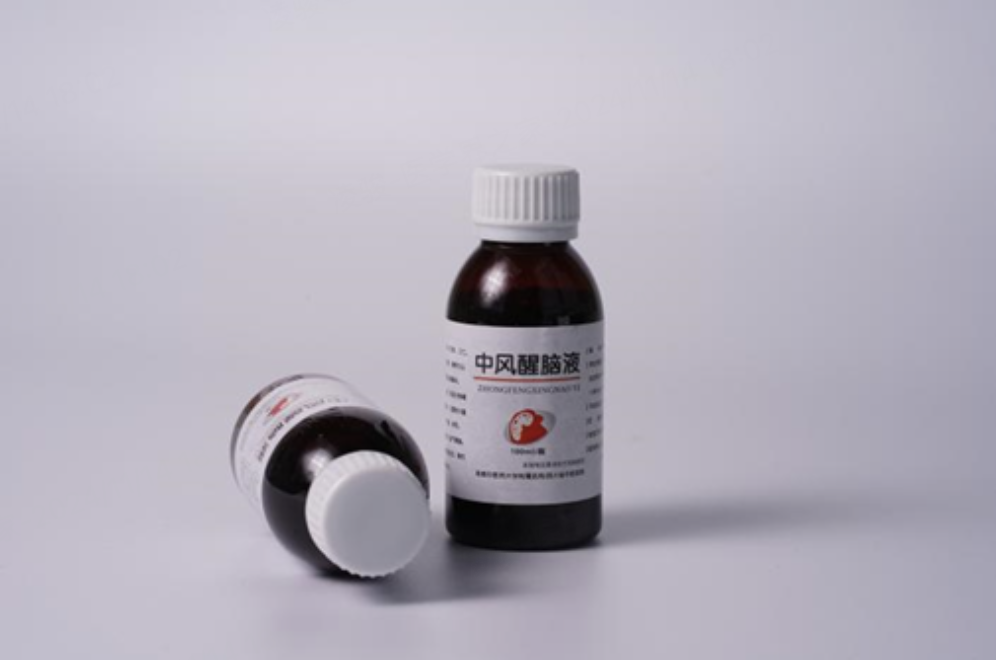
Image source: Affiliated Hospital of Chengdu University of Traditional Chinese Medicine
According to the official website of Chengdu University of Traditional Chinese Medicine Affiliated Hospital, stroke awakening liquid is currently one of the most popular in-house preparations in the hospital, with the function of invigorating qi and awakening the brain, used for patients with acute cerebral hemorrhage and acute cerebral infarction. It is administered orally or through nasogastric feeding after meals, with cerebral hemorrhage patients taking one bottle a day, divided into 4 doses of 25ml each time, and ischemic stroke patients taking 4 times a day, 20ml each time.
Regarding the pharmacological effects and clinical efficacy of stroke awakening liquid, there have been some animal experiments and small-sample clinical studies published domestically in the past. In May of this year, an experiment with rats published in the "China Journal of Chinese Materia Medica" suggested that stroke awakening liquid could promote the recovery of cerebral hemorrhage damage by inhibiting oxidative stress reactions in neurons and reducing the occurrence of ferroptosis.
In 2023, a master's thesis from the Clinical College of Chengdu University of Traditional Chinese Medicine also showed opposite results to the Lancet study. This study also adopted a randomized double-blind control and included 101 patients from 8 units in the southwest region, showing that after treatment with stroke awakening liquid, the patients' mRS scores, NIHSS scores, disability rates, and self-care abilities all improved.
In fact, before conducting this "Lancet study," the researchers conducted a systematic review and meta-analysis of 9 previous trials (2 of which were placebo-controlled, double-blind), with a total of 1,448 participants, showing that stroke awakening liquid could improve hematoma clearance, reduce patient mortality, and improve recovery after cerebral hemorrhage.
However, the researchers believe that due to the limitations of small sample size, single-center or methodological settings, the evidence level of previous studies is generally not high - which is also one of the reasons they conducted this, so far, the largest and most well-designed large-scale traditional Chinese medicine stroke treatment trial.The researchers stated that this result once again shows the need for scientifically rigorous randomized controlled trials to assess the effectiveness of existing therapies, including traditional Chinese medicines that have been widely used around the world.
After the study was published, Chen Shaohong publicly expressed his hope to further study and observe severely ill patients based on the existing research results, and to accelerate the development of new drugs in terms of drug preparation and toxicology testing.

