


I.TP53: The Most Widespread Cancer Driver Gene
TP53 is the most frequently mutated gene in human cancer, with approximately 36% of all cancer patients carrying TP53 somatic mutations. It is particularly prominent in highly lethal tumor types:
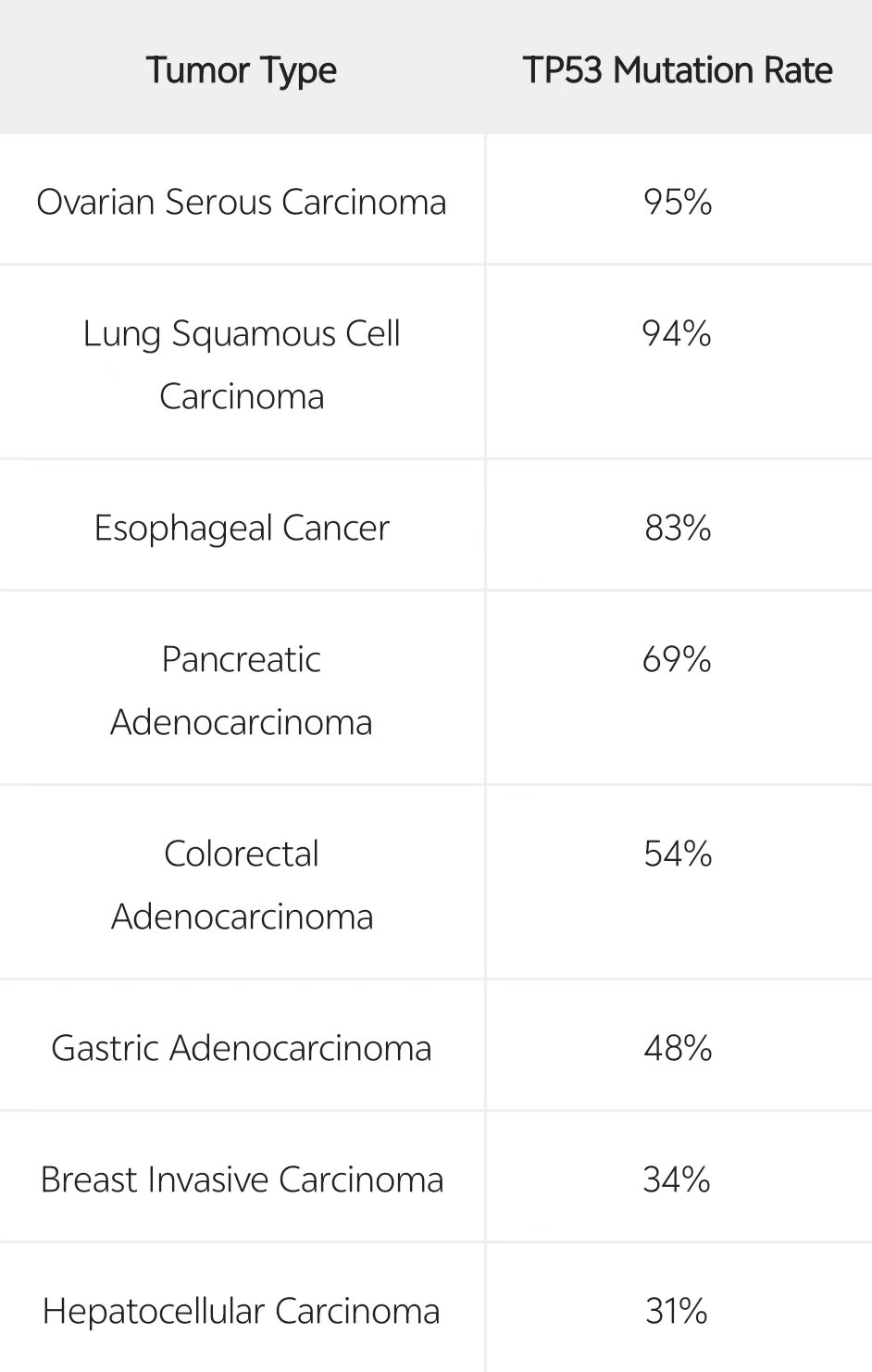
Six hotspot codons (R175, G245, R248, R249, R273, R282) account for nearly 30% of all mutations. By single site, R175H has the highest frequency (~5.5%); R248Q/W and R273H/C are about 3–4%; Y220C is about 2.8%; G245S is about 1.6%.
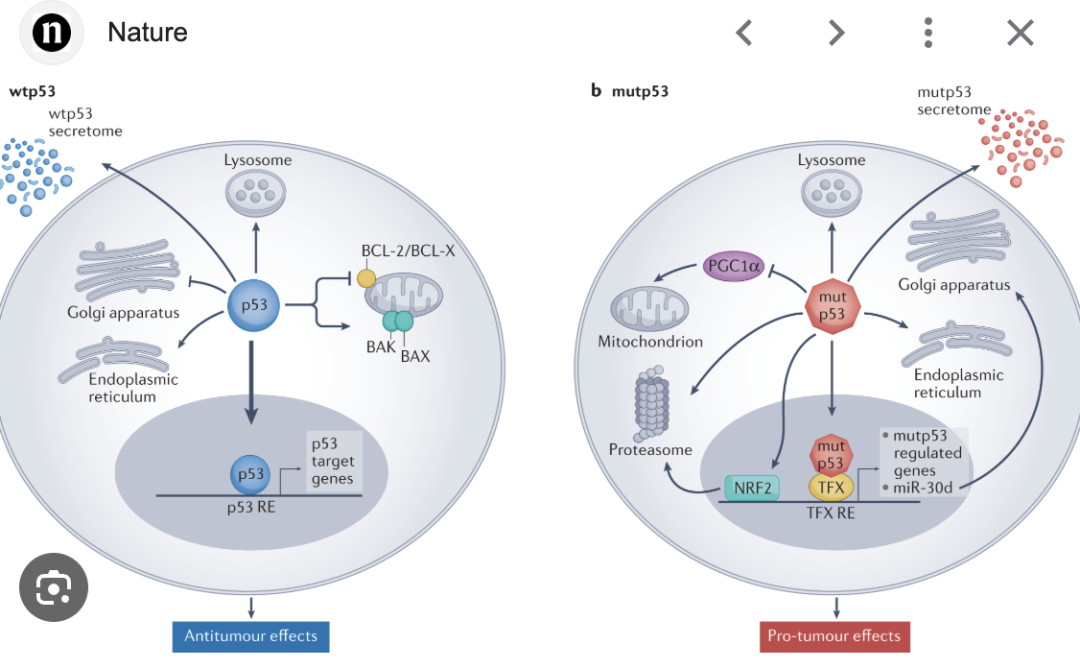 Different mechanisms and ultimate effects of wild-type p53 (wtp53) and mutant p53 (mutp53) in cells
Why is it worth focusing on? TP53 mutations usually occur in the early clonal evolution stage of tumorigenesis and are driver mutations (actively driving tumor development), rather than randomly accumulated “passenger mutations.” Targeting a driver mutation means hitting the tumor’s core dependency, not a peripheral detail. Currently, there are almost no approved TP53 mutation-specific therapies; TP53-mutated patients have a worse prognosis in most tumor types and lower chemosensitivity, making the clinical need extremely urgent.
II. From “Undruggable” to Precision Breakthrough: Key Concepts First
Why was p53 once considered “undruggable”?
p53 is a transcription factor — its function is to bind DNA and initiate downstream gene transcription, rather than to phosphorylate a substrate through a catalytic active pocket like a kinase. Traditional small-molecule drugs are best at “blocking” an enzyme’s active pocket, but directly activating a transcription factor was previously almost impossible. Combined with the fact that p53 functions as a tetramer with an extremely complex structure, early research generally considered it an “undruggable target.”
Why is it now possible?
The turning point came from three cognitive breakthroughs:
① Structural cavities can be filled:
Some TP53 mutations (especially Y220C) create a hydrophobic “cavity” on the protein surface. Filling this cavity with a small molecule can “right” the misfolded protein back into a wild-type conformation, reactivating its tumor-suppressor function — these drugs are called conformational stabilizers/reactivators.
② Mutant peptides is a immune target:
TP53 hotspot mutations generate mutant amino-acid sequences that are processed into short peptides and presented on HLA molecules on the cell surface — the tumor cell essentially displays its “evidence of guilt” on the outside. Engineered T cells can precisely recognize and kill tumor cells carrying the mutation without damaging normal tissue — this is neoantigen immunotherapy.
③ Synthetic lethality strategy:
Rather than repairing p53, we exploit the “loophole” caused by p53 loss to turn the tables.
III. Mutation Subtype Determines Treatment Route
To understand drug design, one must first recognize that TP53 mutations are not monolithic. According to the impact on structure, they mainly fall into two categories:
Conformational mutants: mutations cause errors in three-dimensional protein folding, with the overall structure deviating from wild-type. Representative sites: Y220C (forms a cavity on the protein surface), R175H (affects zinc-ion binding; zinc is a necessary metal cofactor for stabilizing p53 structure), G245S, R282W. For these mutations, one can attempt to use small molecules to “refold” and repair.
DNA-contact mutants: protein folding is largely normal, with only loss of direct DNA-binding ability. Representative sites: R273H, R273C, R248Q, R248W. Folding itself is fine; repairing conformation is meaningless, and the main strategies are to degrade the mutant protein or to use synthetic lethality.
IV. Detailed Clinical Progress by Subtype
Y220C: Most Mature Progress, NDA Imminent
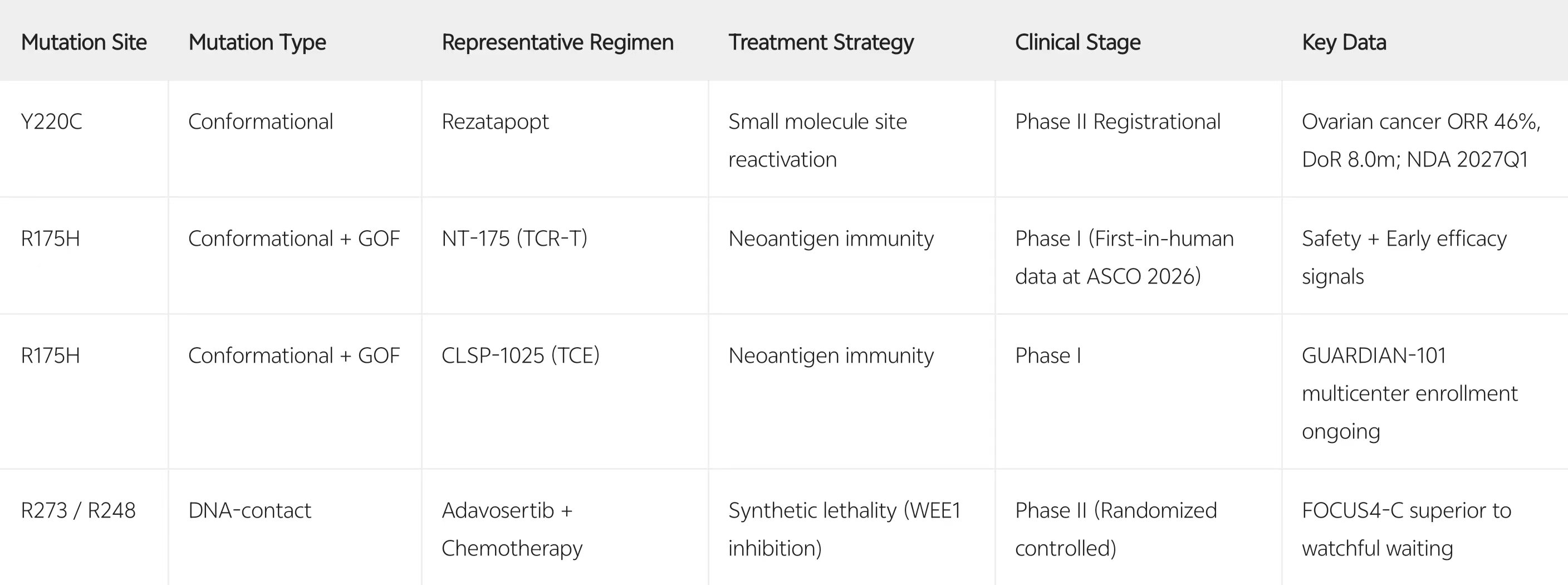
Rezatapopt (PC14586) is the current representative TP53-mutation targeted drug, administered orally and specifically designed for Y220C.
Mechanism: The Y220C mutation creates an approximately 6 Å hydrophobic cavity on the surface of the p53 DNA-binding domain, and overall protein thermal stability decreases. Rezatapopt fills this cavity through covalent binding, “locking” the unstable mutant p53 back into a wild-type conformation, and restoring its transcription-activation and apoptosis-induction functions. This mechanism is strictly site-specific — it is effective only for Y220C, and not for other sites.
Phase 1 (NEJM, published March 2026):
- l 71 evaluable patients, median3 prior lines of therapy (range1–9)
- l Overall ORR 19.7%, median DoR 7 months, median PFS 4.3 months, median OS 11.4 months
- l All responders were KRAS wild-type; responding tumor types included ovarian (7), breast (3), and1 each of endometrial, head and neck, prostate, and small cell lung cancer.
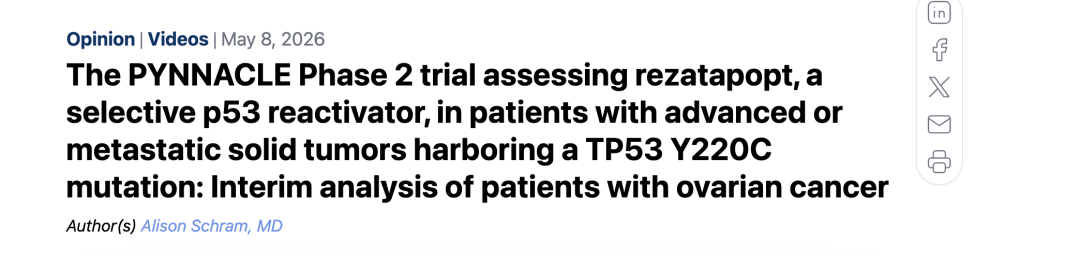
Phase II PYNNACLE Pivotal Trial (data cutoff September4, 2025):
- l 103 evaluable patients, overall ORR 34%
- l Ovarian cancer cohort ORR 46% (22/48), median DoR 8.0 months, median time to response only 1.3 months, 1 complete response (CR)
- l Endometrial cancer ORR 60% (small sample), lung cancer 21%, breast cancer 17%
- l Responses observed after prior bevacizumab or PARP inhibitor failure
- l NDA planned for Q1 2027 (indication: platinum-resistant/refractory ovarian cancer); FDA Fast Track designation already granted. TP53 gene also has targeted drugs; cancer may soon be conquered.
Issues to watch:
A2026 Nature sub-journal study confirmed that some patients rapidly acquire secondary TP53 second-site mutations during treatment, leading to resistance. This “single-site dependency” is an inherent vulnerability of site-specific strategies; second-generation regimens and combination strategies are the next core research directions.
R175H Neoantigen Immunotherapy Enters the Clinic: First Reported at ASCO 2026
Why is R175H leveraged as an immune target? The R175H mutation generates a peptide sequence different from wild-type, and this peptide can be presented on the tumor cell surface by the HLA-A*02:01 molecule (a common HLA subtype). Because large numbers of patients share the same mutation site and the same HLA type, this mutant peptide is called a “public neoantigen”— the same TCR can recognize R175H-positive tumor cells from different patients and different tumor types, holding “universal” development value.
Representative drug NT-175 (AstraZeneca/Neogene): an autologous TCR-T cell therapy. The specific workflow: collect the patient’s peripheral blood T cells → engineer them in vitro to introduce a TCR specific for the R175H-HLA-A*02:01 complex → simultaneously knock out TGF-β receptor I (enhancing T-cell persistence in the tumor microenvironment and countering solid-tumor immunosuppression) → expand in vitro and reinfuse into the patient. The engineered T cells only kill tumor cells presenting the R175H mutant peptide on their surface, without attacking normal tissue (normal cells do not present this mutant peptide).
The2026 ASCO Annual Meeting (Abstract 2506, presented by Prof. Rishi Surana of Dana-Farber Cancer Institute/Harvard Medical School) first disclosed phase 1 human data: acceptable safety, with early efficacy signals observed, an important milestone in the R175H neoantigen route’s journey from preclinical to human validation.
CLSP-1025 (Clasp Therapeutics): also targets the R175H-HLA-A*02:01 complex, but adopts a bispecific T-cell engager (TCE) approach — a protein drug that recognizes the R175H mutant peptide–HLA complex on tumor cells on one end, and binds the CD3 molecule on T cells on the other end, “pulling” T cells next to tumor cells to exert killing. Compared with TCR-T, TCE is an off-the-shelf biologic that does not require individualized manufacturing. GUARDIAN-101 phase1 (NCT06778863, reported at AACR 2025) is enrolling at multiple centers including Dana-Farber, MSKCC and UCSF.
R273/R248 DNA-Contact Mutants: Synthetic Lethality Strategy
What is synthetic lethality?
Cancer cells have already inactivated gene A (e.g., TP53 loss-of-function) through mutation, while normal cells retain intact gene A; we use drugs to artificially inhibit its backup gene B, cancer cells lose both A and B → die; normal cells retain A and only have B inhibited, and are not damaged. achieving achieving precise cancer-killing without harming normal tissue.
Because TP53-mutated tumor cells have naturally “knocked out” p53 function, they already have defects in certain DNA damage repair or cell-cycle checkpoints. If drugs are used to target another “lifeline” gene, a fatal blow can be dealt to tumor cells, while normal cells — with intact p53 and backup mechanisms — are relatively spared.
For TP53-mutated tumors, a key synthetic-lethality target is WEE1 kinase:
Normal cells have two DNA-damage “brakes”:
G1/S checkpoint:
Mediated by p53; upon DNA damage, prevents cells from entering S phase (DNA replication) from G1.
G2/M checkpoint:
Mediated by WEE1 kinase (phosphorylates and inhibits CDK1); prevents cells from entering mitosis with unrepaired DNA.
TP53-mutated tumor cells lose the G1/S checkpoint and retain only G2/M as their final brake. At this point, a WEE1 inhibitor (adavosertib/AZD1775) cuts off the G2/M checkpoint, and tumor cells carrying extensive DNA damage are forced into mitosis, cannot divide correctly, and ultimately undergo mitotic catastrophe. Normal cells — with intact p53 and a functioning G1/S checkpoint — suffer relatively limited damage.
Clinical evidence: The FOCUS4-C randomized controlled trial (published in JCO) confirmed that adavosertib plus chemotherapy was significantly superior to active surveillance in TP53/RAS co-mutated metastatic colorectal cancer, providing randomized controlled data to support the synthetic-lethality strategy. Phase2 activity data also exist in TP53-mutated ovarian and head-and-neck cancers.
In addition, TCR-T therapies targeting the R248Q neoantigen are in early-stage research (anti-tumor efficacy data published in PMC in 2025), suggesting that DNA-contact mutants also have neoantigen immunotherapy potential.
V. Progress Panorama (as of August 2026)
VI. Summary
TP53-targeted therapy is gradually emerging from the historical predicament of being “undruggable,” and is advancing along three parallel tracks:
- l Small-molecule conformational repair
- l Neoantigen immunotherapy — TCR-T cell therapy
- l Synthetic lethality
The patient populations suitable for the three routes do not overlap, and together they are expected to cover most of the important sites in the TP53 mutation spectrum. Although most clinical progress is still at a relatively early stage, we can remain hopeful — more excellent data may be gradually disclosed.
Reference Sources
- l Rezatapopt NEJM Phase 1 — Healio 2026
- l PYNNACLE Phase 2 Ovarian ORR 46% — PMV Press Release
- l PYNNACLE Phase 2 Ovarian Subgroup — OncLive
- l NT-175 ASCO 2026 — pharmaphorum
- l CLSP-1025 GUARDIAN-101 — NCI
- l Rezatapopt Resistance Mechanism — Nature Signal Transduction 2026
- l WEE1 Inhibitor Synthetic Lethality Mechanism — PubMed 2025
- l FOCUS4-C Randomized Trial — JCO
- l TP53 Mutation Frequencies by Tumor Type — PMC
- l p53 Immunotherapy Review — Frontiers Immunology 2026

