


On December 20th, Oregon Health & Science University announced the passing of Lasker Basic Medical Research Award recipient and pioneer in cardiac medicine, Professor Albert Starr, on December 11th, at the age of 98.
Throughout his career spanning over half a century, Starr made outstanding contributions to human medicine. He ushered in a new era of artificial heart valve replacement, performing the world's first artificial mitral and tricuspid valve replacements, and laid the foundation for the development of heart valves for future generations. This changed medical history and saved the lives of millions.
Steve Stadum, Acting President of Oregon Health & Science University, said, "Starr embodied the highest qualities of a physician, innovator, and teacher. His decades of dedication impacted the lives of countless patients and families around the world."
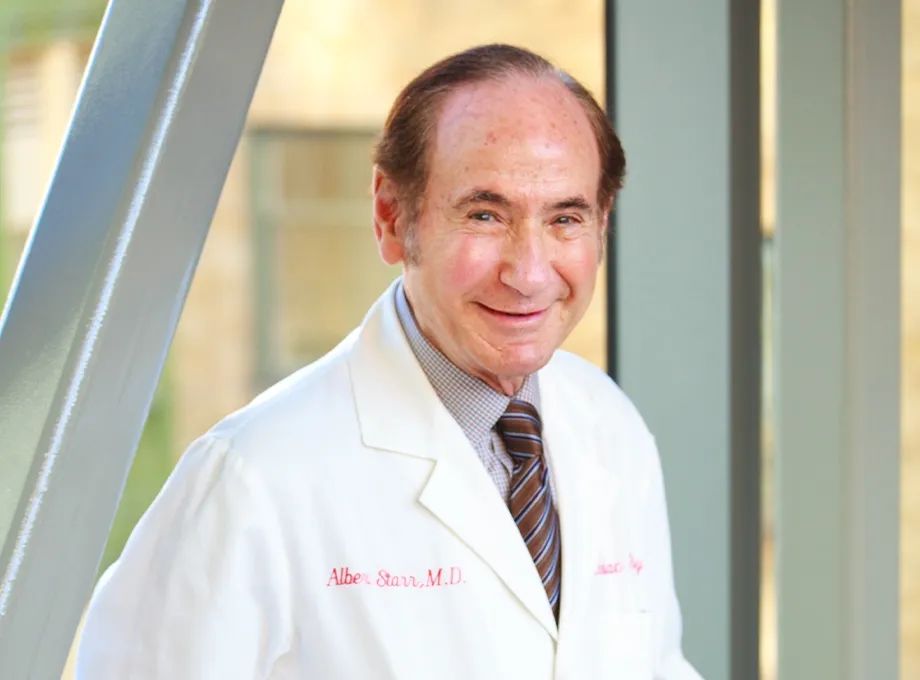
Professor Albert Starr / Photo Source: Oregon Health & Science University
"My greatest fear was to be obscure."
Born in New York in 1926, Starr received his basic education in public schools there. He loved literature, biology, and music. In the era when jazz was sweeping the United States, the young Starr played the piano in a band, performing everywhere and earning his college tuition.
In 1942, at the age of 16, Starr was admitted to Columbia University with excellent grades, majoring in liberal arts. Looking back, Starr was grateful for the guidance of his teachers, a group of experts who loved literature and art. Their critical thinking and humanistic spirit had a profound impact on Starr's future medical thinking and exploration.
In the fields of science and medicine, it was the time of the Manhattan Project in the United States, with universities filled with professors engaged in molecular physics research. However, when choosing his future direction, Starr was particularly fond of biology and medicine. After graduating in 1946 at the age of 20, Starr entered Columbia University College of Physicians and Surgeons and obtained his medical degree three years later.
In the following years, Starr completed his internship and thoracic surgery residency training at Johns Hopkins Hospital and New York Presbyterian Hospital.
In 1953, the heart-lung bypass procedure was invented by the academic community, and the appearance of the artificial heart-lung machine allowed surgeons to open the patient's heart for the first time to treat complex heart diseases. Starr received systematic training and firmly established his professional direction in cardiothoracic surgery.
"My greatest fear was to be obscure," Starr said years later when recalling his teenage years. "I wanted to do something important and have the world recognize my achievements."
The emergence of new technology gave Starr just such an opportunity. Due to his consistently top grades in medical school, in 1957, the chief thoracic surgery team at the University of Oregon invited Starr to Oregon, where the state heart association provided $10,000 in project startup funds, allowing Starr to build a new team for direct heart surgery there.
In 1958, after repeated animal experiments, Starr performed the region's first pediatric direct heart surgery for a child with congenital heart disease. Since then, he has embarked on a lifelong career in congenital heart disease surgery, providing opportunities for children worldwide to return to a normal life.
During the same period, Starr met his life-changing partner, Lowell Edwards, a mechanical engineer who had previously manufactured a new generation of fuel centrifugal pumps for aircraft.
Pioneer of Artificial Heart Valves
Essentially, the heart is also a pump. Throughout one's life, this amazing pump will beat about 3 billion times, delivering oxygen, blood, and nutrients throughout the body. However, if any of the heart's four valves are abnormal and cannot open and close properly, or if there is leakage, it can lead to severe valvular heart disease.
"When we open a patient's heart and see damaged heart valves, sometimes a doctor can repair them. But if not, we have no alternative methods and are out of options. Therefore, heart surgery without artificial valves is a gamble," Starr said in an interview.
For a long time, doctors' treatment for valvular heart disease was limited to "roughly" opening narrow valves in the beating heart with fingers or instruments, and there was no effective treatment for valvular regurgitation. However, with the advent of heart-lung bypass, the academic community realized that perhaps valves could be replaced.
In 1958, Edwards approached Starr, initially planning to develop an artificial heart system to revolutionize the treatment of heart disease.
Starr also inferred that an artificial heart would be the future of medicine, but he also believed that both technologically and in basic research, it was too early to mention an artificial heart at the time. "I told Edwards that it was a great idea, but we should start with more well-researched valve replacement."
Over the next year, Starr and Edwards designed several schemes. To avoid thrombosis of the valve, the two decided to overturn the traditional valve design thinking, that is, instead of designing a "valve," they used a ball-cage design, where blood pushes the ball open to allow flow, and after the pressure drops, the ball falls back into the ring to form a seal.
The advantage of this design is that even if thrombus occurs, it will stay on the "curved surface" and will not affect valve function.
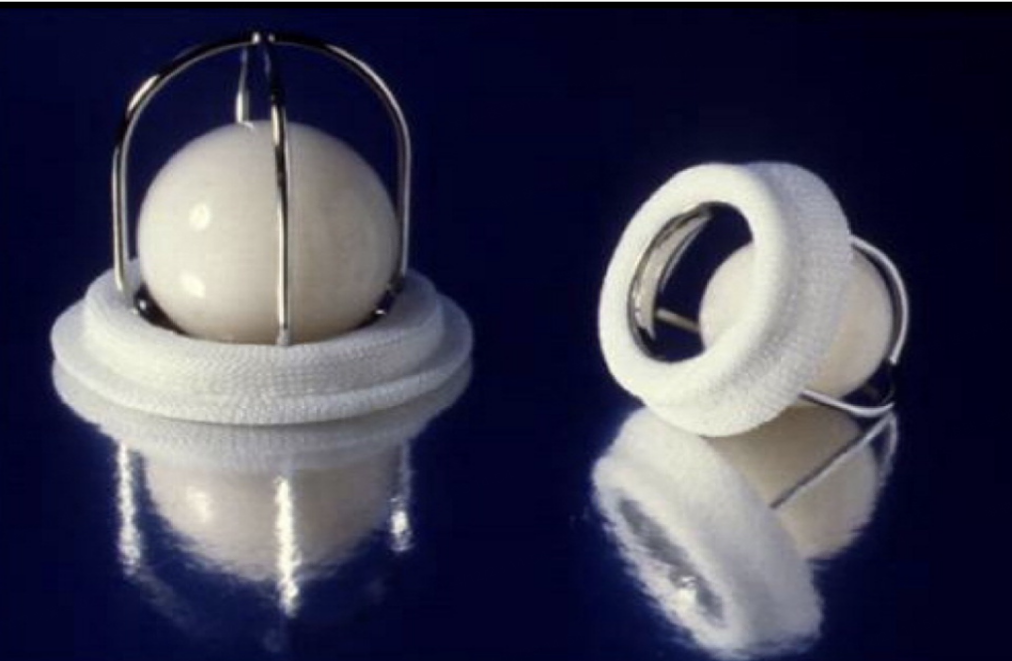
First-generation "Starr-Edwards Valve" / Photo Source: Cell
However, the product did not go well in early animal experiments, with almost all animals dying of valve thrombosis within a month after artificial valve implantation.
For this reason, Starr further improved the valve core and valve ring. He also developed a new perioperative scheme to inhibit thrombosis formation and finally succeeded in animal experiments. In 1960, Starr successfully performed the world's first artificial mitral valve replacement in a 52-year-old male with advanced mitral valve disease. This patient lived for another 15 years until he died in an accidental incident.
In 1961, Starr reported the case at the American Association for Thoracic Surgery, causing a sensation among heart surgeons from around the world. Over the next five years, Starr and Edwards made several adjustments to the valve size, material durability, and various technical details of the perioperative period, and expanded the application of the valve.
"Those years, we had to discuss 3 to 4 times a week. Once, I was camping by the sea, and at 11 o'clock at night, Edwards suddenly came to the beach to find me, saying he had some new ideas." Starr recalled in an interview. In 1963, he performed the world's first tricuspid valve replacement.
The "Starr-Edwards valve" was quickly put into commercial mass production, completely changing the global landscape of valvular heart disease treatment. Over the next 30 years, the "Starr-Edwards valve" was implanted in nearly 200,000 patients worldwide until it was gradually replaced by new generation products after 1990.
More importantly, Starr's invention inspired surgeons and medical device companies around the world to develop and improve mechanical valves, biological valves, and surgical techniques. Relevant statistics show that as of June 30, 2024, the total number of registered effective products for artificial heart valves and valve repair devices worldwide is 62.
In 2007, for his outstanding contributions in the field of heart disease, Starr was awarded the Lasker Basic Medical Research Award. The award citation read: In the early stages of open-heart surgery, Starr pioneered the field of valve replacement, and his work has restored health and longevity to millions of heart disease patients.
Tireless Surgeon
Perhaps because of the influence of literature and music in his youth, Starr was also a doctor with a strong sense of medical humanity and responsibility. As early as before the U.S. Food and Drug Administration (FDA) improved medical device regulatory standards, he established a comprehensive follow-up monitoring system for artificial valves.
Starr once said in an interview that medicine is not only a technical issue but also a moral issue. "We developed the first artificial heart tissue implanted in the human body. Besides performing good surgery, do we also have the obligation to bear the risks faced by patients throughout their lives? From the beginning, I was determined to follow up with patients for life."
Since 1964, Starr established a comprehensive artificial valve clinical follow-up cohort, taking the lead in registering patients who underwent artificial valve replacement in detail and continuously monitoring complications and health conditions. At the same time, to support long-term follow-up clinical care, Starr specially formed a multidisciplinary medical team, with personnel and facilities equivalent to the standards of a cardiac intensive care unit.
In 2004, Starr published a 40-year follow-up result in the "Journal of Heart Valve Disease," summarizing clinical information about long-term complications for patients, which provided insights for the global academic community to continuously improve valve design and perioperative treatment and care plans.
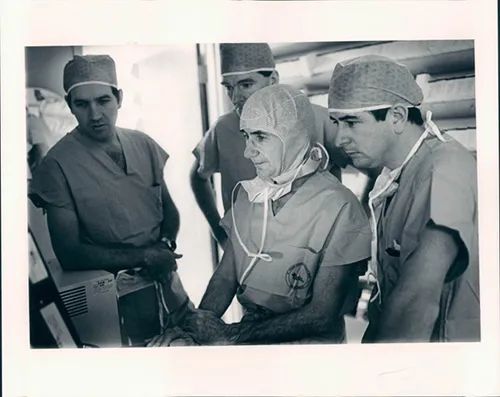
Professor Starr Training Doctors in the Operating Room / Photo Source: Knight Cardiovascular Institute, Oregon Health & Science University
In addition to clinical and academic contributions, Starr was also a beloved mentor, guiding numerous residents, international researchers, and surgeons worldwide, continuously inspiring the younger generation committed to medical development.
Chen Haiquan, a famous thoracic surgeon in China and director of the Department of Thoracic Surgery at Fudan University-affiliated Cancer Hospital, once said in an interview that he saw the power of role models in Starr. Starr was Chen Haiquan's mentor when he went to the United States to study and work as a young man. At that time, Starr was already 71 years old, but ChenHaiquan felt a "tireless energy and thirst for knowledge" from him. "Colleagues always say when they mention him, 'He can still do it for another 20 years.'"
Starr continued to be active as a surgeon until 2006. After that, he left the front line and served in leadership positions in several research institutions, promoting academic research and talent training in the field of heart disease.
In 2012, at the age of 86, Starr helped establish the Knight Cardiovascular Institute at Oregon Health & Science University and served as the executive chairman, promoting translational research, clinical care, education, and lifelong prevention of cardiovascular diseases.
Until his death, Starr remained an emeritus professor of surgery at the Knight Cardiovascular Institute. The American Association of Thoracic Surgeons mourned, "Starr's contributions to the field of thoracic surgery are immeasurable, and his memory will continue to shape the future of the field."

