


Milestone
The milestone is commercial as well as clinical. In 2025, combined sales of Mounjaro and Zepbound reached $36.5 billion, surpassing semaglutide's $34.6 billion and elevating tirzepatide to the top of global drug-sales rankings. That commercial outcome would not matter as much without the underlying clinical evidence: tirzepatide has now built a convincing case that it is not simply another entrant in metabolic disease, but the current efficacy leader in obesity and a formidable competitor in type 2 diabetes.
Clinical foundation of the franchise
Two pivotal head-to-head comparisons with semaglutide define the franchise. In SURPASS-2 for type 2 diabetes, even the 5 mg tirzepatide dose reduced HbA1c by 2.01% compared with 1.86% for semaglutide 1 mg, and achieved HbA1c below 7% in 82% versus 79% of patients. In obesity, the phase IIIb SURMOUNT-5 study showed mean weight reduction of 20.2% for tirzepatide versus 13.7% for semaglutide, a 6.5-percentage-point advantage corresponding to about 7.3 kilograms of absolute difference. Importantly, superiority was also seen across categorical weight-loss thresholds of at least 10%, 15%, 20% and 25%. That is the kind of evidence that changes prescriber preference, not just investor sentiment.
Why the drug is different
Tirzepatide combines GIP and GLP-1 receptor agonism, which is more than a marketing distinction. The dual incretin mechanism appears to deliver stronger effects on weight and glycemic control than GLP-1 agonism alone in many settings. Clinically, that matters because the obesity market increasingly rewards tangible magnitude of effect, particularly as more patients and payers begin to compare agents not merely on whether they work, but on how much weight they remove, how durable the reduction is, and what tradeoffs exist in tolerability, convenience and maintenance.
Three market shifts
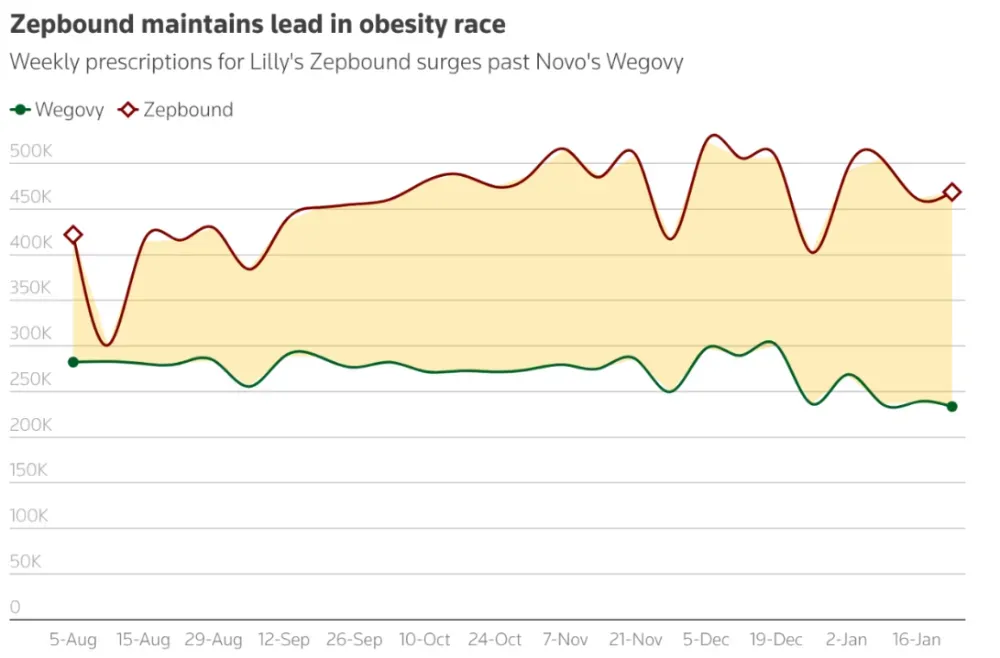
First, obesity is now a scale market in which prescription leadership can move faster than historical pricing logic. Zepbound overtook Wegovy in U.S. weekly prescriptions and has maintained that lead since August of the prior year. Second, list price is no longer an untouchable lever. Novo Nordisk and Lilly have both moved into more aggressive self-pay strategies, with oral and lower-dose entry points starting around $149 per month and higher-dose ceilings becoming increasingly visible. Third, manufacturing is becoming a therapeutic differentiator. Lilly has invested heavily in U.S. production capacity, reinforcing the idea that supply reliability is now part of competitive efficacy in obesity care.
Risk-benefit and durability questions
Tirzepatide's commercial ascent does not erase familiar class questions around gastrointestinal tolerability, long-term adherence or what happens when treatment is interrupted. The piece is more focused on market structure than adverse-event detail, but the relevant analytical point is that obesity therapy has entered a chronic-management model. That means convenience, access and maintenance economics may become as decisive as maximal short-term efficacy. The top-selling drug will not necessarily be the one with the single best trial headline if real-world persistence diverges.
Competitive positioning
For now, tirzepatide holds the strongest combined position across efficacy, prescription momentum and brand scale. But its moat is not permanent. Oral agents, lower-cost alternatives, maintenance combinations and next-generation incretin programs are all advancing. Semaglutide remains deeply entrenched, and oral obesity drugs could reopen the convenience debate quickly. Tirzepatide's best defense is continued evidence depth plus manufacturing discipline.
Outlook
The broader lesson is that obesity has become one of the most strategically important therapeutic markets in global biopharma. Tirzepatide sits at the center because it proved superior clinically and then scaled operationally. Yet the market it helped create is already changing the rules around price, access and life-cycle competition. Going forward, leadership will depend on maintaining efficacy relevance while adapting to a higher-volume, more cost-aware and increasingly multimodal obesity ecosystem. Tirzepatide may be the current king, but it is ruling a market that is becoming harder, not easier, to dominate.

