


Background
A perplexing clinical observation exists in the field of cerebrovascular intervention: numerous patients with acute large‑vessel occlusion stroke end up with unsatisfactory functional outcomes despite angiographically confirmed flawless blood‑flow restoration. Mechanical thrombectomy addresses the large‑vessel obstruction yet does not necessarily tackle microcirculatory disturbance and reperfusion‑related injury.
In June 2026, the ATTRACTION study led by Professor Luo Xiang’s team from Tongji Hospital, Tongji Medical College, Huazhong University of Science and Technology and involving 82 stroke centres nationwide, was published online in The Lancet[1]. This is the first large‑scale, multicentre, double‑blind, randomised controlled trial dedicated to the clinical question of tirofiban administration following successful reperfusion. The study demonstrated that adjuvant tirofiban raised the 90‑day functional‑independence rate by 6.1 percentage points among patients with acute anterior‑circulation large‑vessel occlusion who attained successful reperfusion, while the rise in symptomatic intracranial haemorrhage was not statistically significant.
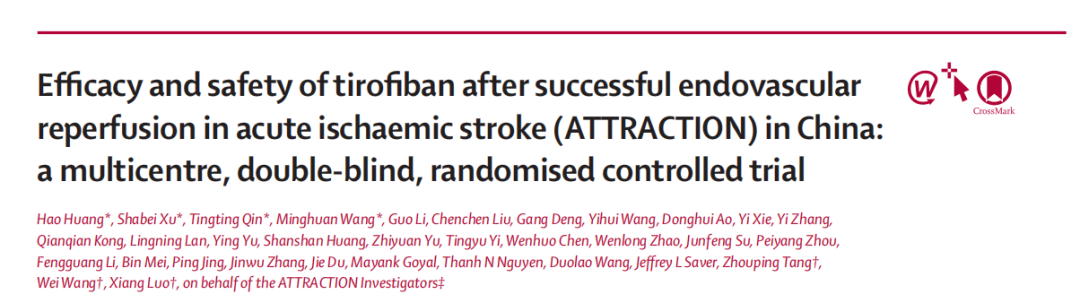
Fig. 1. Study Screenshot
What the Study Found
In ATTRACTION, a multicenter, double-blind, randomized, placebo-controlled trial conducted across 82 stroke centers in China, investigators evaluated whether adjuvant tirofiban — a glycoprotein IIb/IIIa receptor antagonist — could improve outcomes in patients with acute anterior circulation large vessel occlusion (LVO) who had achieved successful reperfusion (mTICI 2b–3) following endovascular thrombectomy (EVT).
A total of 1,380 patients were randomized to receive either intra-arterial tirofiban (5 μg/kg bolus followed by 0.1 μg/kg/min intravenous infusion) or placebo, initiated immediately after confirmation of successful reperfusion. At 90 days, the proportion of patients achieving functional independence — defined as a modified Rankin Scale (mRS) score of 0–2 — was 49% (340/689) in the tirofiban group, compared with 43% (299/691) in the placebo group (adjusted risk ratio [RR] 1.15; 95% CI 1.03–1.27; p=0.0092). An excellent functional outcome (mRS 0–1) was observed in 35% versus 30% of patients, respectively (adjusted RR 1.20; p=0.012). The overall shift in the 90-day mRS distribution favored tirofiban (adjusted common OR 1.22; 95% CI 1.01–1.48).
Safety Findings
Symptomatic intracranial hemorrhage (sICH) within 48 hours occurred in 12% of patients in the tirofiban group (82/687) versus 9% in the placebo group (65/691). The increase did not reach statistical significance (adjusted RR 1.24; 95% CI 0.91–1.68; p=0.17). Rates of 90-day all-cause mortality were similar between groups (18% vs 19%; adjusted HR 0.96), as were overall serious adverse event rates (40% vs 41%).
Clinical Note: The numerical increase in sICH, though non-significant, represents the key safety consideration when weighing the potential benefit of post-reperfusion tirofiban administration.
Why It Matters
The phenomenon of “futile recanalization” — where angiographic reperfusion is achieved but patients do not derive clinical benefit — remains a persistent challenge in acute stroke care. It is estimated that approximately half of patients with successful recanalization after EVT do not regain functional independence. Microvascular obstruction, platelet activation, and re-occlusion at sites of endothelial injury are thought to contribute to this disconnect between angiographic success and clinical outcome.
The ATTRACTION trial is the first large-scale randomized study to specifically evaluate antiplatelet therapy administered after — rather than before or during — successful thrombectomy. This design distinction is critical. Two prior trials, RESCUE BT and MR CLEAN-MED, tested antiplatelet or anticoagulant agents administered in the periprocedural period (before or during EVT) and found no functional benefit, with an increased risk of intracranial hemorrhage. By targeting the post-reperfusion window, ATTRACTION addresses a mechanistically distinct phase in which stabilizing the microvasculature and preventing re-occlusion may outweigh the hemorrhagic risk associated with earlier antiplatelet exposure.
Mechanistic Rationale
Tirofiban is a fast-acting, reversible GP IIb/IIIa inhibitor that blocks the final common pathway of platelet aggregation. Its pharmacological profile — rapid onset, short half-life (~1.5–2 hours), and reversibility upon discontinuation — makes it a candidate for acute interventional settings where a balance between antithrombotic efficacy and bleeding risk is required. In the post-reperfusion setting, the rationale is that microthrombi and platelet-rich emboli in the distal vasculature, as well as re-endothelialization-related platelet adhesion, may be attenuated by GP IIb/IIIa blockade without substantially increasing the risk of hemorrhagic transformation from the already-injured vessel wall.
An exploratory subgroup analysis provides additional support for this mechanistic framework: patients with large artery atherosclerosis (LAA) stroke etiology appeared to derive greater benefit from tirofiban (adjusted RR for functional independence 1.29; 95% CI 1.08–1.53), with no signal of increased sICH. In contrast, among patients with cardioembolic stroke, no clear functional benefit was observed (adjusted RR 1.08; 95% CI 0.94–1.23), and the point estimate for sICH suggested a potential increase in risk (adjusted RR 1.41; 95% CI 0.98–2.01). These hypothesis-generating findings are consistent with the notion that platelet-mediated thrombosis plays a more prominent role in LAA-related occlusion and re-occlusion than in cardioembolic events.
Potential Translational Value
If confirmed in additional studies, these results could help refine post-thrombectomy management by identifying patient subgroups — particularly those with LAA etiology — who may benefit most from short-term GP IIb/IIIa inhibition after successful recanalization. The findings may also support the rationale for etiology-guided antiplatelet strategies in acute stroke intervention.
Clinical Evidence Context
ATTRACTION provides Class I evidence from a randomized, double-blind, placebo-controlled design with adequate statistical power. The trial enrolled patients within 24 hours of symptom onset (76% within 9 hours), with anterior circulation LVO confirmed by imaging and successful reperfusion (mTICI 2b–3) achieved by EVT. Key exclusion criteria included pre-stroke mRS >1 and Alberta Stroke Program Early CT Score (ASPECTS) <6 on baseline imaging. Concomitant antiplatelet or anticoagulant use was protocol-specified.
The trial was led by Professor Xiang Luo and colleagues at Tongji Hospital, Tongji Medical College, Huazhong University of Science and Technology, and was published online in The Lancet on June 24, 2026.
Limitations and Next Steps
Several limitations warrant consideration when interpreting these findings:
· Population Homogeneity. The trial was conducted exclusively in China, with 99% of participants of Han Chinese ethnicity. Generalizability to other populations requires validation in multi-ethnic cohorts.
· Composite Dosing Regimen. The combined intra-arterial bolus and intravenous infusion regimen precludes determination of the optimal route or dose of tirofiban in this setting.
· Imaging Methodology. Dual-energy CT was not routinely used for post-procedural imaging, which may have led to overestimation of hemorrhagic transformation rates.
· Time-Window Constraints. Only 24% of patients were randomized beyond 9 hours from symptom onset, limiting the evidence base for late-window treatment.
· Infarct Core. The trial predominantly enrolled patients with ASPECTS ≥6; results should not be extrapolated to patients with large established infarct cores.
· Subgroup Analyses. All subgroup findings were exploratory and post hoc; no adjustment for multiple comparisons was performed.
Confirmatory trials in broader populations, including non-Asian cohorts and patients outside the 9-hour window, will be needed. Dose-optimization studies and trials incorporating advanced imaging biomarkers may further clarify the risk-benefit profile of post-reperfusion tirofiban.
References
[1]. Huang H, Xu S, Qin T, et al. Efficacy and safety of tirofiban after successful endovascular reperfusion in acute ischaemic stroke (ATTRACTION) in China: a multicentre, double-blind, randomised controlled trial. The Lancet. Published online June 24, 2026. doi:10.1016/S0140-6736(26)00983-9.
[2]. Qiu Z, Li F, Sang H, et al. Effect of intravenous tirofiban vs placebo before endovascular thrombectomy on functional outcomes in large vessel occlusion stroke: the RESCUE BT randomized clinical trial. JAMA. 2022;328:543-553.
[3]. van der Steen W, van de Graaf RA, Chalos V, et al. Safety and efficacy of aspirin, unfractionated heparin, both, or neither during endovascular stroke treatment (MR CLEAN-MED): an open-label, multicentre, randomised controlled trial. Lancet. 2022;399:1059-1069.

