


For decades, peak sales has been the dominant metric for evaluating a new drug’s commercial value. Management teams, investors, and business development groups have typically asked the same question: how large can this product become — 1 billion, 3 billion, or more than 10 billion U.S. dollars? In today’s rapidly evolving pharmaceutical landscape, however, a second question is gaining equal weight: how quickly can the product reach that peak?
Peak sales reflects a drug’s commercial ceiling under stable market conditions, but the figure alone does not fully capture commercial value. A product reaching 10 billion U.S. dollars in year 5 after launch carries very different implications for cash flow, return on investment, and competitive positioning than one that requires 12 years to reach the same level. The underlying logic is straightforward: the post-launch commercial window is not infinite. Development timelines, regulatory protection, patent life, reimbursement negotiations, and competition from similar agents all determine how long a company can fully capture value.
In the past, many drugs could climb slowly toward peak sales through extended market education, indication expansion, and price increases. That model is now under mounting pressure, particularly in the United States. The Inflation Reduction Act (IRA) has further reinforced the urgency: small molecules may enter Medicare price negotiations 9 years after launch, and biologics 13 years after launch. For many products, the timing of peak sales is increasingly likely to approach — or even follow — the price negotiation milestone. As a result, time to peak has shifted from a commercial execution issue to an asset valuation issue.
A Notable Shift Over Two Decades
According to an analysis published in Nature Reviews Drug Discovery, the time required to reach peak sales has shortened substantially over the past 20 years. Globally, drugs launched between 2004 and 2008 took an average of approximately 12.5 years to reach peak sales. For drugs launched between 2019 and 2023, the average is projected at approximately 7.3 years — a reduction of roughly 42%. In the U.S. market, the corresponding figures are approximately 10.5 years for the 2004-2008 cohort and approximately 6.8 years for the 2019-2023 cohort, a reduction of about 35% (Fig. 1).
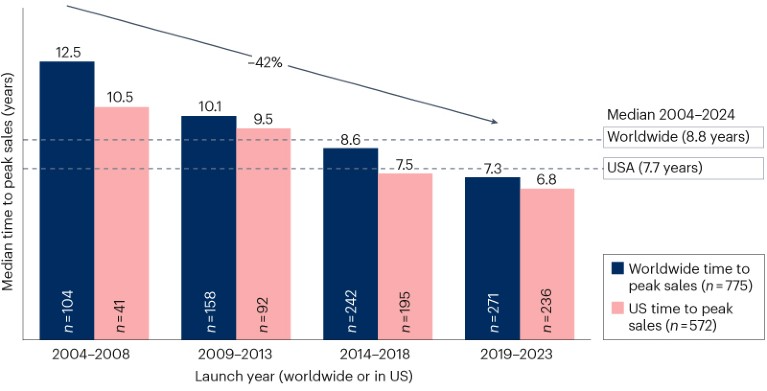
Fig. 1. Peak-Sales Timing by Therapeutic Area: Global vs U.S. Markets
Source: Nature Reviews Drug Discovery
This shift indicates that the commercial ramp-up for new drugs has accelerated systematically. The earlier model — a long sequence of physician education, guideline inclusion, payer coverage, and indication expansion before reaching mature sales — is being compressed. Today, market response cycles are shorter, and early uptake ability more directly determines a product’s trajectory.
Several factors are driving this change. Development cycles have shortened. Regulatory pathways have accelerated, with mechanisms such as Breakthrough Therapy designation, Priority Review, and Accelerated Approval bringing some drugs to market earlier. Competing products with similar mechanisms are also arriving faster, making it harder for any single product to enjoy a long exclusivity window. Payer management has tightened, and post-launch reimbursement, prescribing friction, and access all directly affect uptake speed. Commercial teams increasingly prepare medical education, payer engagement, and market access infrastructure before launch rather than after.
In practical terms, the post-launch period no longer offers the luxury of a slow, trial-and-error rollout. The first 24 to 36 months increasingly resemble a commercial sprint. Evidence generation, access, supply, medical education, physician awareness, patient services, and market feedback must all form a tight loop early in the lifecycle. For large pharmaceutical companies, this requires more front-loaded launch preparation. For smaller biotech companies, strong clinical data alone may not be sufficient; without robust commercial capability, a product may fail to reach its full potential within the available window, with downstream consequences for financing, partnerships, and acquisition value.
Variation by Therapeutic Area
Although the overall trend points to a shorter time to peak, meaningful differences exist across therapeutic areas (Fig. 2). Globally, anti-infective drugs reach peak sales fastest, at approximately 7.4 years, followed by cardiovascular drugs at approximately 7.9 years, respiratory at approximately 8.6 years, oncology at approximately 9.0 years, immunology at approximately 9.4 years, and dermatology at approximately 10.4 years. The U.S. market shows a faster pace across the board: anti-infectives at approximately 6.0 years, cardiovascular at approximately 6.8 years, oncology at approximately 8.0 years, and dermatology at approximately 9.0 years.
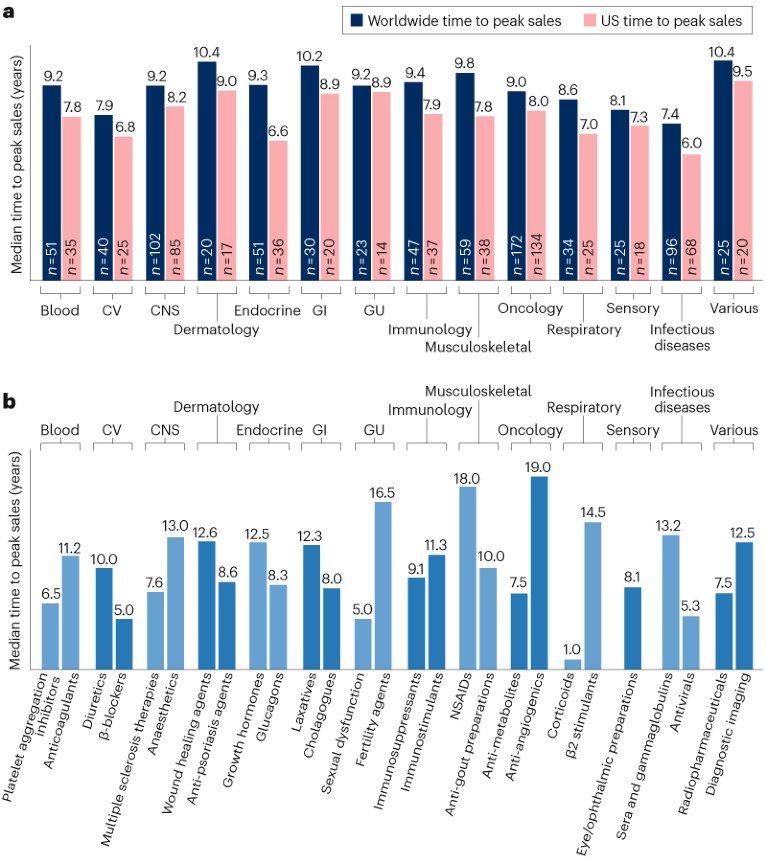
Fig. 2. Time to Peak Sales by Therapeutic Area, Global and U.S. Markets
Source: Nature Reviews Drug Discovery
These differences are not accidental. They reflect the combined influence of disease setting, prescribing habits, the role of clinical guidelines, and physician risk tolerance. Anti-infective drugs tend to scale quickly, particularly when there is a clear public health need, strong guideline support, and a well-defined treatment pathway — the rapid uptake of certain agents during the COVID-19 pandemic being a notable example. Anti-infectives often address acute conditions with short decision timelines, where guidelines and institutional recommendations directly shape clinical use.
Dermatology products take longer to reach peak, shaped by the chronic nature of disease management and physician prescribing style. Many skin conditions are not immediately life-threatening, and physicians and patients tend to weigh long-term safety, dosing convenience, recurrence management, and cost more carefully. Even with strong efficacy, new agents may require extended periods to demonstrate durable safety and benefit. In atopic dermatitis and psoriasis, for example, several major products have emerged, but changes in physician habit and payer coverage do not occur overnight.
Oncology sits in the middle. New oncology agents are often adopted quickly, given high unmet need, physician sensitivity to efficacy advances, and the role of clinical guidelines in driving prescribing. However, oncology products typically expand through multiple indications, combination regimens, and movement into earlier lines of therapy, so reaching a stable peak may still take years.
Therapeutic area averages explain only part of the picture. Within a single area, time to peak can differ widely across mechanisms of action and drug classes. In cardiovascular medicine, for example, beta-blockers reach peak in approximately 5 years, while diuretics take approximately 10 years. Both fall within the same broad therapeutic area, but prescribing context, therapeutic positioning, physician familiarity, competitive landscape, and clinical substitution logic differ. A similar pattern appears in anti-infectives: antivirals reach peak in approximately 5 years, while serum and gamma-globulin products take more than 13 years. The former often involves a defined pathogen, a defined treatment window, and a defined guideline pathway; the latter may involve more complex patient selection, supply constraints, treatment settings, and medical education.
The implication is that mechanism, treatment paradigm, route of administration, disease awareness, physician comfort with safety, ease of patient identification, diagnostic complexity, and distribution model all influence time to peak. Drugs with clear mechanisms, simple prescribing pathways, and benefits that are easy for physicians and patients to understand tend to scale faster. In contrast, products with complex technology platforms, demanding diagnostic requirements, heavy administration logistics, or the need for cross-disciplinary coordination may require extended periods of market education, even with strong efficacy data. This is particularly relevant for cell therapies, gene therapies, radioligand therapies, and complex biologics. Their scientific value may be high, but commercialization depends not only on efficacy but also on the alignment of diagnostics, referral pathways, manufacturing, distribution, administration sites, payer coverage, and adverse event management.
Profile of Faster-Scaling Drugs
A frequently overlooked finding is that being first to market does not necessarily translate into faster peak sales. According to the analysis, first-in-class drugs reach peak in approximately 9.3 years, while other drugs in the same class reach peak in approximately 9.35 years — essentially the same. First-in-class status does not, on its own, appear to shorten time to peak.
The reason is not difficult to grasp. First-in-class products often bear the cost of market education, explaining new disease biology, new treatment pathways, new endpoint interpretation, and new safety management approaches. Physicians do not adopt simply because the mechanism is novel, and payers do not grant coverage simply because a product is first. In many cases, first-in-class drugs help establish category awareness for the field as a whole, without necessarily achieving the fastest commercial ramp.
A more counterintuitive finding involves best-in-class products. According to the analysis, best-in-class products take approximately 11.6 years to reach peak, compared with approximately 9.2 years for other products. The result appears surprising but has a plausible explanation. Best-in-class products are typically positioned not as simple substitutes for existing therapies but as agents intended to reshape the established treatment landscape. When a product offers stronger efficacy, better safety, or greater convenience, it carries higher commercial potential — but physicians still need time to shift from existing treatment pathways. Payers may also require additional real-world evidence, long-term safety data, and cost-effectiveness documentation. In addition, products with strong mechanistic foundations often expand through additional indications. The broader the indication base, the longer the lifecycle, and the further peak sales may be pushed back. In immunology and inflammation, for example, key pathway drugs often begin in one indication and expand into multiple adjacent diseases. Sustained sales growth is positive, but by the strict definition of reaching a stable peak, it also extends the timeline.
In short, the relationship between degree of innovation and speed of commercial ramp is not straightforward. First-in-class status addresses a scientific gap, best-in-class status addresses competitive positioning, and rapid time to peak requires evidence, access, execution, and timing to align.
Orphan Drug Designation Does Not Markedly Shorten Time to Peak
Another notable finding is that orphan drug designation does not appear to significantly shorten time to peak. According to the analysis, orphan drugs reach peak in approximately 9.4 years, compared with approximately 8.83 years for non-orphan drugs — a relatively small difference that runs counter to common intuition.
Orphan drugs typically involve smaller patient populations, concentrated treatment centers, and well-defined physician networks, which might suggest faster patient identification and uptake. In practice, however, rare disease products often face diagnostic friction. Patients may wait years from symptom onset to confirmed diagnosis, and limited physician awareness, restricted access to testing, and complex referral pathways can delay treatment initiation. Some products must be administered at a small number of specialized centers, which adds delivery and administration constraints. Complex modalities such as gene therapy, enzyme replacement therapy, and RNA-based drugs also increase decision burden for hospitals, payers, and patients.
On the other hand, orphan drugs face less pressure from price negotiations and large-scale same-class competition. They may not reach peak faster, but their commercial window may be longer. The value of these products lies less in rapid scaling and more in stable market building through clear patient identification, specialty center coverage, and long-term treatment management. This serves as a reminder that rare disease commercialization cannot be modeled on common chronic disease launches. Success depends less on the size of the post-launch sales force and more on the ability to build patient identification systems, diagnostic pathways, referral networks, and payer support.
Company Size and Therapeutic Familiarity
Company size also influences time to peak. Between 2004 and 2024, products from the world’s top 20 pharmaceutical companies reached peak in approximately 9.5 years on average, while those from smaller biotech companies took approximately 10.3 years. The gap may appear modest, but in a compressed commercial window, nearly a year of difference carries meaningful value.
Large pharmaceutical companies’ advantages are largely commercial: larger sales forces, more established medical affairs functions, deeper payer relationships, more complete patient support programs, and stronger global launch coordination. Together, these help products scale faster.
Notably, however, deep therapeutic area experience does not, on its own, appear to confer a clear additional advantage. Within large pharmaceutical companies, products in their core therapeutic areas reach peak in approximately 9.4 years, while products in non-core areas reach peak in approximately 9.6 years — a small gap. The data suggest that commercial speed is driven primarily by resource allocation and execution capability, not by familiarity with a specific therapeutic area.
This carries important implications for smaller companies. Many biotech companies hold strong assets but lack global commercialization infrastructure. As the window to peak narrows, standalone commercialization becomes more difficult. If access, medical education, and supply systems are not in place before launch, a product — even if approved — may miss the critical uptake window. This is also why many large pharmaceutical acquisitions evaluate not just clinical data but the post-launch uptake trajectory of the asset. A near-approval asset with complex commercialization may reach peak more quickly under a company with an established network. Part of the acquisition value lies in time compression and the resulting earlier cash flow.
Implications for Future Launch Strategy
If time to peak is shortening, launch strategy must change accordingly. In the past, companies could treat approval as the starting point of commercialization — win the label first, then gradually add data, expand access, and educate the market. That pacing is increasingly risky.
Looking ahead, successful launches are likely to require more pre-approval preparation.
First, the evidence package needs to be front-loaded. A positive primary endpoint is the baseline; key secondary endpoints, patient-reported outcomes, quality of life data, subgroup analyses, and real-world evidence plans may all shape early judgment by physicians and payers. For chronic disease drugs, long-term safety and adherence data are especially important. For high-cost innovative therapies, payers are likely to focus on cost-effectiveness and real-world value.
Second, access infrastructure needs earlier design. Reimbursement, commercial insurance negotiations, patient assistance, prescribing workflow, distribution models, and hospital access cannot be deferred until after approval. Many products show slow early growth not because physicians doubt efficacy, but because prescribing pathways are complex, payer restrictions are tight, and out-of-pocket costs for patients are high.
Third, medical education should shift from mechanism explanation to clinical decision support. What physicians actually need to know is not how novel a mechanism is, but in which patients to use the drug, when to use it, how to sequence it with existing therapies, how to manage adverse events, and what to do when response is inadequate. Products that scale quickly tend to communicate these points with clarity.
Fourth, companies should treat the first 24 to 36 months after launch as a critical sprint window. Early market feedback should translate rapidly into action. If uptake is slow among a particular group of physicians, the company needs to determine whether the issue is evidence, access, competitive pressure, or patient pathway. Strategy should not be revised on an annual cycle but adjusted rapidly around defined triggers — scaling up or stopping as warranted.
This also means peak sales forecasts should no longer be presented as a single long-dated number. Companies need to evaluate the sales ramp curve, resource investment cadence, and policy window together. A drug with a high but slow-rising peak may, in the current environment, be less attractive than a drug with a moderate peak that scales quickly.
Reference
Alvarez, D. et al. Time to peak sales: how long is the climb? Nature Reviews Drug Discovery (2026).

