


According to "Xinhua News Agency," the Republican presidential candidate Trump announced at dawn on the 6th that he won the 2024 presidential election.
The results of this U.S. election will have a profound impact on global development, including the healthcare system. On the eve of the election, the prestigious international medical journal New England Journal of Medicine (NEJM) published a commentary point out the U.S.'s insufficiency in safeguarding individual health and enhancing public welfare, stating that the election results will determine the future direction of the healthcare system and the United States.

NEJM publishes related commentary articles
In the article, NEJM questioned the U.S. healthcare system: "What will be the future of a country that causes countless people to suffer unnecessary pain and death due to the lack of basic medical services... Can this country still survive and develop?" In fact, the core data and arguments of this NEJM commentary article all come from the latest survey by the independent organization "Commonwealth Fund" - "Mirror 2024: The Failed U.S. Healthcare System" (hereinafter referred to as "Mirror 2024"). The report is based on 70 indicators, assessing the current state of healthcare in 10 high-income countries, involving five dimensions of medical service accessibility, care processes, administrative efficiency, medical equity, and population health outcomes.
The results show that the healthcare systems of Australia, the Netherlands, and the United Kingdom perform the best overall. Despite the U.S. spending more on healthcare than any other high-income country, compared to the other nine high-income countries, the U.S. healthcare system's overall performance is the worst, ranking last overall.
In layman's terms, compared to other high-income countries, the United States spends the most money but receives the worst medical services, with higher disease rates and shorter life expectancies among its residents. The "Commonwealth Fund" states that this is the eighth time a healthcare-related report has been released since 2004, and the United States has ranked last for seven consecutive times.
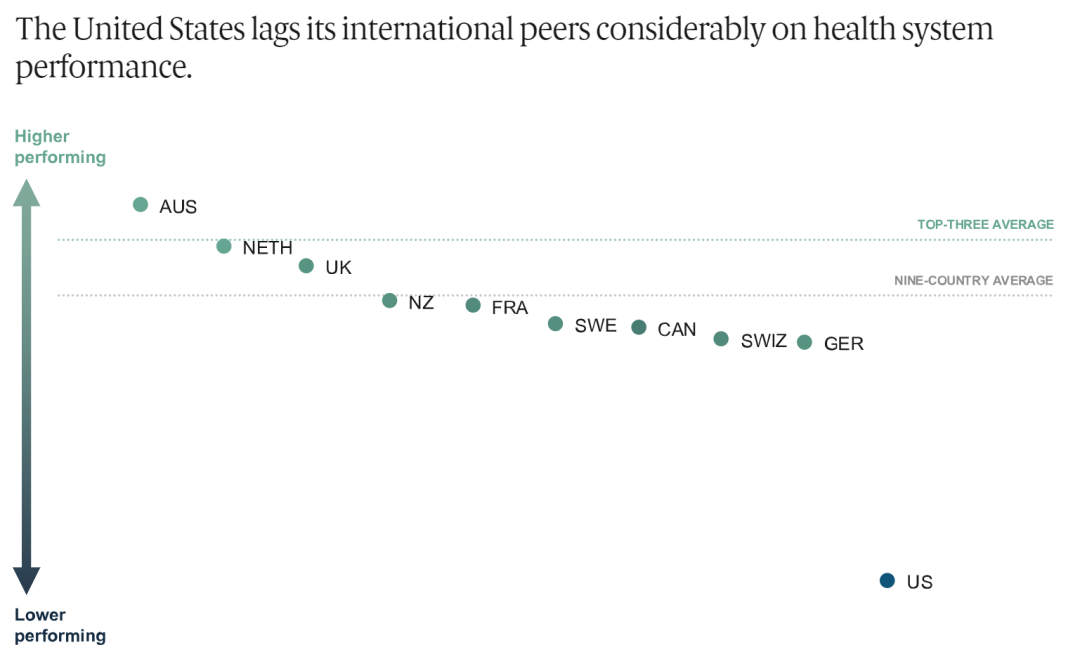
Comparison of health systems in 10 high-income countries, including Australia, Canada, France, Germany, the Netherlands, New Zealand, Sweden, Switzerland, the United Kingdom, and the United States. Among them, the U.S. healthcare system ranks last. [Source: Commonwealth Fund]
After Trump was elected president, can he change the lagging U.S. healthcare system?
The Commonwealth Fund, established in 1918, is a globally authoritative research and rating organization. The figure is from the original text of "The Failing U.S. Health System" / Source: NEJM.
Medical accessibility and fairness rank last
The United States ranks last in both medical service accessibility and medical fairness.
Medical service accessibility is divided into "affordability" and "accessibility." Except for the United States, the other nine countries have achieved "universal health insurance coverage" in terms of "affordability." Among them, the Netherlands, the United Kingdom, and Germany have performed exceptionally well. The UK's National Health Service offers "free healthcare for all," while Germany sets a maximum out-of-pocket limit based on people's income.
In the United States, dealing with medical bills is a nightmare for many. According to statistics from the American insurance company "International Citizen Insurance," the minimum cost of calling an ambulance in the United States is $400, with the highest exceeding $1,200. Due to the exorbitant costs, a 33-year-old U.S. citizen once complained to the media that they received a $1,000 bill for a visit to the hospital for a viral cold.
"No other country in the world requires patients and families to pay such high costs for basic medical care as the United States does," said Joseph Betancourt, President of the Commonwealth Fund.
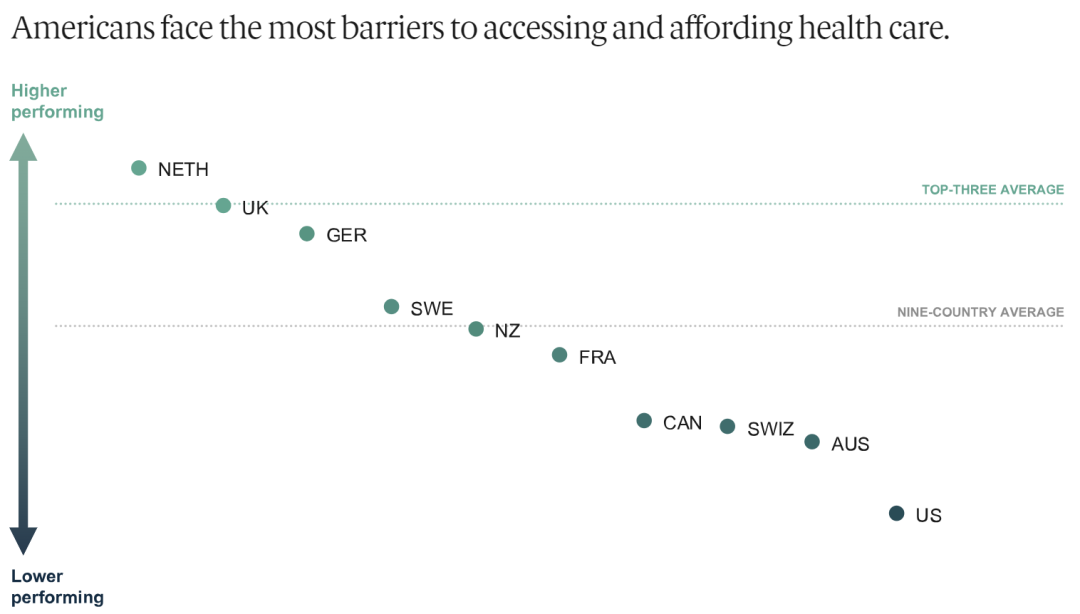
Among the 10 high-income countries, the United States ranks last in terms of healthcare accessibility. [Source: Commonwealth Fund]
"Mirror 2024" states that although the proportion of uninsured residents in the United States has dropped to a historical low, there are still about 26 million people without insurance, accounting for 7.8% of the total population. Among working people who are covered by insurance, about one-quarter have insufficient coverage.
Ironically, despite paying a large amount, people may not necessarily receive better medical services. Compared to other developed countries, many Americans do not have a regular doctor or health clinic and also find it difficult to seek medical care outside of working hours. "The Netherlands is different. The country requires healthcare providers to work an additional 50 hours outside normal business hours each year to maintain their practicing qualifications," writes Mirror 2024.
In terms of medical equity, the United States also ranks last. Considering factors such as low income, remote areas, minority groups, and gender, many people struggle to afford basic medical services and experience unfair treatment or discrimination.
David Blumenthal, the former president of the "Commonwealth Fund," told the media: "The main reason for the poor performance of the U.S. healthcare system is the poor accessibility and equity of medical services. These two aspects are seriously hindered by insurance coverage and quality."
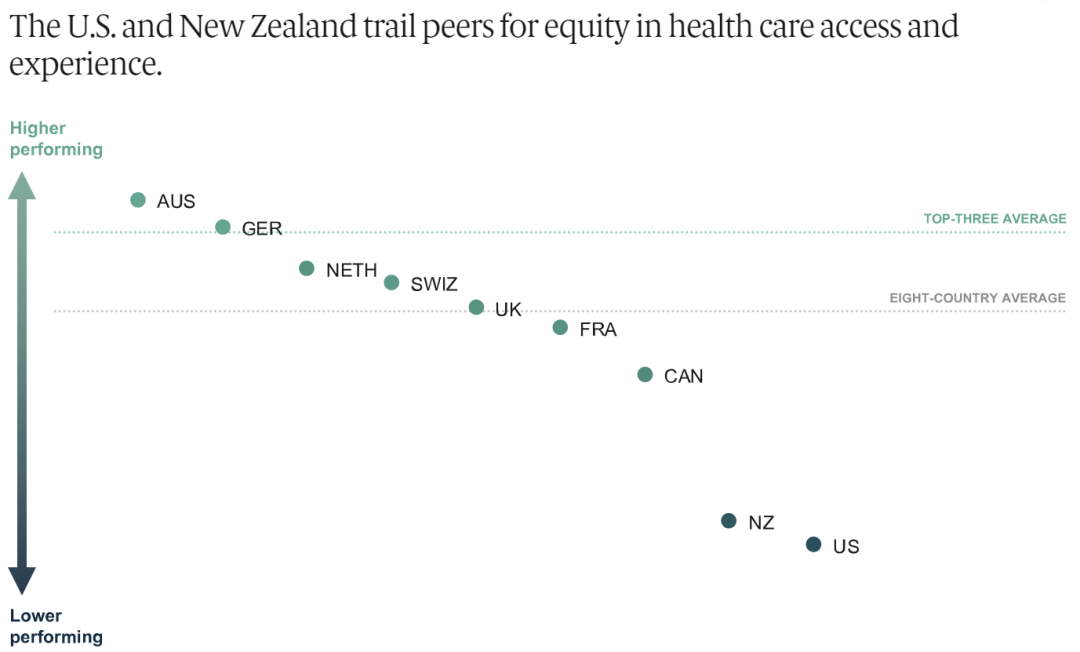
In the 10 high-income countries, the United States ranks last in terms of healthcare equity. [Source: Commonwealth Fund]
Medical administrative efficiency ranks second to last.
"Mirror 2024" points out that many countries have simplified their medical insurance and payment systems through legislation, regulation, and standardization.
For example, based on regional conditions, standardized payments are implemented for all doctors' services. In this way, doctors can clearly know what kind of compensation they can receive, and patients also know what expenses they have to bear.
However, the United States has not done so. The U.S. has a large number of insurance companies, each selling different insurance products with varying payment requirements. The advantage is that it can meet diverse medical needs, while the disadvantage is the complexity of hospital bills, continuous insurance disputes, and the time-consuming process for both doctors and patients to calculate out-of-pocket expenses and complete paperwork, with frequent denials of claims.
"The administrative efficiency of the U.S. healthcare system is consuming the time and money of patients and doctors," said Reginald Williams, Vice President of International Health Policy and Practice Innovation at the Commonwealth Fund.
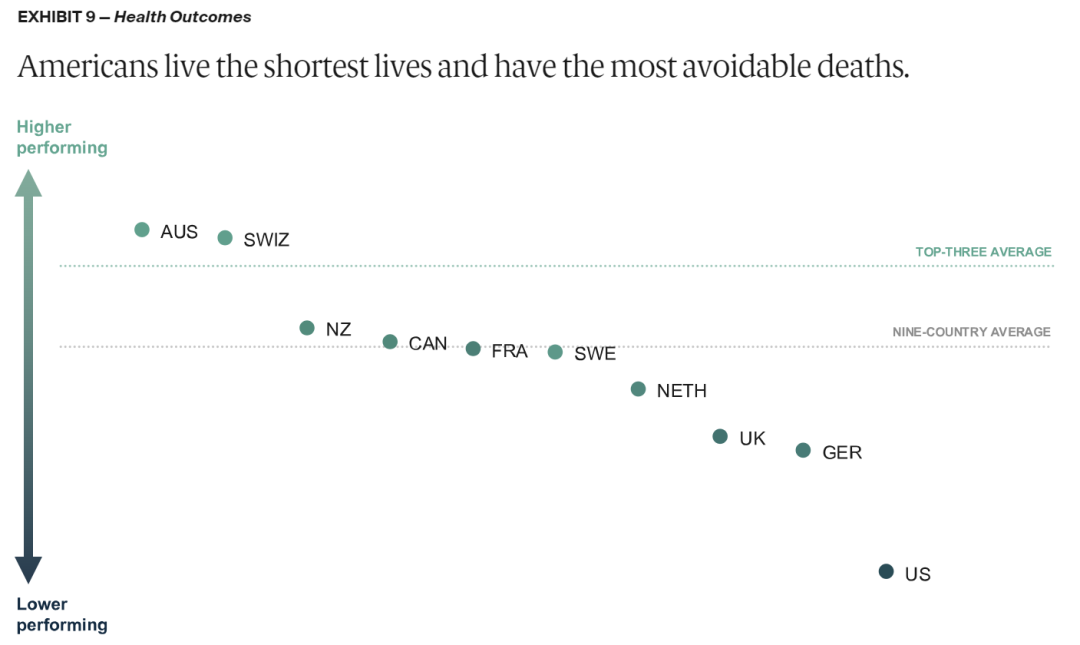
Among the 10 high-income countries, the United States has the worst population health outcomes. [Source: Commonwealth Fund]
The health outcomes of the U.S. population are the worst.
The poor ranking in many dimensions leads to a grim reality: the health outcomes of Americans are the worst among the 10 high-income countries.
This is reflected in the shortest average life expectancy of Americans, four years less than the other nine countries. At the same time, the excess mortality rate of preventable and treatable diseases at all ages in the United States is the highest, and the COVID-19 pandemic in recent years has exacerbated this situation. In the global COVID-19 pandemic, the excess mortality rate related to the pandemic among people under 75 in the United States is the highest.
In addition, the excess mortality rate in the United States caused by self-harm and violence (including gun violence) is also the highest among the 10 countries, several orders of magnitude higher than other countries.
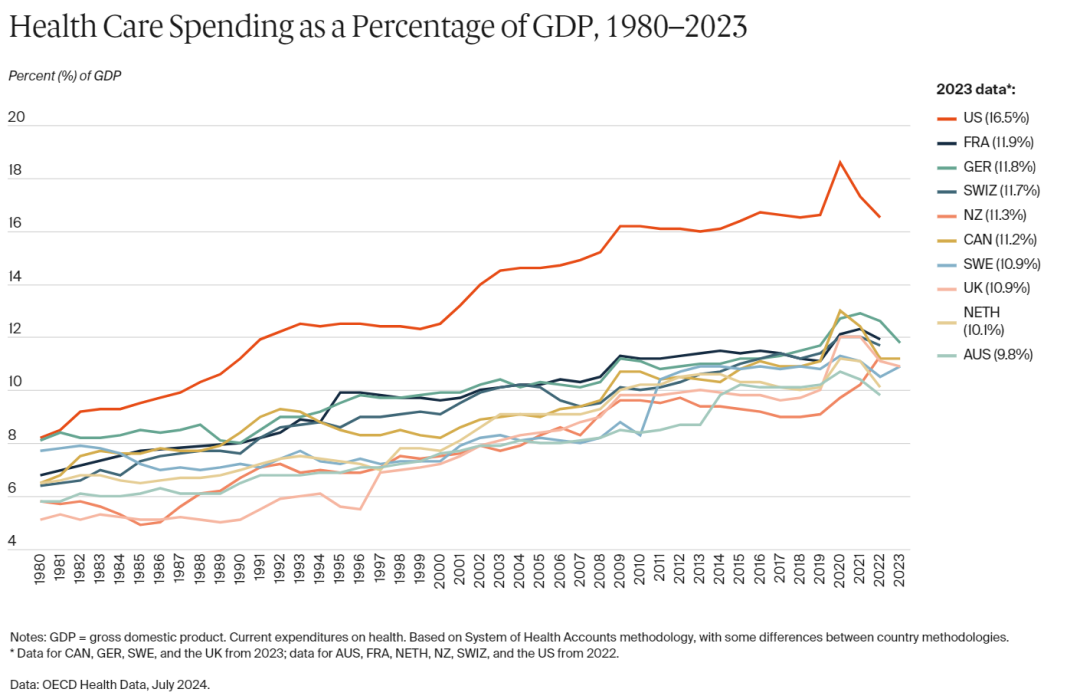
From 1980 to the present, the proportion of total U.S. healthcare expenditure to GDP has generally shown a stable upward trend. [Source: Commonwealth Fund]
Care process is the "only" bright spot.
It is worth noting that the United States performs well in the care process, ranking second. "Mirror 2024" points out that this is the only "strong performance" dimension of the United States, second only to New Zealand.
This excellent performance is mainly due to the successful provision of preventive healthcare services in the United States, such as actively promoting influenza vaccinations, as well as a focus on patient safety.
The NEJM article suggests that this may be because the relevant indicators rely on the population's responses to survey questions, such as whether they have received advice from physicians on smoking cessation, alcohol consumption, diet, and weight control, whether they have received influenza vaccinations, mammography screenings, and other preventive services, and whether clinical physicians respect and participate in treatment.
In addition, the Affordable Care Act requires health insurance to fully cover evidence-based preventive services, which may also affect the evaluation results in this area.
Be vigilant against low-value health systems.
"Mirror 2024" points out that "there are 'outliers' in U.S. healthcare spending, with inputs and outputs being completely disproportionate." Since 1980, the United States has been the "big spender" in healthcare among the 10 developed countries, with healthcare spending accounting for 16.5% of GDP in 2022, and it is expected to exceed 20% by 2035.
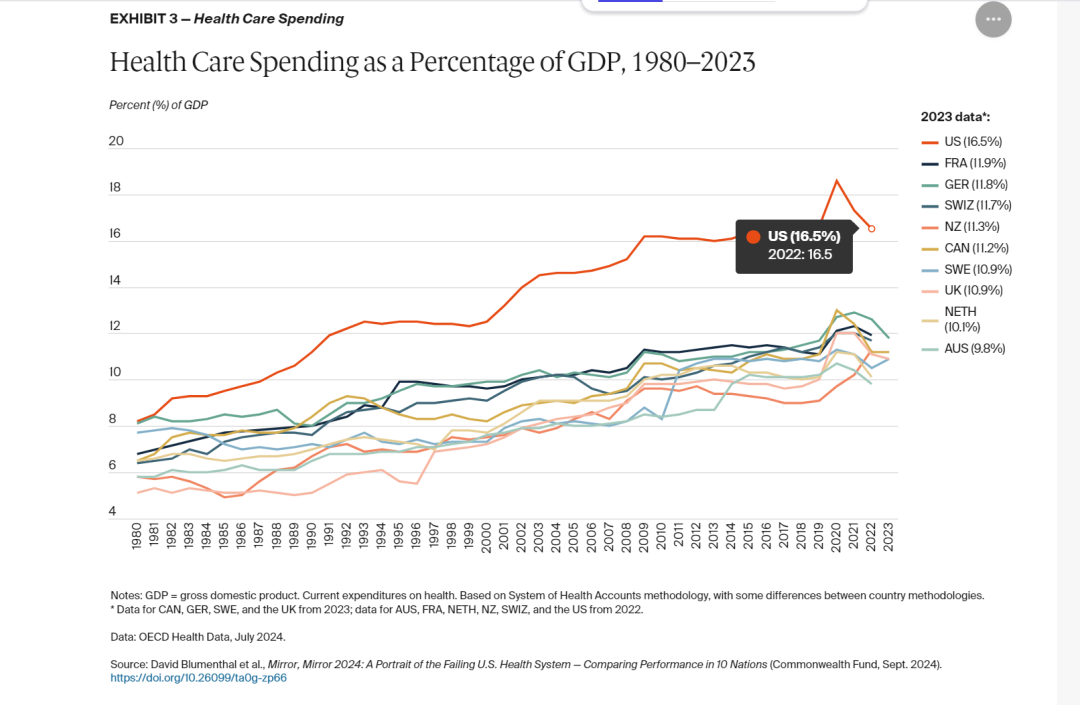
The percentage of healthcare expenditure as a share of Gross Domestic Product from 1980 to 2023.
Although the United States spends a lot on healthcare, "Mirror 2024" describes this as a state of "low-value health system," mainly because there are long-standing economic barriers for the population to access basic medical services.
To break this deadlock, it is necessary to increase investment in primary care, provide high-quality health insurance with reasonable out-of-pocket limits for everyone, and make health insurance more affordable for more people. The NEJM also points out that providing health insurance alone is not enough; the low efficiency and high costs of the U.S. healthcare system will limit the benefits of expanding health insurance coverage.
Another failure of the U.S. healthcare system is that medical institutions and professionals charge exorbitant fees, far exceeding the fees of other healthcare systems. This further leads to the high cost of medical care in the United States, making the insurance that pays for it more and more unaffordable, creating a vicious cycle.
"One of the reasons why medical institutions can charge high fees is that they gain increasing economic power in the local market through mergers. Secondly, private equity investors take over local market physician clinics and then raise fees." The NEJM points out that government antitrust agencies at all levels must strengthen scrutiny to mitigate the impact of medical institution mergers on U.S. healthcare costs.
Furthermore, the NEJM states that the United States lags behind peer countries in addressing health-related social determinants such as poverty, homelessness, inequality, and hunger. The United States needs a stronger public health system to deal with the threat of epidemics, and the loss caused by gun violence also requires policy attention.
What might Trump's healthcare policies be?
After Trump's election victory, how to reform the U.S. healthcare system is one of the core issues. Combining Trump's past healthcare policies and campaign speeches, his healthcare policies can be roughly divided into several parts.
In terms of macro healthcare policy, Trump has always opposed "ObamaCare," advocating for the weakening or repeal of the Affordable Care Act, and promoting a more flexible healthcare market by reducing government intervention.
"ObamaCare," aimed at expanding health insurance coverage and reducing healthcare costs, has been criticized since its implementation in 2010 due to its complex structure and difficulties in implementation.
In a debate in September, Trump reiterated that he believes the Affordable Care Act is "bad healthcare," but when asked about an alternative to the act, he did not propose any suggestions, only saying that he had a "concept of a plan."

Source: Ruijng
According to Drew Altman, CEO of the health policy research organization KFF (Kaiser Family Foundation), the Trump administration might cut federal healthcare spending to enable tax cuts while reducing the role of the federal government in the healthcare sector.
In terms of drug pricing, Trump had clearly stated in his campaign platform that he would push to lower drug prices. In fact, in the last few months of his previous term, Trump issued two executive orders to help reduce the cost of prescription drugs:
One is to prevent pharmacy benefit managers, as third-party companies, from receiving rebates for discounted drugs purchased by seniors on Medicare; the second is an attempt to enforce a "most-favored-nation" pricing model, ensuring that the prices paid by Medicare for drugs do not exceed the lowest prices paid by other developed countries. However, the Biden administration terminated this order in 2022.
Nevertheless, during Biden's tenure, the Inflation Reduction Act (IRA) passed in 2022 may also be subject to change. Some provisions of this act aim to reduce medical expenses for older people enrolled in Medicare and make vaccines covered by Medicare free. Harris has indicated that if elected, she would strengthen this act.
Stacie Dusetzina, a health policy and drug pricing researcher at Vanderbilt University Medical School, stated, "Many Republican congressmen are pushing to stop drug price negotiations, and some pharmaceutical companies have already sued the government... If Trump acts quickly in his second term, he could theoretically prevent or repeal the policy before the new prices take effect (in 2026)."
It is worth noting that although healthcare is the second most concerning issue for U.S. voters, both Trump and Harris seldom touched on this topic during the election. The New York Times analysis suggests that Trump, from his experiences of setbacks in his political career, recognized that proposing significant reform issues on healthcare might lose some voters' support.
After being successfully elected president, how will Trump "save" the bottom-ranked U.S. healthcare system? This question remains to be observed. In his victory speech, he promised to "help our country heal."
It is worth noting that although healthcare is the second most concerning issue for U.S. voters, both Trump and Harris seldom touched on this topic during the election. The New York Times analysis suggests that Trump, from his experiences of setbacks in his political career, recognized that proposing significant reform issues on healthcare might lose some voters' support.

