


According to the latest research published in The Lancet, in 2022, the number of people with diabetes worldwide has reached 828 million, an increase of 630 million since 1990. However, among the 445 million patients globally who have not received treatment, China accounts for 133 million, representing 30% of the global total.
In high-income countries, diabetes seems to have been initially curbed, with the prevalence rate remaining stable or even decreasing, and the treatment coverage rate reaching over 55%. Meanwhile, in low-income and middle-income countries, due to the lack of medical resources and weak health systems, some countries' treatment coverage rates are even below 10%.
Why is the gap in diabetes treatment coverage between high-income and low-income countries continuing to expand?
A recent article titled "Worldwide trends in diabetes prevalence and treatment from 1990 to 2022: a pooled analysis of 1108 population-representative studies with 141 million participants" published in The Lancet conducted an in-depth analysis of the global trends in the prevalence and treatment of diabetes from 1990 to 2022. The article integrated data from 1.41 billion participants covering 200 countries and regions, revealing the significant expansion of the prevalence of diabetes and the vast regional differences in treatment coverage, especially the growing health divide between high-income and low-income countries.
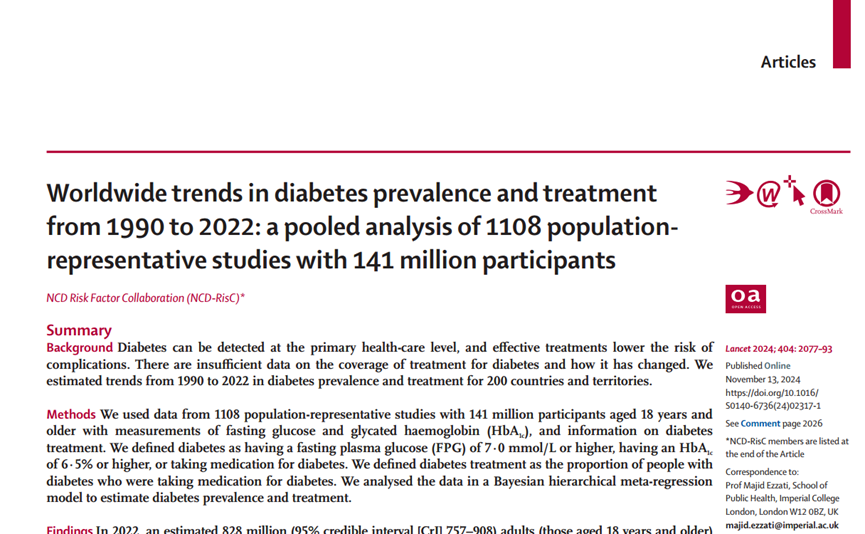
Figure 1 Article Screenshot
The "Invisible Crisis" Behind the Global Prevalence of Diabetes
From 1990 to 2022, the global prevalence of diabetes has risen significantly. The study shows that in 2022, the number of adults with diabetes worldwide reached 828 million, an increase of 630 million compared to 1990.
Not only has the absolute number increased, but the prevalence rate has also risen significantly. From 1990 to 2022, the age-standardized prevalence rate of diabetes among women in 131 countries and men in 155 countries has increased significantly worldwide.
So, what are the specific characteristics of the prevalence of diabetes in 2022?
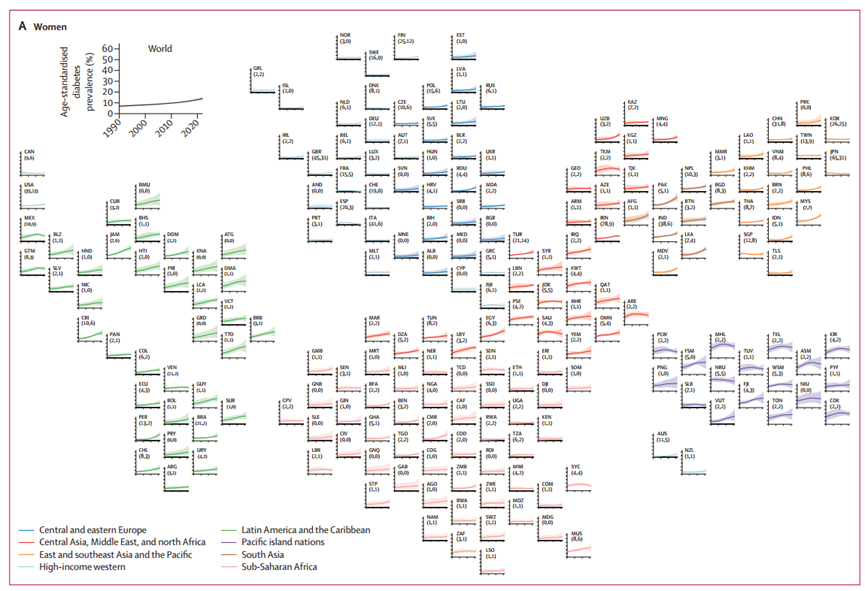
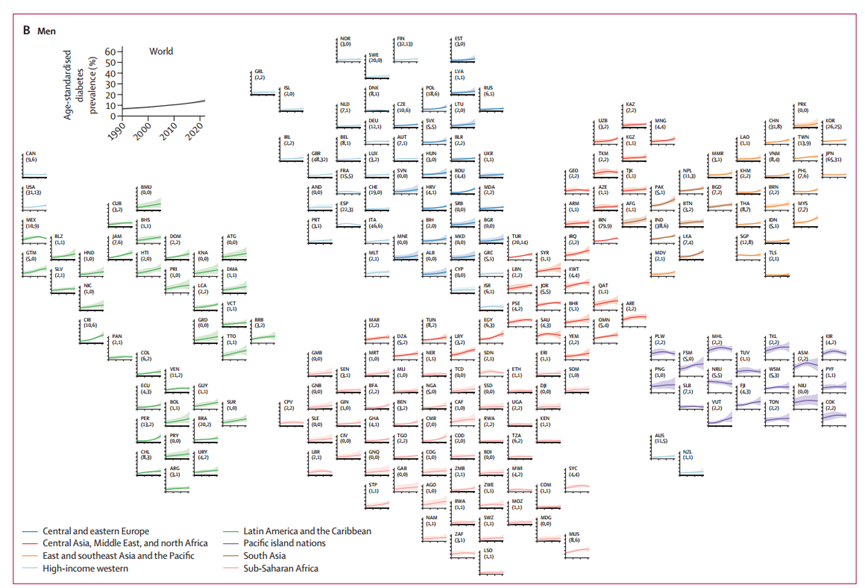
Figure 2 The trend of changes in the age-standardized prevalence of diabetes among global females/ males from 1990 to 2022
Geographical Distribution: The Split Between the North and the South
The "Heavy Burden" of South Asia: India has become the country with the most diabetic patients worldwide, with 212 million patients, accounting for 26% of the global total. The prevalence rate of diabetes among men in Pakistan has doubled since 1990.
The "New Wave of Disease" in the Middle East: The prevalence rate of diabetes in countries like Egypt has exceeded 25%, with rapid urbanization and the obesity epidemic contributing to the trend.
The "Diabetes Peak" in Pacific Island Nations: Countries such as Nauru and the Marshall Islands have a diabetes prevalence rate as high as 30%, the highest in the world.
The "Silent Threat" of Sub-Saharan Africa: Although the prevalence rate of diabetes in this region is low (less than 5% in some countries), the large population base leads to a rapid increase in the number of patients.
It is worth mentioning that China also faces significant geographical challenges: Despite China's rapid economic development, the prevalence of diabetes in China has also increased significantly from 1990 to 2022, and the coverage rate of diabetes treatment has not yet reached the level of high-income countries. Rural areas are particularly lagging, with many patients not even diagnosed. Currently, among the 148 million diabetic patients in China, 78 million patients have not received treatment, accounting for nearly 17% of the global untreated total.
Key Driving Factors: The Cost of "Modernization"
The rapid spread of diabetes is not only a natural trend but also a direct consequence of modern lifestyles. What do you think are the "modernization" factors that have led to the global trend of diabetes prevalence? How about the situation in our country? Scan the code to verify if your thoughts are correct.

The Gap in Treatment Coverage
The difference in diabetes treatment coverage is a microcosm of global health inequality.
The "Impressive Achievements" of High-Income Countries: In 2022, the diabetes treatment coverage rate in high-income countries generally exceeded 55%, thanks to a comprehensive medical insurance system and primary care network, with countries like South Korea and Canada having a treatment coverage rate of over 70%.
The "Desperate Reality" of Low-Income Countries: The treatment coverage rate in Sub-Saharan Africa is only 5%-10%. India and China have 133 million and 78 million diabetic patients untreated, respectively, accounting for 47% of the global untreated patient total.
China's Diabetes Treatment Coverage Rate:On a global scale, it is at a medium level, but there is still a significant gap compared to high-income countries. The national diabetes treatment coverage rate is about 49.2%, and the control rate is about 30.1%.
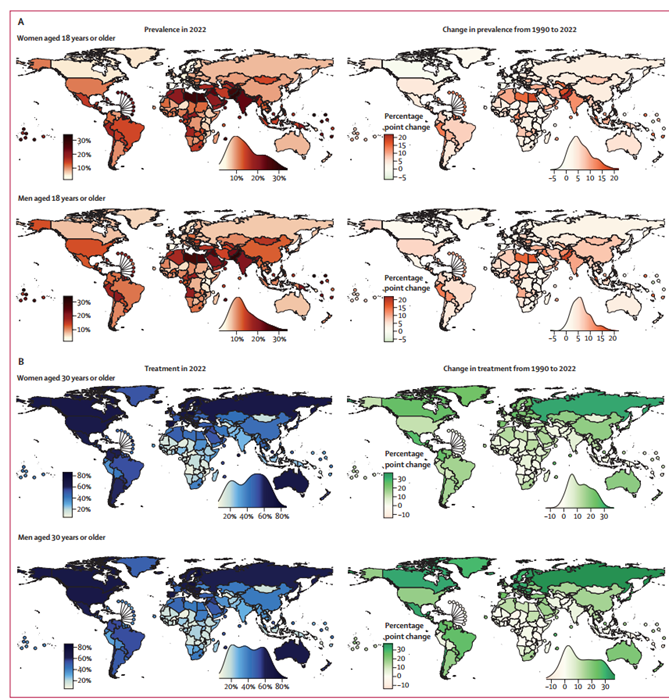
Figure 3 The geographical distribution and trends in the prevalence and treatment coverage of diabetes worldwide from 1990 to 2022
Behind the stark data is a multi-level imbalance.
Diagnosis Gap: In Sub-Saharan Africa and South Asia, 94% of diabetic patients are undiagnosed, leading to the loss of opportunities for early intervention and treatment. According to the "China Resident Nutrition and Chronic Disease Status Report (2020)," the awareness rate of diabetes in China is only 43.3%, which means that more than half of the diabetic patients do not know they have the disease. Especially in rural areas and areas with poor primary medical conditions, the diagnosis rate of diabetic patients is even lower.
Economic Barrier: The high cost of drugs and the lack of medical insurance make the treatment burden of diabetes unbearable for low-income countries. According to a survey by the "China Health Economics Research," the average annual medical expenses for diabetic patients exceed 5,000 yuan, accounting for more than 20% of the annual per capita income of rural residents. Moreover, some high-efficiency diabetes drugs (such as GLP-1 receptor agonists) have not been fully included in the medical insurance catalog, and patients need to purchase them at their own expense. The limitations on drug reimbursement increase the economic burden.
Why is Global Health Inequality Getting Worse?
From 1990 to 2022, the gap in global diabetes treatment coverage has further widened. In 1990, the coverage rate difference between high-income and low-income countries was 43%-56%, and by 2022, this gap had expanded to 71%-78%. What has allowed this divide to continue to grow?
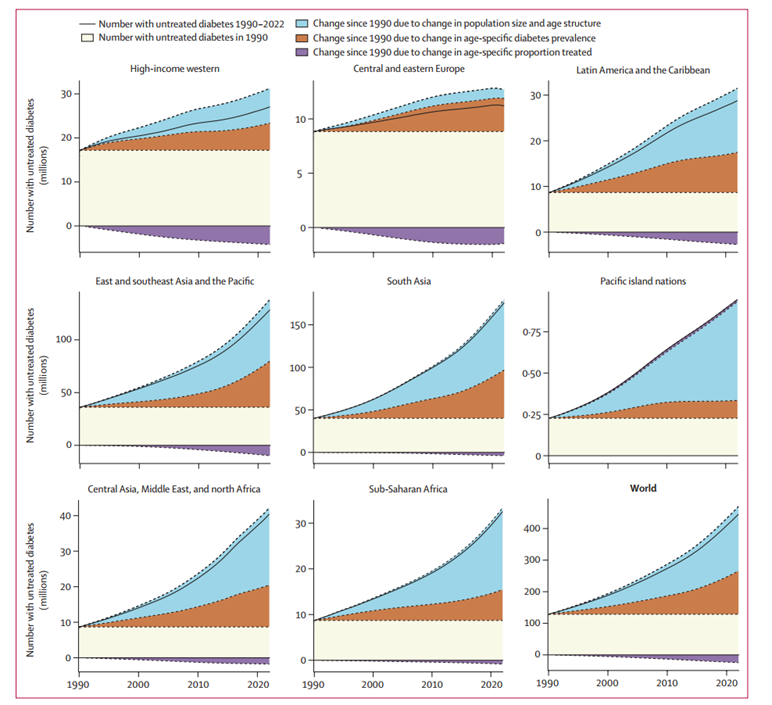
Figure 4 The changes in the number of untreated diabetic patients in various regions worldwide from 1990 to 2022 and their driving factors
Medical Resource Imbalance Between the North and the South
Low-income countries lack medical infrastructure and professional personnel, with limited screening capabilities, preventing diabetic patients from being diagnosed in a timely manner.
The "Luxury" Attribute of Health Insurance
High-income countries have medical insurance that covers most residents, while low-income countries' insurance systems have not been widely implemented, and many patients face the dilemma of not being able to afford medical treatment.
The Insufficiency of International Aid
Although some organizations provide drug and equipment aid, global resource sharing is still insufficient and cannot effectively narrow the gap in treatment coverage.
Where is the Hope to Bridge the Gap?
Faced with this global health challenge, future actions require multifaceted efforts.
International Cooperation: The Importance of the "Global Health Alliance." The international community should help low-income countries establish a comprehensive primary care system through financial support, technology sharing, and policy dialogue.
Policy Intervention: Comprehensive Reform from Diet to Exercise. Governments should implement healthy diet policies, such as taxing high-sugar foods, subsidizing healthy foods, and encouraging national participation in sports activities to control obesity.
Early Intervention: Winning at the "First Step." By establishing a screening system and implementing early interventions for high-risk groups, the incidence of diabetes can be significantly reduced.
Drug Popularization: Making Treatment "Within Reach." Reducing drug prices and strengthening drug distribution channels to ensure that every patient can afford basic treatment.
Summary
The global spread of diabetes highlights the severe reality of health inequality. From the significant progress in high-income countries to the arduous journey in low-income countries, global health governance faces tremendous challenges. For China, how to narrow the urban-rural gap and improve treatment coverage is an urgent issue to be resolved. In the future, while addressing the challenges of diabetes, China also needs to take on the responsibility of global health governance and explore fair and accessible medical solutions with other countries. The control of diabetes is not only about the quality of life of every patient but also an important step in promoting universal health and global equity.
Reference:
[1]Zhou, Bin et al. Worldwide trends in diabetes prevalence and treatment from 1990 to 2022: a pooled analysis of 1108 population-representative studies with 141 million participants The Lancet, Volume 404, Issue 10467, 2077 – 2093
[2] Zhou M, Wang H, Zeng X, Yin P, Zhu J, Chen W, Li X, Wang L, Wang L, Liu Y, Liu J, Zhang M, Qi J, Yu S, Afshin A, Gakidou E, Glenn S, Krish VS, Miller-Petrie MK, Mountjoy-Venning WC, Mullany EC, Redford SB, Liu H, Naghavi M, Hay SI, Wang L, Murray CJL, Liang X. Mortality, morbidity, and risk factors in China and its provinces, 1990-2017: a systematic analysis for the Global Burden of Disease Study 2017. Lancet. 2019 Sep 28;394(10204):1145-1158. doi: 10.1016/S0140-6736(19)30427-1. Epub 2019 Jun 24. Erratum in: Lancet. 2020 Jul 4;396(10243):26. doi: 10.1016/S0140-6736(20)31450-1. PMID: 31248666; PMCID: PMC6891889.
[3] Wang L, Gao P, Zhang M, Huang Z, Zhang D, Deng Q, Li Y, Zhao Z, Qin X, Jin D, Zhou M, Tang X, Hu Y, Wang L. Prevalence and Ethnic Pattern of Diabetes and Prediabetes in China in 2013. JAMA. 2017 Jun 27;317(24):2515-2523. doi: 10.1001/jama.2017.7596. PMID: 28655017; PMCID: PMC5815077.
[4] NCD Risk Factor Collaboration (NCD-RisC). Worldwide trends in body-mass index, underweight, overweight, and obesity from 1975 to 2016: a pooled analysis of 2416 population-based measurement studies in 128·9 million children, adolescents, and adults. Lancet. 2017 Dec 16;390(10113):2627-2642. doi: 10.1016/S0140-6736(17)32129-3. Epub 2017 Oct 10. PMID: 29029897; PMCID: PMC5735219.
[5] Xu Y, Wang L, He J, Bi Y, Li M, Wang T, Wang L, Jiang Y, Dai M, Lu J, Xu M, Li Y, Hu N, Li J, Mi S, Chen CS, Li G, Mu Y, Zhao J, Kong L, Chen J, Lai S, Wang W, Zhao W, Ning G; 2010 China Noncommunicable Disease Surveillance Group. Prevalence and control of diabetes in Chinese adults. JAMA. 2013 Sep 4;310(9):948-59. doi: 10.1001/jama.2013.168118. PMID: 24002281.

