


On July 24, a new study by researchers from Southwest Jiaotong University, City University of Hong Kong, and West China Hospital of Sichuan University was featured on the front page of the prestigious international academic journal Cell.
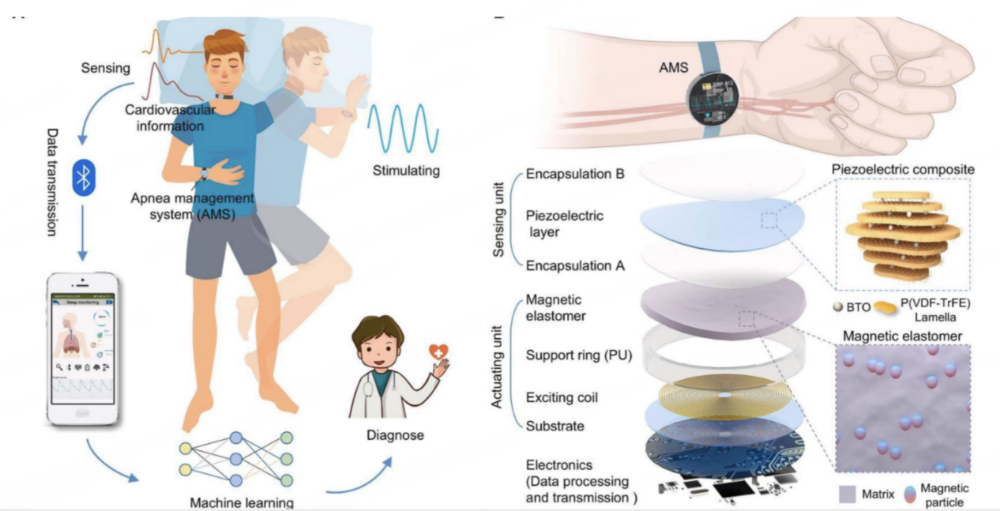
The researchers have invented a "wearable sleep management system (AMS)" that can automatically detect the occurrence of obstructive sleep apnea (OSA) after the user falls asleep. It then applies synchronized stimulation to relieve airway obstruction and alleviate symptoms.
According to relevant statistics, the number of OSA patients in China reaches as high as 176 million, the highest in the world. The sleep disruptions and intermittent hypoxia caused by OSA not only lead to daytime fatigue and decreased work performance but also increase the risk of heart disease, stroke, and metabolic disorders in the long term.
Currently, polysomnography (PSG) is the gold standard for diagnosing sleep apnea, but its clinical accessibility is limited, and various treatment options for OSA face similar issues.
Therefore, the researchers aimed to develop an "integrated device" for real-time identification and intervention of OSA in home sleep environments.
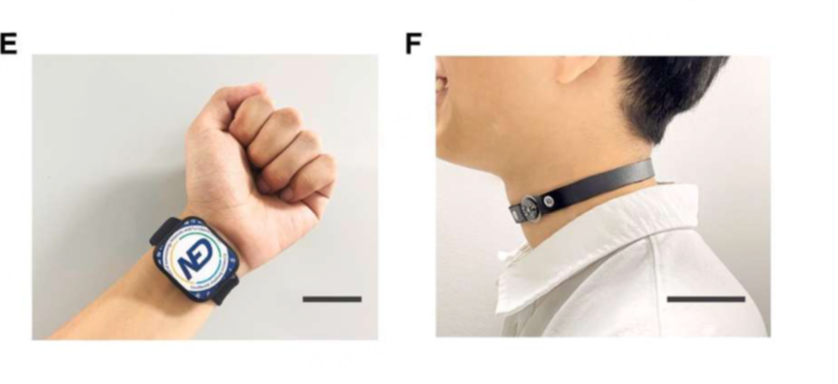
The newly developed device integrates two systems: one for continuous monitoring of physiological signals using sensors, and the other for providing non-invasive stimulation through a soft magnetic elastic actuator, which can be worn on the wrist or neck.
Specifically, when OSA occurs, the lack of oxygen causes a series of cardiovascular parameters, such as heart rate and blood pressure, to change, indicating a disruption in autonomic nervous function.
Due to these characteristics, the sensor uploads the corresponding monitoring data to a terminal, where it is processed by a big data algorithm to accurately assess the patient's real-time sleep status.
The study results show that the device achieved a real-time OSA detection accuracy rate of 92.7%.
Furthermore, once the device detects OSA, the terminal system immediately transmits instructions to the actuator, which applies mild physical stimulation, subconsciously prompting the sleeper to change their posture until OSA disappears and normal breathing is restored.
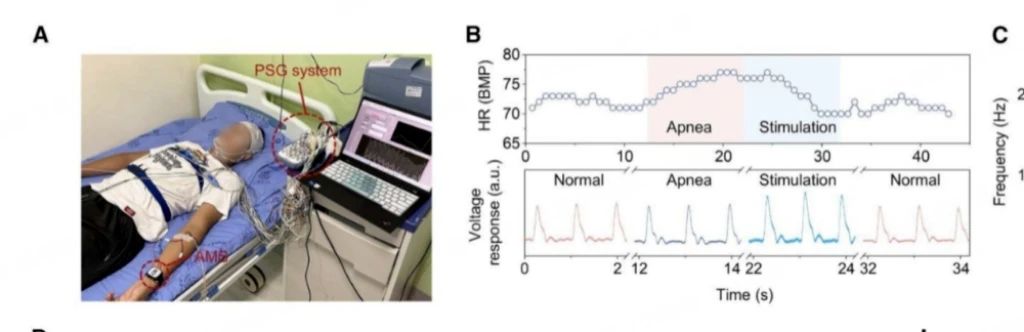
Building on this, the researchers tested the new device alongside "Doctor + Polysomnography" in typical OSA patients.
The results showed that when the clinician detected OSA using polysomnography, the new device also identified the abnormality, demonstrating good consistency in diagnosis between the two methods.
Subsequently, the new device began applying stimulation, and the patient adjusted their sleeping posture. Heart rate, systolic blood pressure, and diastolic blood pressure gradually returned to normal. At this point, polysomnography confirmed that the patient was starting to recover from OSA.
After the patient woke up, the researchers found that they were unaware of the mechanical stimulation applied, indicating that the stimulation had negligible impact on sleep quality.
The researchers noted that, compared to the cumbersome polysomnography detection, the portable new device can be used in home environments and can intervene in OSA quickly without affecting sleep, making it a promising tool for sleep management and home healthcare.
However, the study also pointed out that the device is currently only suitable for mild and positional OSA patients, serving as a supplement to existing clinical diagnostic and treatment approaches.
For severe cases or patients with underlying conditions, such as adenoid hypertrophy or jaw malformations, professional clinical intervention is still necessary.
Additionally, factors like blood pressure and heart rate can be influenced by multiple variables, leading to a certain false-positive rate. The researchers believe that further iterations and upgrades of the sensors, such as metabolic and electrophysiological sensors, are needed to provide a deeper understanding of organ function, improve detection accuracy, and validate the device in larger-scale clinical trials.

