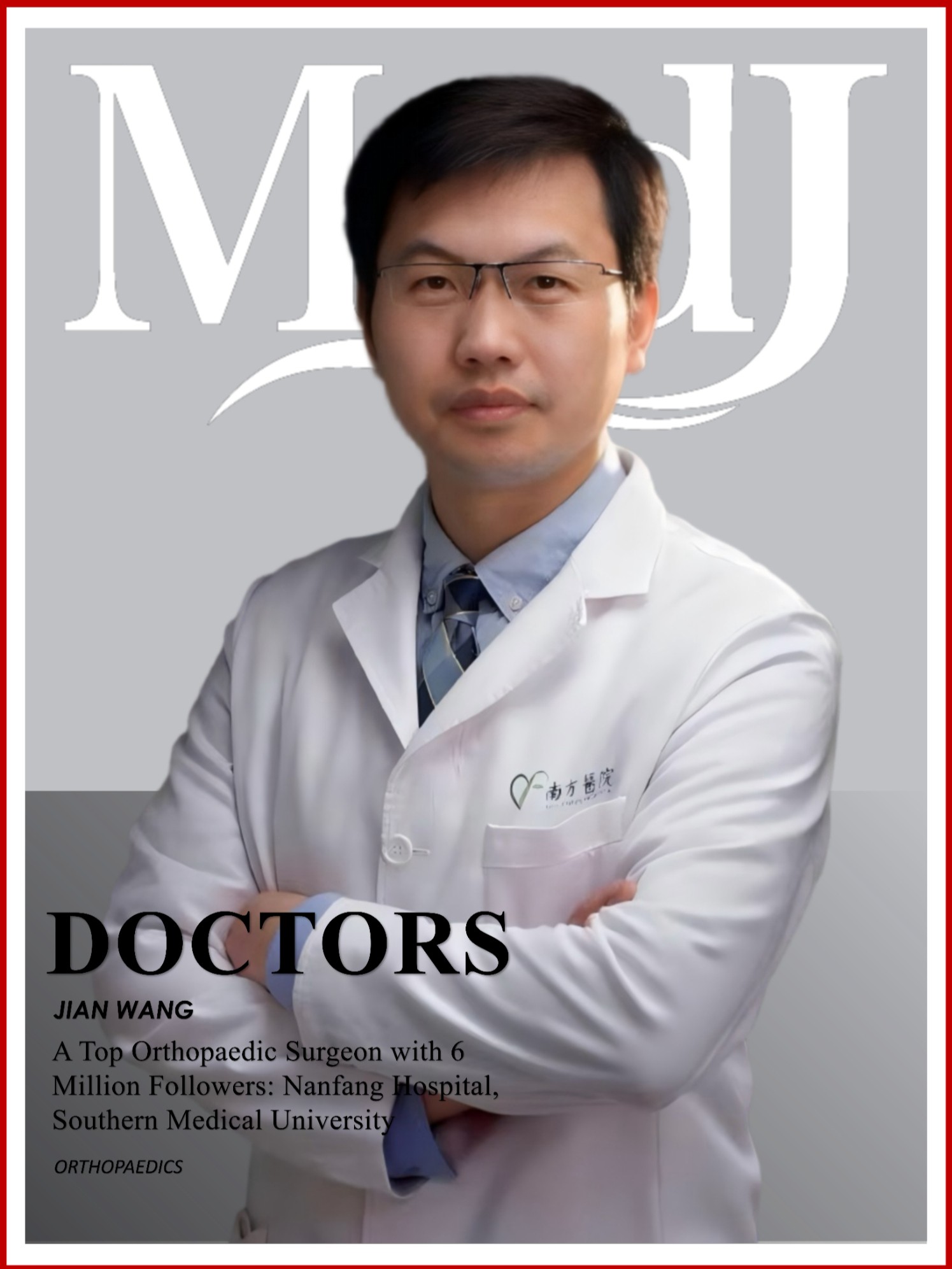
Dr. Wang Jian from Southern Medical University's Nanfang Hospital has two identities: chief physician and medical influencer.
As an orthopedic surgeon specializing in joints and bone diseases, he has completed the first "heart repair" and joint replacement surgery in the country and is the first in the South China region to obtain the qualification for "orthopedic robot surgery." He performs more than 500 complex orthopedic surgeries every year.
As a medical influencer, Dr. Wang Jian has over 6 million followers across various platforms, with content views exceeding 2.1 billion. In July 2024, he was elected as the director of the Health Media Committee of the Guangdong Provincial Medical Association, transitioning from a "guerrilla" to a "regular army."
After 21 years of medical science popularization, Dr. Wang Jian has been questioned by peers for "not focusing on his main business," yet he has also created multiple works with over 100,000 and 1 million views. He hopes that more doctors will participate in medical science popularization and convey accurate medical information to the public.
Starting Popularization to "Be Lazy"
Dr. Wang Jian is one of the earliest doctors in China to engage in science popularization. In 2004, after graduating from the integrated master's and bachelor's program at the First Military Medical University of the People's Liberation Army (now Southern Medical University), he started working at Southern Medical University's Nanfang Hospital and began his journey in medical science popularization that year.
"Initially, I started popularization to 'be lazy' and wanted to finish outpatient clinics sooner," Dr. Wang Jian admitted to Medical Circles. In his department, avascular necrosis of the femoral head and knee arthritis are the most common diseases, accounting for the majority of patients. He had to repeat the same medical advice dozens of times during each outpatient session, which was very inefficient.
How could he efficiently finish outpatient clinics? How could he free up time to see more patients and perform more surgeries? Science popularization thus entered Dr. Wang Jian's view.
Unlike today's short videos and public accounts, in the era when Dr. Wang Jian first encountered medical science popularization, 3G mobile phones had not yet appeared, and no one knew what public accounts were.
He and his colleagues came up with the idea of creating science popularization booklets, printing treatment plans for common orthopedic diseases, daily precautions, preventive measures, etc., on them. They would give a booklet to patients with corresponding symptoms, and other interested patients could also take them as needed.
The good news was that Dr. Wang Jian's outpatient efficiency improved, and he no longer had to repeatedly introduce some diseases to patients. However, as more booklets were distributed, the number of patients in the department also increased, and the goal of "finishing outpatient clinics sooner" still could not be achieved.
"Patients showed the booklets to their relatives, friends, and neighbors in the community. After reading them, they came to us with the booklets, wanting to check if they had the same problems," Dr. Wang Jian said. Some patients indeed found abnormalities, but fortunately, they were discovered early, and the conservative treatment was effective. They still do not need surgery to this day.
Science popularization not only helped patients but also increased the department's fame, which surprised and satisfied Dr. Wang Jian. Since then, he has developed a strong interest in science popularization and continuously updated his methods of medical science popularization with the rise of microblogs and short videos, becoming a medical "influencer."
Questioned by Peers for "Not Focusing on Main Business"
How many patients can a doctor see by continuously treating them in a year? Dr. Wang Jian told Medical Circles that he has three outpatient sessions per week, seeing 40 patients each time, and can see more than 5,000 people in a year. "But a single piece of medical science popularization could potentially reach 100,000, 500,000, or even 1 million people."
As early as 2016, Dr. Wang Jian became well-known with a text and image work related to arthritis, which garnered over 1 million views. This shocked him.
"At that time, achieving over 100,000 views was something to be proud of. I shared that article on my social media, and many medical peers said they finally saw an article with over 100,000 views. I felt that I could not see 1 million patients in my lifetime," Dr. Wang Jian said.
Encouraged by this, he successively opened accounts on various social platforms and used fragmented time such as after work and during lunch breaks to create content. At that time, to write a text and image popularization piece that was easy to understand and accurate, Dr. Wang Jian had to consult a large number of documents and repeatedly revise individual sentences, often staying up late into the night.
He admitted to Medical Circles that although writing text and image popularization was time-consuming and laborious, he still persisted. During this period, Dr. Wang Jian continuously produced hit articles with 100,000+, 200,000+, and 500,000+ views. After gaining some fame, many peers questioned why he "was not focusing on his main business": clinical doctors should just focus on treating patients; why waste spare time on popularization?
Even Dr. Wang Jian himself wavered at times. However, as his popularization articles increased, more and more patients came to see him specifically. Dr. Wang Jian said that these patients who came to him because of his popularization brought him great motivation.
For an orthopedic doctor, forming a "brand effect" through popularization is not easy. Dr. Wang Jian told Medical Circles that although diseases like knee arthritis and avascular necrosis of the femoral head are common in orthopedics, compared to chronic diseases like hypertension and diabetes, the patient volume is still much smaller, and few users specifically pay attention to orthopedic doctors.
To expand his user base, Dr. Wang Jian considered creating content on more attention-grabbing topics such as sexual health but eventually gave up. "I don't want to attract people who are just there for the spectacle; I want to reach those who truly have orthopedic health needs."
Dr. Wang Jian believes that persisting in a niche field to create regular and in-depth popularization can better demonstrate a doctor's professionalism and increase patients' trust. "If you only popularize one type of disease, when patients have needs and search online, they will see your name repeatedly, which will leave a particularly deep impression. After they are cured, they will also refer other patients to you."
Although based in Guangzhou, Dr. Wang Jian's patients come from all over the country. Patients from Xinjiang, Gansu, Inner Mongolia, and other places travel across half of China to see him specifically. Dr. Wang Jian has even summarized a pattern: "Kuaishou attracts more patients from the north, while Douyin attracts more from the south."
Many young women from Xiaohongshu (Little Red Book) also bring their parents to see Dr. Wang Jian. Although joint diseases mainly affect elderly patients, Dr. Wang Jian found that over 80% of his fans are young people aged 20–30. "Users who find a content creator's posts valuable will casually follow them, and when they need help, they will remember that there is a doctor who specializes in this disease."
21 Years of Persisting in Personal Popularization
This year marks the 21st year of Dr. Wang Jian's popularization efforts, and he has accumulated over 6 million followers with a total of over 2.1 billion views on his popularization content. "Although it's not comparable to the top accounts in popular departments, it's still number one or two among orthopedic doctors."
In recent years, Dr. Wang Jian has noticed that his popularization account is continuously losing followers. He analyzed that this might be related to the platform's algorithm. Since medical science popularization has low profit margins, the platforms have reduced related investments. In the past, a single video of his could reach over 80 million views, which is hard to achieve now.
Dr. Wang Jian understands the platforms' approach. Compared to sensational and entertaining content, medical science popularization naturally lacks appeal. "After work, everyday people open their phones and would definitely find it boring to see doctors earnestly imparting knowledge. Instead, they prefer to hear doctors talk about gossip, scandals, and other hospital anecdotes."
For departments like urology, obstetrics and gynecology, and emergency medicine, doctors can weave medical knowledge into more entertaining storytelling. However, for rare diseases and other niche specialties, straightforward educational content is unavoidable. Over the years, Dr. Wang Jian has been communicating with short video platforms, hoping for more traffic support for niche specialties, but with little effect.
Another reason for losing followers is that from video topics to shooting and editing, Dr. Wang Jian insists on completing everything by himself. After being promoted to chief physician, he has to see more patients, perform more surgeries, lead a team, and conduct research, making it increasingly difficult to find time to shoot videos, and his update frequency has gradually fallen behind some top accounts.
"Now, without professional team guidance, it's still very difficult for me to make videos vivid and eye-catching," Dr. Wang Jian said. If it's like this for him, it's even harder for other doctors who are just starting out in popularization. Lack of platform support will make it difficult for them to build up their accounts, gradually causing them to lose interest and confidence in popularization.
In fact, many MCNs (Multi-Channel Networks) and short video platform operation teams have approached Dr. Wang Jian to discuss cooperation, promising to help him with shooting and editing, and even creating viral topics and crafting a public persona to help him gain more followers. However, after carefully considering the details, Dr. Wang Jian refused all of them.
"Cooperating with a third party means having to follow their rules and embedding a lot of commercial content in the videos. On one hand, it's very restrictive and lacks freedom; on the other hand, it deviates from my original intention of doing popularization," Dr. Wang Jian explained to Medical Circles.
Even after so many years of popularization, he has found that there are still many cases of excessive and ineffective medical treatments in reality. In July 2024, Dr. Wang Jian led many doctors to compile A Complete Guide to Femoral Head Necrosis — Diagnosis, Treatment, and Rehabilitation, to correct public misconceptions about the diagnosis and treatment of femoral head necrosis.
At the same time, his other orthopedic popularization book, Knee Osteoarthritis Care Guide, won topic support from the 2024 Guangzhou Popular Science Works Competition and will be published soon. "I hope patients will not be misled by incorrect medical information and suffer irreversible consequences," Dr. Wang Jian said.