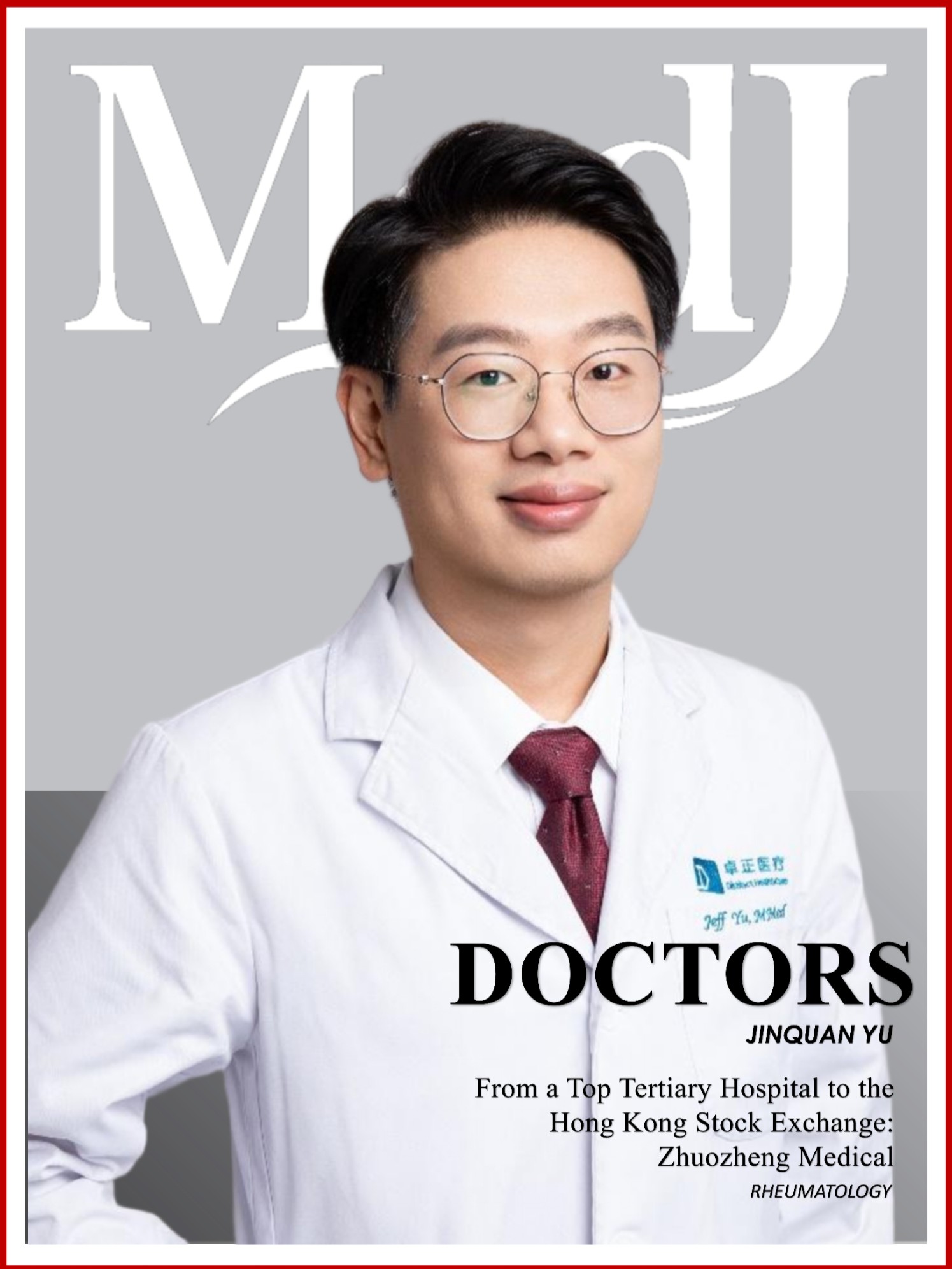
On February 6, 2026, Zhuozheng Medical was officially listed on the Hong Kong Stock Exchange. When the bell rang, Dr. Jinquan Yu witnessed the moment as a physician representative. “This was not something that happened suddenly, but I was even more excited than I had expected,” he said.
Ten years earlier, Dr. Yu had resigned from the First Affiliated Hospital of Sun Yat-sen University. He later worked for three years at The University of Hong Kong-Shenzhen Hospital and ultimately joined Zhuozheng Medical, which had been founded only a short time before and had almost no name recognition. Today, he has taken on both clinical and managerial responsibilities and has carved out a highly distinctive path for the development of a young physician.
It was a decision full of “adventure.” Against the backdrop of widespread market difficulties for non-public medical care, his choice to leave a public hospital was once described by others as “having water in his brain.” But Dr. Yu told MedJ that although his workplace has changed, his original commitment to clinical medicine has never changed.
“All this tossing about was only to become a better version of myself,” said Dr. Yu.
Taking an Unconventional Road: A Young Doctor’s “Triple Jump”
In 2009, Dr. Yu graduated from Sun Yat-sen University Zhongshan School of Medicine and successfully stayed on to work at the First Affiliated Hospital of Sun Yat-sen University. It had been his “dream hospital” in his student days.
“To stay in the best hospital and then keep getting promoted—isn’t that usually how medicine works?” Dr. Yu recalled to MedJ. At the time, both his clinical and research performance were strong among peers of the same age, and there should have been no problem obtaining professional promotion.
The First Affiliated Hospital of Sun Yat-sen University ranked first in South China, and the Department of Rheumatology and Immunology where Dr. Yu worked was likewise an industry leader.
It was one of the earliest units in China to establish rheumatology and immunology. The department’s founder, Prof. Xiuyan Yang—Dr. Yu’s clinical mentor—and Prof. Hanshi Xu, his master’s supervisor, were both renowned rheumatology experts in China. The department attracted critically ill and difficult patients with a wide range of rheumatic and immune diseases, and registration for clinic appointments was perennially hard to obtain.
A top platform, formal staffing, and smooth promotion prospects—precisely because of this, when Dr. Yu resigned from the hospital, many people felt either that “something was wrong with his brain” or that “his head had been caught in a door.”
“In rheumatology, there are very few doctors like me who do not take the conventional path,” said Dr. Yu.
“A person may not always know what he wants, but he definitely knows what he does not want.” Dr. Yu said that although he was capable of doing research and writing papers, he did not enjoy laboratory work unrelated to clinical practice. What he enjoyed more was communicating with patients and spending time thinking through disease conditions.
“The assessment system in traditional public hospitals places greater weight on research, while clinical work is relatively hard to quantify,” Dr. Yu said.
Compared with the quantifiable nature of research—how many projects were applied for, what level they were, how much funding was obtained, what papers were written, and how many SCI points they carried—clinical work is often measured by how many night shifts one has taken or how many patients one has seen. These figures can clearly show workload, but they cannot show what Dr. Yu wanted most: the quality of care.
In September 2013, with new ideals and hopes, Dr. Yu went to The University of Hong Kong-Shenzhen Hospital. The hospital had opened only in July 2012. It was established by the Shenzhen Municipal Government and operated by The University of Hong Kong. Although it was a public hospital, it did not use the formal staffing system and instead hired all staff on contracts renewed every three years.
“You could call it semi-institutional,” he said. What attracted Dr. Yu included innovative models such as appointment-based care, de-administration, and transparent compensation. What attracted him even more was that the then head of rheumatology, Prof. Chak-sing Lau, former president of the Asia Pacific League of Associations for Rheumatology and now vice-president of The University of Hong Kong and dean of its medical faculty, was there. “I really wanted to see what the style of a true international giant would be like.”
During those years at The University of Hong Kong-Shenzhen Hospital, Dr. Yu felt he gained a great deal. Prof. Lau and Prof. Zhimei Zhu gave him profound insights into evidence-based medicine and a general practice perspective.
Moreover, although he was still a relatively junior attending physician, Dr. Yu “made quite a stir”: he participated in establishing a gout specialty clinic, founded a lupus specialty clinic, set up a patient association, and ran patient communities.
“Here, as long as you have the ability and are willing to try, you can do things,” Dr. Yu said. Away from the protection of his teachers, many matters required him to make decisions independently, which trained his ability to stand on his own. Yet soon after his three-year term at The University of Hong Kong-Shenzhen Hospital ended, he once again took an unconventional road.
At that time, a number of major public tertiary hospitals offered him positions, but Dr. Yu ultimately chose Zhuozheng Medical, a private medical clinic.
“The First Affiliated Hospital of Sun Yat-sen University, The University of Hong Kong-Shenzhen Hospital, and Zhuozheng Medical—that was a triple jump from within the system to semi-within the system to outside the system,” he summarized.
“Returning to the essence of medicine” is the philosophy of Zhuozheng Medical, and it was also what Dr. Yu identified with. “In work and in career, what I seek is simply a platform where I can steadily do some clinical work.” In addition, private medical care in China has still not been fully developed, and Dr. Yu hoped to embrace it proactively and grow together with it.
After Joining Zhuozheng Medical, Clinical Care Remained the Core
In January 2017, Dr. Yu joined Zhuozheng Medical. At the time, Zhuozheng was still best known for pediatrics, internal medicine was in an expansion phase, and rheumatology was completely blank. Dr. Yu recalled, “I was the only one.”
Everything had to start from scratch. Fortunately, he had already accumulated some “followers”: “Some patients had been seeing me since my days at the First Affiliated Hospital, and some followed me from Hong Kong. That’s how chronic disease works. Once you establish a reputation, patients keep following you. That kind of connection is very rare.”
“But difficulties certainly existed. Outside the system, it is impossible for work to be little, pay to be high, and home to be nearby,” he admitted. Doctors coming out of public hospitals must face a reality gap: after the halo of the platform fades, the number of patients willing to follow you is smaller than one might imagine.
“And Zhuozheng didn’t have the recognition it has now,” Dr. Yu said. “When a doctor decides to leave the system, he or she needs strong self-motivation and an entrepreneurial mindset, and must be prepared for a period of growth and accumulation.”
One year later, Dr. Yu’s outpatient sessions at Zhuozheng were almost fully booked. “It all accumulated gradually through reputation—some were referred by patient communities and some by colleagues.”
Just one year after joining Zhuozheng, Dr. Yu was named 2017 Doctor of the Year for Clinical Service.
“I was really flattered at the time. There were so many doctors, and only two doctors of the year were selected, with only one in the clinical service category.” He analyzed the reasons: “One was the expansion of internal medicine and rheumatology services that I was doing, which patients welcomed. The other may have been that I wrote a great deal of science communication, which was very meaningful for educating patients about evidence-based medicine.”
Since 2015, Dr. Yu has persisted in writing original science communication articles on his personal WeChat public account. At his most productive, he updated almost every day, becoming an important window through which many patients learned about rheumatic and immune diseases and about him himself.
He was also the first contracted columnist for the rheumatology channel of MedJ, writing both for patients and for fellow clinicians. “At the peak, half of the headline pieces were written by me.” This tireless writing brought him greater recognition from both patients and colleagues.
In 2018, Dr. Yu co-authored the popular science book Smiling at Lupus: Beating Lupus Can Be This Simple with his mentor Prof. Yang. It sold out as soon as it was released, and many new patients came because of the book.
After joining Zhuozheng, one of Dr. Yu’s main plans was to establish a lupus specialty clinic. “Zero glucocorticoid use” was a concept he had long advocated. On that basis, he also set up a lupus pregnancy clinic focusing on autoimmune disease complicated by pregnancy, especially systemic lupus erythematosus and antiphospholipid syndrome in pregnancy.
Systemic lupus erythematosus is one of the most complex diseases in rheumatology and commonly affects women of childbearing age, making fertility an issue they must face. Something as ordinary as pregnancy and childbirth can carry high maternal and fetal risk in patients with lupus. For a long time, the view that patients with lupus should not bear children was widely accepted.
With advances in medical technology, however, there are now many means of controlling systemic lupus erythematosus. With standardized treatment, most patients can achieve complete remission. For patients with lupus to live like healthy people and have children like healthy people is no longer an unrealistic dream.
“For those whose disease is already well controlled and who can become pregnant, we do our utmost to help them realize their wish to have children and not leave regret in life,” Dr. Yu said. “This is one of my professional directions, and it is also doing good.”
Over nine years, Dr. Yu has already helped more than 100 patients achieve successful pregnancies. “Good news comes every so often.” Just a few days ago, a patient with lupus who had been seeing him since she was a 20-year-old girl successfully delivered twins. “Helping patients with lupus fulfill their dream of becoming mothers makes me feel that this work is highly meaningful.”
“What we are doing is not something radically new. Based on evidence-based medicine, and within what we are capable of, we individualize diagnosis and treatment and carefully calculate every step for each patient. Many patients become pessimistic after being diagnosed with lupus. We hope to comfort them often and help them always when they are at their most difficult moment,” Dr. Yu said. “A doctor’s high point is not in certificates, but in patients’ hearts and colleagues’ eyes.”
Today, Dr. Yu is not only a clinician at Zhuozheng but also a manager responsible for people, operations, and business. Yet he still insists on seeing patients two days a week. “Being a doctor will always be my base color,” he told MedJ. “No matter how busy work becomes, my profession will always come first.”
What he hopes for is exactly what he wrote in the slogan he gave to MedJ in 2016: “Every doctor who takes clinical work seriously deserves to be warmly treated by this world.”
How Can a Clinician Become a Manager?
Beginning in 2018, besides being a doctor, Dr. Yu also started to hold administrative management positions, including deputy executive director of the medical executive committee of Zhuozheng Medical, joint secretary-general for the Shenzhen-Wuhan region, executive deputy director for the Shenzhen-Wuhan region, head of the Shenzhen region, chair of the regional medical affairs committee, and head of the group dental department.
It was a management path he did not notice at first. “At the beginning I thought it had developed naturally. Later, after talking with the CEO, I learned that it had been intentionally designed. They believed I had management potential, so they arranged for me to train in different positions as a Z-shaped talent development path, so that the pieces of my perspective could be put together more completely,” Dr. Yu said.
In his view, managers of medical institutions should themselves also be excellent doctors, otherwise what they say will be less convincing.
He once wrote that managers with a physician background often face a natural paradox: the persistence that makes a good expert is professional focus, while a good manager often has to look in all directions and listen on all sides.
“Taking on administrative management is not an inevitable choice. What attracts doctors to Zhuozheng is that doctors with different styles can all find a development path that suits them. Doctors not interested in administration can concentrate on clinical care and become excellent doctors recognized by patients and peers; doctors who like discipline building can gain a sense of professional achievement by actively building a department; doctors interested in business and operations can also display their talent and ability in corresponding positions.”
From once finding administrative work cumbersome to actively embracing it, Dr. Yu believes this reflects a change in his stage of personal growth. His own lesson can be summarized in four Chinese characters meaning “many things, but no irritation”: matters may be complex, but the mindset must not become impatient.
“To be honest, it is not easy. There has been research saying that hospital management is the most complex management in the world. Taking 2019, when I first became involved in management, as an example, I read more books outside medicine that year than in the previous ten years combined,” Dr. Yu said. “I am the kind of person who sets high standards for whatever he does, so when I encounter difficulties I try to solve them—look outward and ask inward.”
To make up for his lack of management knowledge, Dr. Yu enrolled in the Executive MBA program at Peking University HSBC Business School outside work. “In the class everyone called me the top scorer. People trained in medicine are very good at studying, and I accidentally came first in the entrance exam.”
In his early years after joining Zhuozheng, Dr. Yu also persisted in clinical research and in writing papers, and his findings were cited by several international guidelines. But a person’s energy is limited after all. As management work deepened, he had to give up research, “but I will never let clinical care fall behind.”
Dr. Yu also does not regard himself as a “leader.” Recently, a newly joined doctor sent him a message saying that Zhuozheng’s management style is “a style of helping and supporting management”—not a relationship between manager and managed, but one that tries as much as possible to help doctors find a better development direction and a better practice state.
Dr. Yu felt that summary was very accurate: “We work together to get things done, rather than one person managing another.”
In 2025, Dr. Yu’s responsibilities expanded again—he also began serving concurrently as head of the dental department of Zhuozheng Medical Group. An internist managing dentistry sounds like a major cross-disciplinary move, but in Zhuozheng’s context it is “an old hand doing something new.”
“I want to get into it and see whether we can find a different path. To build a dental service that, while ensuring a high standard of medical quality, does not rely on marketing to acquire patients and still achieves both medical and business success is itself quite an impressive thing,” Dr. Yu said. “Not relying on marketing” has always been a core logic of Zhuozheng.
From a one-person department to leading a regional team of more than 300 people, including 90 full-time doctors, nine years have brought more transformation to Dr. Yu. “My perspective has become more diversified. Before, it was more of an expert’s perspective. After going through many positions, the dimensions from which I view problems have become much richer. What has not changed is change itself and the mindset of embracing change.”
For doctors who are hesitating over whether to leave the public system, Dr. Yu’s advice is straightforward: have a clear career plan. “The earlier you understand what you want, what kind of practice state you expect, and which kind of road suits you better, the more likely you are to proceed steadily.”
Asked whom he most wanted to thank along the way, Dr. Yu almost did not hesitate: “First, I thank myself, thank the self who dared to choose back then… Leaving the First Affiliated Hospital to go to Hong Kong, and then leaving Hong Kong to choose Zhuozheng—at the time several roads were in front of me, and in the end I chose this one.” In addition, he remains grateful to the partners who fought alongside him and the supervisors who always tolerated him.
As for the future, he said, “As the platform keeps developing, there are constantly new things to do. Serving clinical patients well, taking regional development to the next level, and this new field of dentistry—I think there is already plenty to do.”
If he had to speak of a more ambitious plan, “it would be Zhuozheng’s vision: together with everyone, to build the most respected private medical institution and the preferred practice platform for doctors,” Dr. Yu said.