


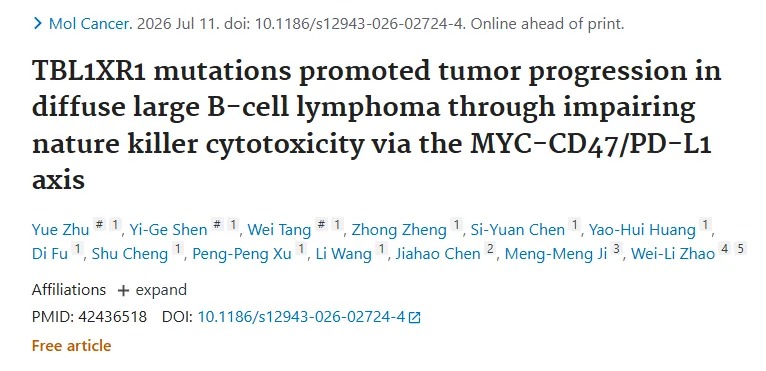
In July 2026, the team of Prof. Weili Zhao at the Shanghai Institute of Hematology published a paper in Molecular Cancer (IF 42.2) titled “TBL1XR1 mutations promoted tumor progression in diffuse large B-cell lymphoma through impairing nature killer cytotoxicity via the MYC-CD47/PD-L1 axis.”
Co-corresponding authors: Prof. Weili Zhao, Associate Chief Physician Mengmeng Ji, and Associate Researcher Jiahao Chen of the Shanghai Institute of Hematology. Co-first authors: Postdoctoral Fellows Yue Zhu and Yige Shen, and Chief Physician Wei Tang, all of the Shanghai Institute of Hematology.
DLBCL is the major subtype of non-Hodgkin lymphoma, with diverse clinical, immunophenotypic, and genetic features. In recent years, genomic analyses have further revealed the molecular subtypes of DLBCL and the association of gene mutations with prognosis. The MCD subtype, characterized by MYD88 L265P, CD79B, and TBL1XR1 mutations, shows MYC overexpression and achieves immune escape through PD-L1 upregulation and suppression of natural killer (NK) cell function, mediating unfavorable clinical outcomes. The biological heterogeneity of DLBCL arises not only from genomic alterations but also from dynamic interactions between tumor cells and the tumor microenvironment. However, the role of TBL1XR1 mutations in regulating the DLBCL tumor microenvironment has remained to be clarified.
In the present study, clinical cohort, DNA sequencing, RNA sequencing, and Cut&Tag sequencing analyses were used to systematically dissect the specific molecular mechanism by which TBL1XR1 mutations promote tumor progression through regulation of the DLBCL tumor microenvironment. Based on a clinical cohort of 1,842 newly diagnosed DLBCL patients, the study found that TBL1XR1-mutated patients had a higher proportion of patients older than 60 years, those with high-risk International Prognostic Index (IPI) scores, and those of the non-GCB subtype, and indicated that progression-free survival and overall survival were significantly shortened in TBL1XR1-mutated patients. Meanwhile, the MYC protein activity pathway was the most significantly enriched in TBL1XR1-mutated patients, accompanied by upregulation of MYC, CD47, and PD-L1 at the transcript and protein levels.
In vitro studies showed that TBL1XR1 mutations cause upregulation of MYC, CD47, and PD-L1 at the transcript and protein levels, while inhibition of MYC expression significantly downregulates CD47 and PD-L1 expression. Further mechanistic dissection revealed that TBL1XR1 mutations enhance H3K27ac modification at the MYC promoter region, promoting MYC transcriptional activation, which in turn upregulates the transcriptional activation and expression of its downstream immunoregulatory targets CD47 and PD-L1.
To further characterize the changes in the immune microenvironment induced by TBL1XR1 mutations, TBL1XR1-mutated patients showed impaired NK cell function. In vitro co-culture experiments showed that TBL1XR1 mutations suppress NK cell function and downregulate their cytotoxicity against lymphoma cell lines, while combined anti-CD47 and anti-PD-L1 antibody treatment can reverse NK cell dysfunction. In the A20 mouse B lymphoma model, Tbl1xr1 mutation upregulated MYC, CD47, and PD-L1 expression, and through this axis caused NK cell dysfunction and accelerated tumor growth, whereas combined blockade of CD47 and PD-L1 effectively restored NK cell-mediated antitumor immunity and significantly inhibited the growth of mutated tumors.
This study demonstrates that TBL1XR1 mutations mediate the formation of an immunosuppressive tumor microenvironment and promote DLBCL progression through epigenetic regulation of the MYC-CD47/PD-L1 axis, providing important theoretical evidence and application prospects for designing targeted therapeutic strategies for TBL1XR1-mutated DLBCL patients.
The study provides an in-depth elucidation, from patient tumors, cell lines, and animal models, of the molecular mechanism by which TBL1XR1 mutations mediate epigenetic regulation of MYC-CD47/PD-L1 to suppress NK cell antitumor immunity. It provides a theoretical foundation for novel therapeutic strategies targeting the “mutation-epigenetic regulation-tumor immunity” regulatory network, and offers new directions for targeting TBL1XR1-mutated tumors, with important clinical translation prospects.
Author Profiles
Prof. Weili Zhao: Chief physician, professor, doctoral supervisor; Vice President, Ruijin Hospital, Shanghai Jiao Tong University School of Medicine; Director, Shanghai Institute of Hematology. Research focus: pathogenesis and targeted therapy of lymphoma.
Prof. Mengmeng Ji: Associate chief physician, master’s supervisor, Ruijin Hospital, Shanghai Jiao Tong University School of Medicine / Shanghai Institute of Hematology. Research focus: clinical and translational research in malignant lymphoma.
Prof. Jiahao Chen: Principal Investigator / Associate Researcher, master’s supervisor, Ruijin Hospital, Shanghai Jiao Tong University School of Medicine / Shanghai Institute of Hematology. Research focus: molecular mechanisms and targeted interventions in hematologic malignancies and transplantation immunology.
Prof. Yue Zhu: Clinical postdoctoral fellow, Ruijin Hospital, Shanghai Jiao Tong University School of Medicine / Shanghai Institute of Hematology. Research focus: clinical and translational research in malignant lymphoma.
Prof. Yige Shen: Clinical postdoctoral fellow, Ruijin Hospital, Shanghai Jiao Tong University School of Medicine / Shanghai Institute of Hematology. Research focus: clinical and translational research in malignant lymphoma.
Prof. Wei Tang: Chief physician, Ruijin Hospital, Shanghai Jiao Tong University School of Medicine. Research focus: clinical and translational research in malignant lymphoma.

