


Syphilis is a well-known sexually transmitted infection, but have you ever heard of gastric syphilis?
According to official information from Changhai Hospital, on March 2, 2024, an article titled "Gastric Syphilis" from the hospital's Dermatology Department was officially published in the New England Journal of Medicine's "Clinical Medical Images" section. The article introduces the consultation process of a gastric syphilis patient and details the clinical treatment course.
Currently, syphilis remains a global public health problem. It is a chronic, systemic disease caused by Treponema pallidum, with strong infectivity. In its early stages, it primarily affects the skin and external genitalia, but can also cause damage to other tissues and organs throughout the body. Gastric syphilis, occurring in the stomach, results from the invasion of the gastric wall by Treponema pallidum and is a rare gastric disease.
As early as 1834, Andral first reported two cases of gastric syphilis. Since then, case reports of gastric syphilis have been scattered globally, remaining relatively rare overall. The recently reported patient from Changhai Hospital is a 32-year-old who initially presented at the internal medicine outpatient clinic with a two-week history of upper abdominal pain, nausea, poor appetite, and weight loss.
Upon arrival at the hospital, physical examination revealed upper abdominal tenderness. An abdominal CT scan showed thickening of the antral wall. Endoscopy revealed a 4.0 cm x 5.0 cm ulcer in the gastric antrum (Image A below) and a 1.2 cm x 1.2 cm ulcer on the greater curvature of the stomach (Image B below), suggestive of gastric cancer. Ulcer biopsy specimens showed infiltration of lymphocytes, neutrophils, and plasma cells, with no tumor cells seen.
Through further detailed history-taking, the patient reported experiencing a genital ulcer one month before seeking medical attention. Subsequently performed serological tests were positive: the Treponema pallidum particle agglutination test was positive, and the rapid plasma reagin (RPR) titer was positive at 1:128. Immunohistochemical staining of the ulcer biopsy specimen for Treponema pallidum was positive (Image C below). The human immunodeficiency virus test was negative.
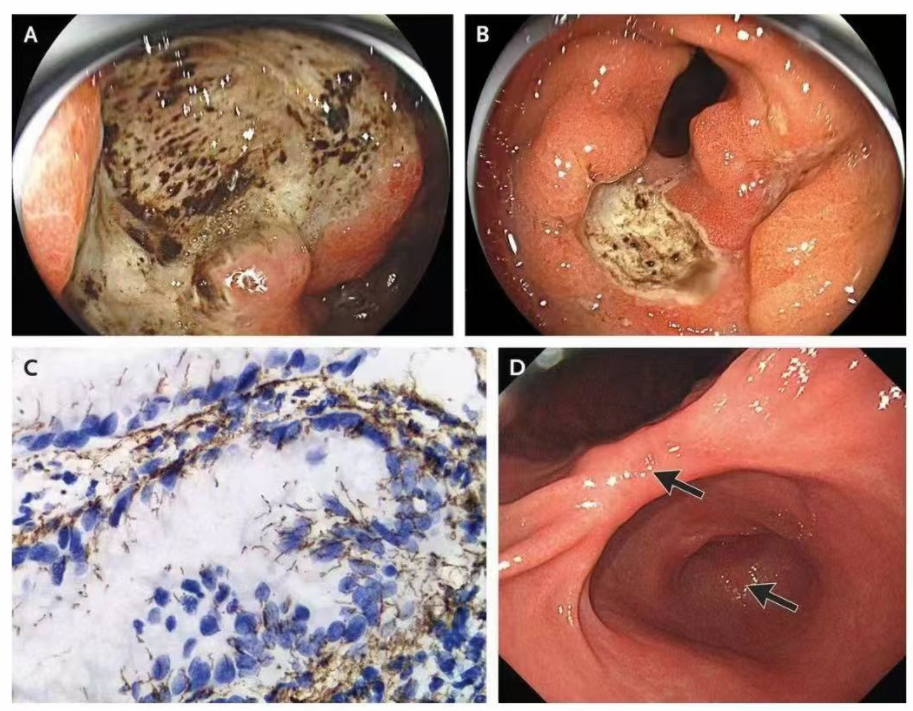
Image source: Changhai Hospital
Ultimately, this patient was diagnosed with gastric syphilis. In fact, the clinical symptoms of gastric syphilis are diverse and lack specificity, with an incidence of <1%, leading to a considerable number of patients being misdiagnosed and mistreated.
MedJ's review found that in 2011, the Department of Gastroenterology at Dalian Third People's Hospital in Liaoning Province reported a case of gastric syphilis in the journal Gastroenterology. The article stated that both congenital and acquired syphilis can involve the stomach, and it is generally believed that gastric lesions are caused by secondary or tertiary syphilis. "Gastric syphilis is very rare clinically."
"Due to the lack of specific clinical manifestations and the fact that endoscopic and imaging findings often resemble advanced gastric cancer or gastric lymphoma, the diagnosis of gastric syphilis is challenging and prone to clinical misdiagnosis. Syphilis serological tests and histological examination are necessary for differentiation." The paper also mentioned that such patients often conceal their history of unclean sexual contacts, which further adds to the diagnostic difficulty.
In 2015, the Hanjiang District Center for Disease Control and Prevention in Yangzhou City, Jiangsu Province, also reported a case of gastric syphilis in the Chinese Journal of Leprosy and Skin Diseases. The paper described gastric syphilis as a rare condition, with clinical manifestations including abdominal distension, abdominal pain, acid reflux, nausea, heartburn, poor appetite, weight loss, melena, and other symptoms.
The article emphasized that gastroscopic findings in gastric syphilis patients are non-specific, making it difficult to differentiate from gastric cancer endoscopically. It is noteworthy that this reported gastric syphilis case from Yangzhou was initially misdiagnosed as acute gastritis. The local CDC analyzed the reasons for misdiagnosis as follows:
"Gastric syphilis is rare, and the patient's clinical manifestations are non-specific; non-venereology doctors have insufficient knowledge of syphilis; besides gastric symptoms, the patient lacked other manifestations of syphilis, such as chancres or syphilitic rashes."
Regarding misdiagnosis of gastric syphilis, the journal Sexually Transmitted Diseases published a paper in 2010 titled "Gastric Syphilis: A Systematic Review of Published Cases of the Last 50 Years." The paper pointed out that due to the non-specific clinical presentation, gastric syphilis is often misdiagnosed as other gastric diseases, and 17% of patients underwent surgical treatment due to complications and suspected malignancy.
Exploring the reasons, the Hanjiang District CDC in Yangzhou explained that syphilis is a systemic disease with a long course and complex symptoms that can resemble many other diseases. Therefore, clinicians, endoscopists, and pathologists must be familiar with this disease, and its possibility should be considered and ruled out in diagnoses across various clinical specialties.
"To reduce misdiagnosis and missed diagnosis of syphilis, it is essential to conduct in-depth and detailed history-taking, especially regarding any history of unclean sexual contacts, the health status of spouses, and history of sexually transmitted diseases; perform comprehensive physical examinations and promptly consult with dermatology and venereology doctors; conduct syphilis-related laboratory tests, such as initial screening with RPR or USR tests, alongside Treponema pallidum antigen tests for further confirmation."
Beyond the stomach, MedJ's review found that in recent years, with the rising incidence of syphilis, cases involving the eyes, oropharynx, larynx, and heart have also been commonly reported. For example, the Chinese Journal of Interventional Cardiology published a case report on "Syphilitic Cardiovascular Disease" in 2020; this patient was ultimately diagnosed with syphilitic aortitis.
Regarding treatment, Changhai Hospital also detailed the treatment process for this gastric syphilis patient: receiving benzathine penicillin G at 2.4 million units intramuscularly, once weekly for three weeks. Two weeks after starting treatment, the patient's symptoms significantly improved. Four months after treatment completion, follow-up RPR titer decreased to 1:4, and repeat endoscopy showed the ulcers had healed (Image D above).
Multiple medical institutions that have reported cases of gastric syphilis also point out that gastric syphilis is a treatable disease. Early, standardized, effective, sufficient, and full-course treatment with long-acting benzathine penicillin, combined with other adjuvant therapies, can provide patients with satisfactory outcomes and prognosis. Additionally, surgical intervention may be considered for patients with severe lesions.

