


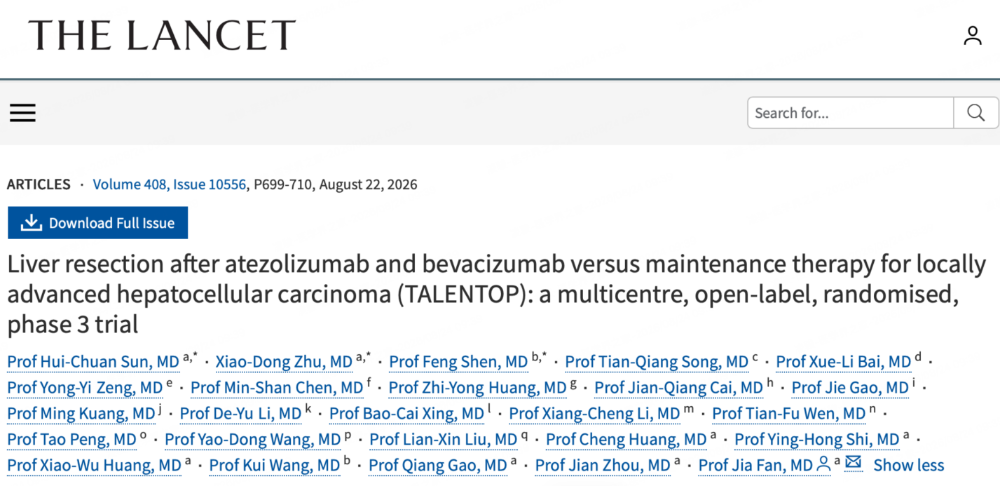
On 22 August 2026, The Lancet published online a new study from a Chinese clinical team that adds evidence for the management of some patients with locally advanced hepatocellular carcinoma (HCC).
The study was led by Academician Jia Fan’s team at Zhongshan Hospital, Fudan University, in collaboration with 24 major hepatobiliary cancer centers across China. In patients with locally advanced HCC who achieved tumor control on atezolizumab plus bevacizumab and who were eligible for surgical resection, the investigators found that surgery followed by continued systemic therapy significantly extended time to treatment failure (TTF) compared with continued systemic therapy alone.
HCC remains one of the malignancies that pose the most serious threat to health in China. The majority of patients are diagnosed at intermediate or advanced stage, when curative-intent options are no longer feasible and prognosis is poor. With the progressive improvement of systemic regimens represented by atezolizumab plus bevacizumab, median overall survival in advanced HCC has reportedly extended from approximately one year to nearly two years, although overall outcomes are still considered unsatisfactory.
In clinical practice, the investigators noted, a subset of patients with advanced HCC achieve tumor shrinkage or downstaging on systemic therapy and become candidates for surgical resection. Whether such patients should proceed to surgery or continue on drug therapy is a real-world decision dilemma for clinicians, patients, and families.
On the one hand, surgery can remove residual drug-resistant tumor cells and offers a chance of curative-intent treatment; on the other, perioperative interruption of systemic therapy risks loss of tumor control, and surgery itself adds procedural trauma. Whether resection is truly superior to continued systemic therapy requires high-level evidence.
To address this question, the team designed an investigator-initiated, national, multicenter, open-label, randomized Phase III trial—TALENTOP—with the principal results now published in The Lancet.
Study Design
In TALENTOP, patients with locally advanced HCC and vascular tumor thrombus received atezolizumab plus bevacizumab for four cycles. Those without radiographic tumor progression and whose tumors were deemed resectable were then randomized to:
- Group A: surgical resection, followed by atezolizumab and bevacizumab for up to one year.
- Group B: continued systemic therapy.
A total of 489 patients entered the study and received systemic therapy, of whom 201 were randomized.
Primary Results
At the first interim analysis, the study met its primary endpoint. Compared with continued drug therapy, surgery followed by adjuvant systemic therapy significantly improved time to treatment failure (TTF).
In simple terms, the time from randomization to recurrence or death in Group A was significantly longer than the time from randomization to tumor progression or death in Group B—an extension of nearly twofold (20.4 months vs 11.8 months; HR=0.60, P=0.015).
The benefit of surgical treatment was consistent across key subgroup analyses. Overall survival follow-up is continuing. A preliminary survival analysis showed a trend favoring Group A (HR=0.67), but the data have not yet matured.
Safety
Surgery was associated with a higher rate of adverse events. Grade 3-4 treatment-related adverse event rates were 39% in Group A versus 21% in Group B.
Interpretation
The study authors concluded that, in patients with advanced HCC who have responded to treatment, surgical resection may offer a chance of tumor-free survival. The findings, they suggested, have the potential to influence HCC clinical practice both in China and internationally. Patients receiving systemic therapy for advanced HCC, while undergoing scheduled imaging assessment of response, may also benefit from multidisciplinary team evaluation of resectability and the potential benefits of surgery.
Editorial Commentary
In a same-issue commentary in The Lancet, Prof. Alejandro Forner of Spain wrote that the authors should be commended for designing and conducting this complex study. The trial, he noted, is the first multicenter, randomized Phase III study to evaluate whether surgical resection can benefit patients with advanced HCC who have responded to systemic therapy. The findings suggest that resection of the tumor and its macroscopically visible vascular tumor thrombus may help prevent systemic dissemination, converting transient systemic disease control into durable remission.

Context and Continuing Work
In the field of conversion therapy for HCC, the Zhongshan Hospital team—led by Academicians Jia Fan and Zhou Jian and Prof. Sun Huichuan—has previously led multiple retrospective and prospective studies. The team previously chaired the development of two Chinese expert consensus documents on HCC conversion therapy (2021 and 2024 editions). Several additional conversion-therapy studies are ongoing, with the aim of bringing surgery and the chance of tumor-free survival to more patients with intermediate and advanced HCC.
The corresponding author of the paper is Academician Jia Fan, Zhongshan Hospital, Fudan University. The co-first authors are Prof. Sun Huichuan and Associate Chief Physician Zhu Xiaodong (both Zhongshan Hospital, Fudan University), and Prof. Shen Feng (Third Affiliated Hospital of Naval Medical University).

