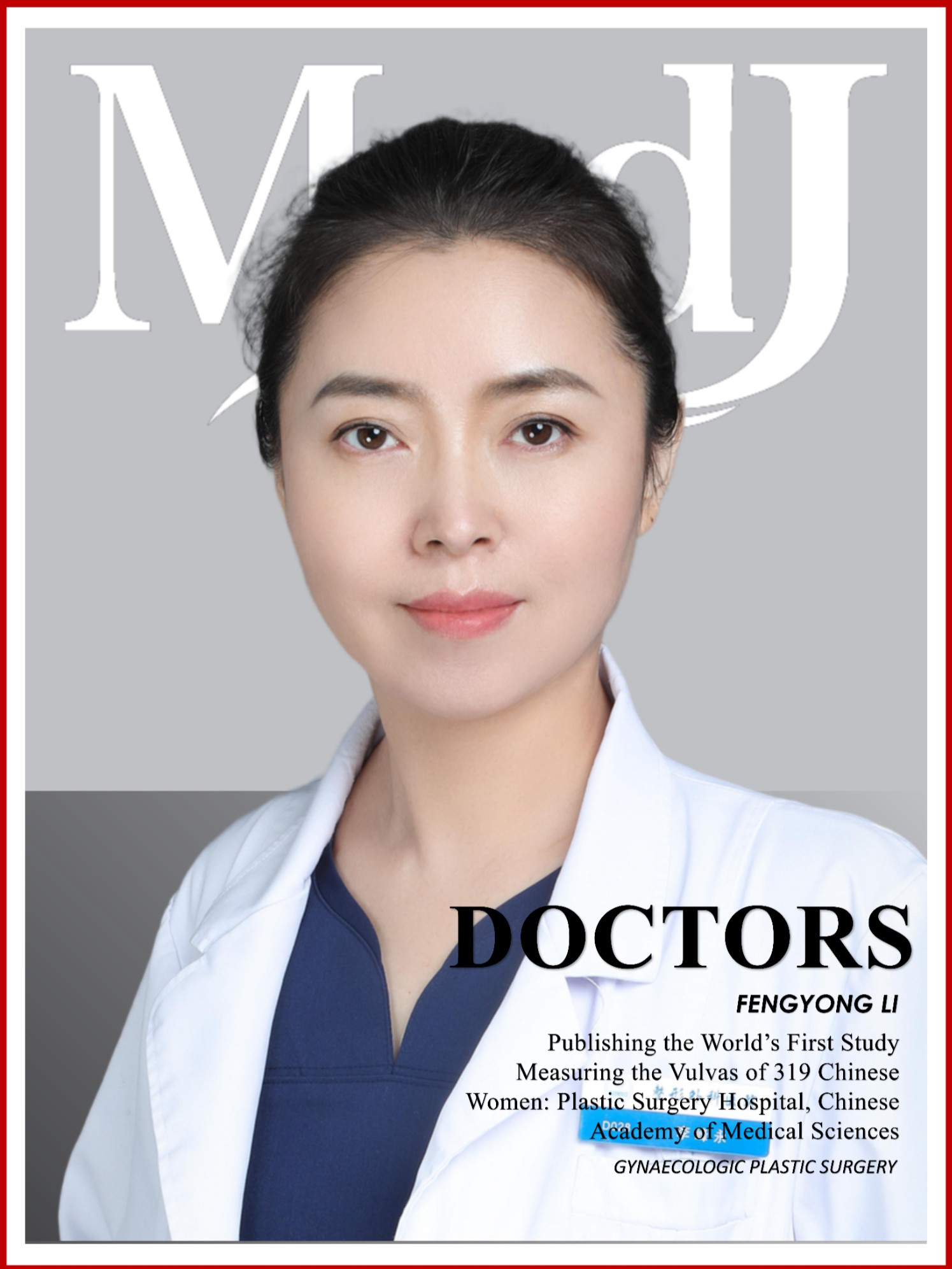
In October 2014, the International Urogynecology Journal published the world's first study to measure the vulvar anatomy of Chinese women. Over three years, the researchers measured the vulvas of 319 Chinese women.
The project was carried out by physicians from the Tenth Department of Plastic Surgery at the Plastic Surgery Hospital of the Chinese Academy of Medical Sciences, also known as the Badachu Plastic Surgery Hospital. Dr. Fengyong Li, one of the paper's authors and an associate chief physician, said that when the department was founded in 2008, the team searched the global literature and still could not find an accurate description of this most private part of the female body.
Not only vulvar anatomy but the entire field of gynecologic plastic surgery was almost blank at that time. Pelvic floor repair and labiaplasty were topics that many women found too embarrassing to discuss. Outsiders often believed such patients were making trouble for no reason, or even implied that they had improper private lives.
Things are different today. In 2022, the Tenth Department of Plastic Surgery was officially renamed the Gynecologic Plastic Surgery Center, and its clinics are now full every day.
From the early days of almost no patients, to a period of wild market growth, and then to an era of improving treatment standards and professional ethics, Dr. Li has witnessed 15 years of development in gynecologic plastic surgery in China. She has also seen women become more economically independent and socially self-aware. Topics once impossible to speak about can now be stated clearly and openly.
A Blank Field Even Internationally
More than a decade ago, a woman in her forties came to our department with a severe urethrovaginal fistula. Whenever she urinated, urine leaked into the vagina and spilled everywhere.
She had previously undergone genital reconstruction elsewhere. The surgeon had removed almost all of her original structures, leaving only a tiny bean-sized piece attached to the pubic bone and telling her that this was the clitoris. Two openings were left below, one for the urethra and one for the vagina, but the labia majora and labia minora had not been reconstructed at all.
The appearance had become so damaged that there was almost no room for further repair. When she came to us, she only hoped that we could solve the fistula. She had no other request.
That case represented the condition of gynecologic plastic and reconstructive care in that era.
Women with enlarged or asymmetric labia minora often had chronic friction and discomfort in daily life. After childbirth, pelvic floor laxity could lead to poor sexual function and urine leakage when coughing or jumping. Yet constrained by traditional views and limited information, most women simply endured it, some for their entire lives.
A small number sought help from obstetrics and gynecology departments, but many were told, 'You are a healthy person, why should you undergo surgery?' Others were told even more bluntly, 'Everyone looks like this. Why are you the only one who cannot tolerate it?' Almost no one paid attention to the aesthetics or comfort of the external female genitalia.
I came to Badachu Plastic Surgery Hospital after graduation in 2004 and was first assigned to the hypospadias center, where the department focused on perineal reconstruction. Most patients had congenital or acquired perineal deformities, and more than 90% were male.
After I had worked there for just over two years, the department director told me that plastic surgery would eventually see large numbers of female patients and that people's demand for beauty would keep increasing. As the only female doctor in the department, he hoped I would focus on female perineal plastic surgery and develop both pathologic reconstruction and aesthetic procedures.
In 2008, our department was formally established as the Tenth Department of Plastic Surgery. In the early years, very few patients came solely for female vulvar aesthetics, and most patients were still male, with a wide variety of conditions.
Among those seeking gynecologic plastic surgery, many had vaginal agenesis, commonly referred to as being born without a vagina. The incidence is about 1 in 4,000, and we reconstructed the vagina using flap transfer or autologous oral mucosal particle grafting.
We also treated disorders of sex development. Because of congenital or iatrogenic causes, some patients had ambiguous genital development and an unclear sex phenotype. Surgery was needed to make their external genital characteristics match their chosen sex.
For patients undergoing vulvar reshaping, pathologic repair and functional restoration were no longer the main technical challenge. But after surgery we still felt something was wrong. Especially in patients choosing a female phenotype after disorders of sex development, we were reconstructing external genitalia from nothing, as if shaping rubber. We could make the patient female, yet it still did not look like the vulva of a typical woman.
We tried to find a reference standard, but after reviewing large amounts of literature, we realized that this field was blank internationally as well.
Three Years Measuring 319 Vulvas
In 2010, the department director convened a meeting and planned to begin measuring the vulvas of healthy Chinese women. Saying that someone 'looked female' was far too vague. We wanted to fill that gap.
The project officially started in August that year. We measured the anterior labial distance, the perineal distance, the amount of skin above the clitoral hood, and the way the labia minora connected to the clitoris. From the department director to visiting trainees, everyone carried a ruler during consultations. With consent, regardless of what kind of gynecologic condition the patient had, we first performed the measurements one by one.
Only by collecting these data could we have evidence to guide future surgery in disorders of sex development and vulvar reconstruction. Medical concepts evolve. Doctors should not only treat disease but also try to minimize visible scarring. As plastic surgeons, we have an even greater responsibility to improve appearance.
Because there were not many aesthetic gynecology patients at that time, progress was quite slow.
We were also extremely busy. I was still an attending physician then, and eyelid surgery, laser scar treatment, rhinoplasty, and breast augmentation took up nearly 80% of my daily work. But everyone understood what the ultimate goal was. These were only temporary compromises.
The measurements continued for a full three years. After obtaining the vulvar data of 319 Chinese women, we felt the sample was sufficient to clarify the issue and that further expansion would not meaningfully change the averages. We then began organizing the data and preparing the paper.
In October 2014, our preliminary study of vulvar measurements in Chinese women undergoing cosmetic gynecology surgery was published in the International Urogynecology Journal, becoming the world's first study of its kind in this field.
That gave us a strong sense of achievement. As initiators, we succeeded in making the medical community pay attention to this overlooked part of the body. After our paper appeared, medical institutions in several other countries quickly followed by publishing measurements of local female vulvar structures.
Once we had concrete data, we gradually shifted our focus to improving surgical techniques.
Procedures for labia majora and labia minora reshaping, clitoral hood reduction, and posterior fourchette repair were also nearly blank, with only a few papers to consult. When we copied those approaches directly, long-term follow-up revealed many problems. We spent several more years exploring and refining them.
After 2018, both postoperative appearance and long-term comfort feedback improved significantly. As refinement of surgical plans approached a bottleneck, we turned our attention to even more detailed questions.
How is subcutaneous tissue in the labia minora different from that in other parts of the body? What are the patterns of innervation, vascular supply, lymphatic drainage, and reflux routes in the normal female vulva? Some patients develop long-term postoperative tissue edema. Is that due to surgically impaired lymphatic drainage, or to innate physiologic characteristics? And why is postpartum urinary leakage so common?
No one has yet provided answers to these questions either, and they remain the focus of our ongoing research.
Fifteen Years Before the Sign for a Center Was Hung
I joined Badachu Plastic Surgery Hospital in 2004 after completing my graduate training at the Norman Bethune Health Science Center of Jilin University. During my first year I rotated through different departments. I ultimately chose perineal plastic surgery mainly because of the department atmosphere, which made me feel a sense of belonging. I also agreed with the director's view of where the field was heading, and at the end of 2007 I went for additional training in obstetrics and gynecology.
What I did not expect was how fast this field would develop and how uneven the quality would become.
Around 2010, with the rise of the internet, rumors spread online claiming that enlarged labia or darkened coloration meant promiscuity. Riding those sensational claims, the first wave of private hospitals offering 'intimate plastic surgery' began to appear. Vaginal rejuvenation, labiaplasty, and vulvar whitening suddenly multiplied, even though there were almost no standards for indications or operative techniques.
According to the procedure performed, many severe complications and sequelae were concentrated in that period.
I once treated a woman in her twenties who had believed the rumor that her appearance reflected an improper private life and went to a private institution for surgery. It was the first time I had seen a normal woman whose labia had been completely excised.
There was also vaginal tightening surgery. Without injection standards, practitioners simply injected hyaluronic acid or fat around the vagina. These procedures not only failed to produce obvious benefit, but because of improper injection and intravascular entry of graft material, fatal cardiopulmonary embolism occurred from time to time.
This situation lasted until around 2017, when professional medical communication finally became more established and we were able to spread the concept of standardized diagnosis and treatment. That was also the year I was promoted to associate chief physician and began attending academic meetings to give talks and lectures.
We repeatedly emphasized that all vaginal injection filling should, as far as possible, be prohibited. And for healthy nulliparous women, unless there was a special reason, we would not accept requests for vaginal tightening surgery.
Regarding labiaplasty, we tell all healthy women that no matter what their labia look like, whether large or small, thin or thick, they are normal. Only if they create inconvenience in daily life or the woman feels that the appearance is unattractive might we be able to help after individual assessment.
In 2022, together with scholars from Capital Medical University, Peking University People's Hospital, West China Hospital of Sichuan University, Shanghai Ninth People's Hospital, and other institutions, we led publication of the Chinese expert consensus on plastic surgical treatment of hypertrophy of the labia minora. It proposed that postoperative labial width should be at least 1 centimeter to preserve room for any future repair. If a woman's natural width is below that threshold, the surgeon should refuse surgery unless there are special circumstances.
We hope that with guidance on indications, contraindications, aesthetics, and surgical choices, tragedies like those suffered by some girls will never happen again.
Perhaps because of earlier painful lessons, and also because the country has strengthened regulation of medical aesthetics, the entire field of gynecologic plastic surgery is gradually becoming standardized. Our Tenth Department of Plastic Surgery has also been officially renamed and listed as the Gynecologic Plastic Surgery Department.
It took a full 15 years to go from being unknown to having clinics packed with patients, and even many obstetricians and gynecologists now come for advanced training. We are finally a little closer to what we envisioned years ago.
To Please Themselves
About three years ago, I treated an underage girl. Because of harmful things she had read online, she became extremely insecure about the appearance of her genitals. By the time her parents brought her to me, her anxiety was so severe that she could no longer attend school normally. In public baths she always felt that others were staring at her strangely.
I performed labiaplasty for her because I knew that when parents bring a child in, it usually means repeated communication and psychological counseling have already failed, and the family has been driven to the limit. With parental consent, proper assessment, and fulfillment of indications, surgery that helps a child regain confidence and return to normal life is a form of help I can offer.
In fact, even when treatment fully meets medical standards, plastic surgery is still often regarded as overtreatment because most patients are otherwise healthy. But in my view, if someone seeking aesthetic improvement has psychological needs or preferences regarding beauty, what we provide is also psychological support.
More often, what I see is that with the progress of the times, women have developed new understandings and demands regarding their own identities and lifestyles.
One girl, age 14, practiced horseback riding and developed repeated vulvar abrasions after each training session. I told her mother that although the child was young, surgery could be considered because of her special needs. But I also explained clearly that she was still developing and might have friction again at age 17 or 18.
Her mother replied, 'That's fine. Then I will bring her back again if needed. If she is uncomfortable now, why should she have to endure it?'
Another patient was a 72-year-old woman who came to my clinic alone for labiaplasty. She did not hesitate and completed surgery within a week. She had endured decades of discomfort from friction, simply because she had never known it could be treated.
That is also the most obvious change in the field.
In the past, most of our patients were young women around age 25. In recent years, women of all ages have come increasingly often. We now perform an average of seven operations a day, and occasionally patients are even referred by previous patients, which would once have been unimaginable. In the past, women often deleted my contact information as soon as surgery was over, afraid that a second person might ever learn about it.
There are also many postpartum mothers whose daily lives have been greatly affected by childbirth. But unless they had reached the severe stage of uterine or bladder prolapse, most obstetrics and gynecology departments in general hospitals would not previously choose surgical treatment.
Among the few who came to me before, the main reason was usually disharmony in sexual relationships. Now, however, women openly come to consult about pelvic floor repair and share with me the changes they have experienced after childbirth. They pay attention to every detail of their bodies after giving birth. They are no longer doing this to please others. They want to live more comfortably for themselves.