


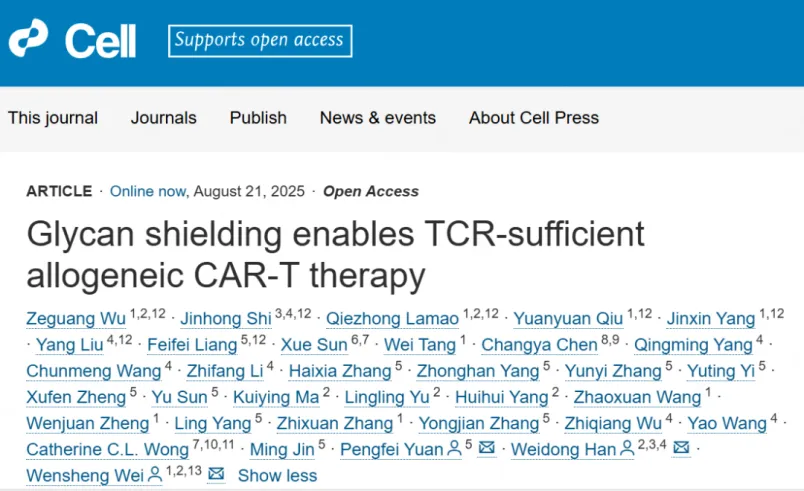
A breakthrough study led by Prof. Weidong Han’s team at the Chinese PLA General Hospital in collaboration with Prof. Wensheng Wei’s team at Peking University has brought major progress to the field of universal CAR-T therapy. The study is the first to show that loss of SPPL3 creates an immune shield through altered surface glycosylation, allowing universal CAR-T cells to avoid graft-versus-host disease while preserving T-cell receptor function. In this way, the cells achieve both long-term persistence and strong antitumor activity, resolving a central problem that has challenged the field for years. MedJ invited Prof. Han and core team members Prof. Yang Liu and Dr. Jinhong Shi to discuss the study’s background, target identification, mechanistic breakthrough, clinical data, and future prospects.
Breaking the Universal CAR-T Deadlock: Why SPPL3 Matters
CAR-T therapy has already achieved revolutionary success in B-cell non-Hodgkin lymphoma, acute lymphoblastic leukemia, and other hematologic malignancies, but the limitations of autologous CAR-T are becoming increasingly clear. Prof. Han pointed out that many patients with relapsed or refractory disease have undergone repeated chemoradiotherapy and no longer have enough functional T cells for ex vivo expansion. Others urgently need treatment and have no window in which cells can be collected. Roughly half of patients are therefore unable to benefit from autologous CAR-T.
Universal CAR-T offers a possible answer to problems of poor adaptability and delayed supply. Unlike autologous products, it can be generated from healthy donor T cells, used off the shelf, and potentially lower cost. Yet traditional universal CAR-T has been limited by three major problems: the risk of severe and even fatal graft-versus-host disease, rejection by the host immune system leading to short persistence, and the inability of the cells to survive long enough to provide durable tumor control.
Since 2015, international efforts to optimize allogeneic CAR-T have made only limited progress. Early strategies knocked out CD52 and then used alemtuzumab to intensify preconditioning and suppress host immunity, but this came at the cost of impaired immune reconstitution and a high rate of severe infection. Later strategies knocked out HLA molecules to reduce immunogenicity, but that did not prevent rejection by host natural killer cells. In addition, these strategies all removed the T-cell receptor, which caused universal CAR-T cells to lose the persistence needed for long-term efficacy.
From Whole-Genome Screening to the Discovery of SPPL3
The T-cell receptor acts as the identity sensor of a T cell. Although knocking it out can help avoid graft-versus-host disease, the receptor is also crucial for long-term survival. Studies published in 2021 showed that after infusion of TCR-knockout CAR-T cells, the remaining detectable cells were almost entirely TCR-positive within two months. In another study of double knockout of TCR and HLA, more than half of patients no longer had detectable TCR-negative cells at two months, whereas the small number of residual TCR-positive cells expanded significantly. These data strongly indicated that preserving TCR function is essential for CAR-T persistence.
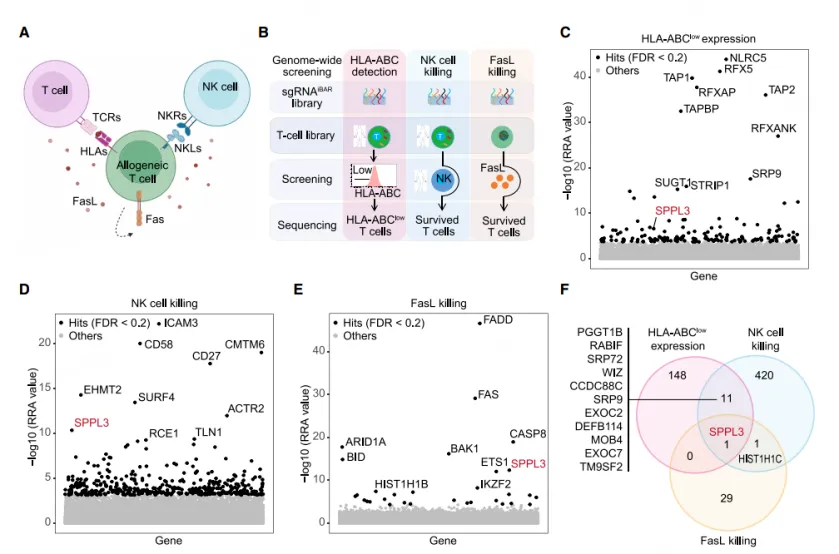
This created the central contradiction in universal CAR-T design: how to preserve TCR function while still avoiding graft-versus-host disease. To solve it, Prof. Han’s group defined a clear goal - to create allogeneic CAR-T cells that would avoid damaging patient tissues while also persisting and coexisting immunologically within the host. In collaboration with Prof. Wei’s team at Peking University, the researchers built a gene-editing library in primary human T cells and applied three selection criteria: resistance to killing by allogeneic T cells and natural killer cells, and resistance to activation-induced death. Whole-genome screening identified only one gene, SPPL3, whose loss met all of these requirements. When SPPL3 was knocked out, CAR-T cells both gained protection from host immune attack and became resistant to self-induced apoptosis, opening an entirely new path for universal CAR-T development.
Clinical Validation: 100% Response and Zero Graft-versus-Host Disease
In a phase I study that enrolled 9 patients with relapsed or refractory B-cell non-Hodgkin lymphoma, universal CAR-T cells with dual knockout of SPPL3 and TCR demonstrated both strong efficacy and excellent safety. Across low-, medium-, and high-dose cohorts, the objective response rate was 100%, and 6 patients achieved complete remission. Even more importantly, none of the patients developed graft-versus-host disease, breaking through the major safety bottleneck that has historically limited universal CAR-T.
These patients were all heavily pretreated and had failed end-stage therapies, so the ability of the new technology to balance efficacy and safety provides valuable clinical proof of concept. Prof. Liu noted that earlier universal CAR-T approaches were either too dangerous because of graft-versus-host disease or too weak because extensive modification impaired function. The SPPL3-loss strategy was the first to achieve an optimized balance between the two.
An unexpected clinical observation provided even stronger support. In some patients, the initial proportion of CD3-positive CAR-T cells was below 0.3%, yet after infusion those cells expanded more than 100-fold and continued to suppress B cells. These residual TCR-positive cells gradually proliferated as the dual-knockout CAR-T cells declined, and they did so without causing severe graft-versus-host disease while showing even stronger vitality and persistence. What initially looked like a technical loophole turned into a major clue, directly prompting the team to launch clinical research on SPPL3 single-knockout CAR-T that preserves TCR. Early data have been even more promising.
Prof. Han emphasized that under this strategy, CAR-T persistence may even surpass that of autologous CAR-T. In tumor treatment, persistence beyond six months is a crucial feature for durable control, meaning that this approach may truly have long-term disease-controlling potential.
The Research Story: Close Cooperation Between Basic and Clinical Science
This research spanned several years and crossed the boundary between basic and clinical science. The core challenges included demonstrating the anti-rejection effect of SPPL3 loss in patients, understanding the expansion dynamics and evolution of CAR-T cells in the complex in vivo environment, and interpreting unusual adverse effects such as head and neck edema and abnormal skin rashes.
The team established a refined monitoring system for cellular subpopulations that could distinguish donor cells from recipient cells and separate CAR-T cells by phenotype and editing status. These clinical observations were then matched with in vitro experiments and mouse models to verify the underlying mechanisms. Ultimately, the researchers proposed the concept of a bidirectional allogeneic T-cell reaction syndrome as a framework for understanding and managing the adverse events. Dr. Shi said that this model of precise monitoring, mechanistic hypothesis, and multidimensional verification exemplifies how concept validation should be performed clinically and demonstrates the value of close collaboration between laboratory and clinic.
Future Directions: From Leukemia to Broader Clinical Use
The current work mainly targets CD19-positive B-cell lymphoma and leukemia, but the team’s next major focus will be adult leukemia. Existing CAR-T treatment for adult leukemia often produces only short-lived benefit and usually must be followed by transplantation, leading to high cost and considerable damage to the patient. By taking advantage of the strong expansion and long persistence of SPPL3 single-knockout CAR-T, the team hopes to explore whether cure without transplantation may become possible. Multicenter studies are already underway in collaboration with Prof. Ying Wang at the Institute of Hematology, Chinese Academy of Medical Sciences, Prof. Jian Li at Peking Union Medical College Hospital, and Prof. Mingfeng Zhao at Tianjin First Central Hospital to test reproducibility and generalizability.
Before SPPL3-deficient universal CAR-T can move from clinical trial to routine practice, multiple hurdles still need to be cleared. In cell manufacturing, healthy-donor selection must be standardized more precisely to identify the donors who can provide the highest-quality seed cells, and the safe limit for cryostorage must be defined. At present, the team uses cells stored for no more than six months in order to preserve activity.
Treatment protocols will also need optimization. Current lymphodepleting regimens using fludarabine and cyclophosphamide reduce lymphocytes and help CAR-T survive, but future work may determine whether the chemotherapy dose can be reduced or partly replaced by antibody-based approaches to lower toxicity. Indications must be refined further so that the field knows which disease subtypes and treatment stages are best suited to this strategy, and whether earlier intervention brings additional value.
Adverse-effect management also remains important. Although SPPL3 loss weakens graft-versus-host disease, specific management plans still need to be established, including the timing and dosing of agents that modulate T-cell function and the integration of intervention strategies with CAR-T expansion kinetics. As with autologous CAR-T, combination approaches that could further strengthen long-term efficacy should also be explored.
Conclusion
By enabling immune escape through glycosylation shielding, SPPL3 loss addresses the three major clinical bottlenecks of universal CAR-T. The clinical data showing a 100% response rate with zero graft-versus-host disease highlight its transformative value. From target discovery to clinical validation, and from dual knockout to the new single-knockout strategy, the work reflects sustained, cross-disciplinary collaboration between basic scientists and clinicians. As multicenter studies advance and treatment strategies continue to improve, this glycan-shielded universal CAR-T platform may offer a new hope of transplant-free, durable tumor control for more patients with relapsed or refractory B-cell malignancies.

