


Hypertension is the leading modifiable risk factor for cardiovascular disease, stroke, and chronic kidney disease worldwide. An estimated 1.3 billion adults globally are affected by hypertension [1]. In China, the prevalence of hypertension among adults is as high as 31.6%, but the control rate is only 12.9% [2]. In the face of this severe public health challenge, treatment strategies based on hypertension grading, staging, and typing require comprehensive, multi-system solutions, among which the search for novel antihypertensive agents with new targets, safety, and efficacy is of important clinical significance.
Recently, the results of a national multicenter, randomized, double-blind Phase 3 clinical study of the original Chinese Class 1 innovative direct renin inhibitor (DRI) — sitogluren (SPH3127) — in mild-to-moderate essential hypertension were formally published online in Drugs (IF=14.4). This study not only provides new evidence-based medical evidence for the clinical treatment of essential hypertension but also fills a gap in China’s direct renin inhibitor research and development. To further evaluate the clinical application prospects of DRI-class drugs, this article systematically reviews the pharmacological mechanism of sitogluren and the core key data of the Phase 3 trial.
About the Expert — Prof. Yuqing Zhang

- Chief physician, Department of Cardiology, Fuwai Hospital, Chinese Academy of Medical Sciences (CAMS)
- Vice Chair, Hypertension Branch, China International Exchange and Promotive Association for Medical and Health Care; Chair, Youth Branch
- Chair, Asia-Pacific Advisory Board, International Society of Hypertension
- Special Ambassador, World Hypertension League
- Associate Editor, Journal of Clinical Hypertension; Editorial board member, Journal of Hypertension, Hypertension Research, Chinese Journal of Cardiology, Chinese Journal of Hypertension, Chinese Journal of Medical Frontiers, etc.
- Member of the writing group for the 2005-2024 Chinese Hypertension Prevention and Treatment Guidelines and the 2024 Obesity Diagnosis and Treatment Guidelines
Mechanistic Exploration: Breaking Through the Bottleneck of Traditional RAAS Blockade
The renin-angiotensin-aldosterone system (RAAS) plays a central role in blood pressure and fluid homeostasis regulation. Current antihypertensive drugs such as angiotensin-converting enzyme inhibitors (ACEIs) and angiotensin II receptor blockers (ARBs) mainly act on the middle and downstream portions of the RAAS pathway. This incomplete “downstream blockade” leads to a compensatory increase in plasma renin activity (PRA) through negative feedback [3].
Renin is the first link and the key rate-limiting enzyme of the RAAS cascade, and DRIs can achieve thorough and sustained blockade at the most upstream point of the cascade, thereby avoiding the drawbacks of increased renin activity [4]. The first oral DRI to reach the market was aliskiren, a peptide-mimetic compound with a large molecular weight. Sitogluren, as a new-generation Class 1 oral antihypertensive, uses a non-peptide 2-carbamoylmorpholine as its core scaffold, with a smaller molecular weight [5] and higher renin-inhibitory activity and bioavailability [6]. In addition, as the first-generation DRI, aliskiren has been reported in prior clinical trials to be associated with some serious adverse reactions [4]. In contrast, study data show that sitogluren has better clinical safety and tolerability potential [3].
Study Design: Two-Stage Phase 3 Clinical Trial [3]
The Phase 3 clinical trial of sitogluren in mild-to-moderate essential hypertension (NCT05359068) adopted a national multicenter, randomized, double-blind, active-controlled parallel two-stage design, aiming to comprehensively evaluate the dose-response relationship and non-inferiority of sitogluren.
Stage 1: Conducted at 14 centers nationwide, with 129 patients randomized 1:1:1 to sitogluren 50 mg, 100 mg, 200 mg, or valsartan 80 mg (once daily for 12 weeks). Results showed that, after 12 weeks of treatment, the 100 mg group had the greatest reduction in mean sitting diastolic blood pressure (msDBP) from baseline (reaching -8.17 ± 5.90 mmHg), superior to the 50 mg group (-4.76 ± 6.47 mmHg), 200 mg group (-6.39 ± 8.64 mmHg), and valsartan group (-6.23 ± 6.41 mmHg). Meanwhile, in the 100 mg and 200 mg dose groups, the median reduction in PRA exceeded 80% (83% and 89%, respectively). This indicates that doses ≥100 mg can provide good PRA inhibition, so 100 mg was established as the recommended dose for Stage 2.
Stage 2: 1,260 patients were screened at 43 centers nationwide, and ultimately 828 patients with mild-to-moderate essential hypertension meeting the inclusion criteria were randomized 1:1 to sitogluren 100 mg (N=413) and valsartan 80 mg (N=415) for 12 weeks of continuous double-blind treatment. The primary endpoint was the change in msDBP from baseline after 12 weeks of treatment.
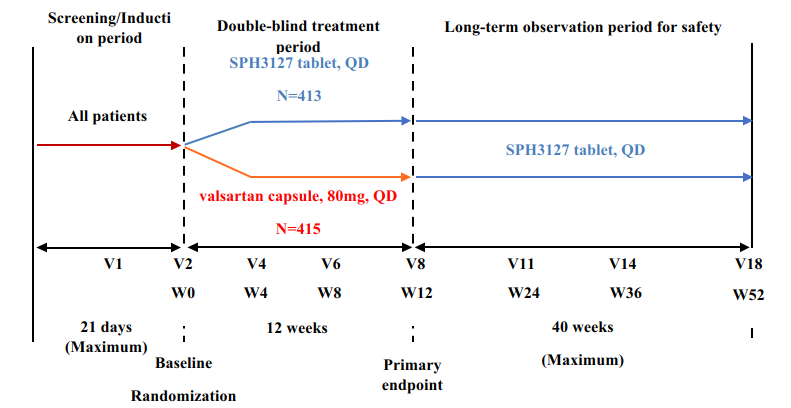
Fig. 1. Stage 2 Study Design (V: visit; W: week)
Efficacy Results: Confirmed Non-Inferiority and Consistency [3]
The Stage 2 study results verified sitogluren’s antihypertensive efficacy with detailed data:
1. Primary endpoint confirmed non-inferiority: The treatment-policy strategy primary analysis showed that, at week 12, msDBP decreased from baseline by 5.97 mmHg (least-squares mean, LSM) in the sitogluren group and by 6.32 mmHg in the valsartan group. The between-group difference was -0.35 mmHg (95% CI: -1.48, 0.78). Rigorous non-inferiority statistical testing confirmed that the antihypertensive efficacy of sitogluren 100 mg was indeed non-inferior to valsartan 80 mg (P=0.005).
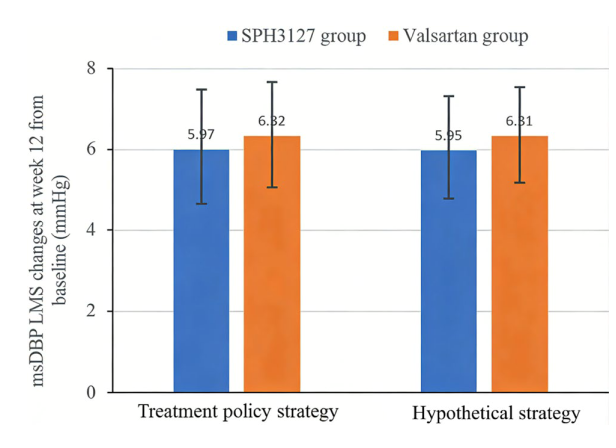
Fig. 2. Primary Study Results
2. Secondary endpoint results similar: In terms of mean sitting systolic blood pressure (msSBP), at week 10, the sitogluren and valsartan groups decreased by 11.1 ± 15.0 mmHg and 11.2 ± 15.5 mmHg, respectively, showing similar antihypertensive trajectories. At the week 2, 4, 6, 8, 10, and 12 follow-up visits, the two groups also showed highly consistent trends in overall response rate and blood pressure target-achievement rate.
3. Broad subgroup benefit: Subgroup analyses showed that, regardless of age (≥65 or not), sex, or baseline msDBP (>100 mmHg or not), the sitogluren and valsartan groups demonstrated comparable antihypertensive effects in all subgroup populations, with stable and consistent efficacy.
Safety Profile: Favorable Tolerability and Manageable Risk [3]
Antihypertensive drugs need to be taken long-term, making safety the core clinical concern. During the 12-week double-blind treatment period, sitogluren demonstrated favorable safety.
The data show that the adverse drug reaction (ADR) rate was 8.3% (34 cases) in the sitogluren group, slightly lower than 10.0% (41 cases) in the valsartan group. No serious ADRs occurred in either group during the study, and no CTCAE grade ≥3 drug-related adverse reactions occurred. All reported serious adverse events (SAEs, 1.2% in each group) were assessed as unrelated to the study drug. With RAAS inhibitors, clinicians commonly focus on the risk of hyperkalemia. In this study, the incidence of hyperkalemia in the sitogluren group was very low, only 0.2% (1 case), versus 0.5% (2 cases) in the valsartan group, confirming the electrolyte safety of sitogluren.
No serious adverse drug reactions occurred during the entire treatment period. With respect to hyperkalemia, the focus when using RAAS inhibitors, the incidence in the sitogluren group was very low (only 0.2%), with no upward trend. Patients also rarely experienced adverse reactions such as cough, diarrhea, rash, and angioedema that are common with traditional antihypertensives.
Study Limitations and Outlook
In academic objectivity, the study also discussed its limitations: First, the study population was limited to Chinese patients, and extrapolation of data to other regions or ethnicities requires caution; second, the double-blind observation period was 12 weeks, with longer-term safety and target-organ protection awaiting the results of an ongoing 40-week long-term extension follow-up period (up to 52 weeks); finally, the study focused on the optimal 100 mg dose identified in the dose-finding study, and more research may be needed in the future to delineate the more complete dose-response curve.
Summary
The large-sample, multicenter Phase 3 clinical study of sitogluren shows that, as an innovative DRI that blocks the rate-limiting enzyme of the RAAS, once-daily oral 100 mg sitogluren can provide a potent and stable antihypertensive effect in patients with mild-to-moderate essential hypertension. It is not only non-inferior to the classic drug valsartan in terms of antihypertensive magnitude, but also has favorable clinical tolerability (lower overall ADR and hyperkalemia risk). This adds a safe and effective “upstream antihypertensive” new option to China’s hypertension monotherapy strategy, and provides important evidence-based evidence for exploring mechanism-based treatment of essential hypertension.
References
[1] Mills KT, Stefanescu A, He J. The global epidemiology of hypertension. Nat Rev Nephrol. 2020;16:223-37.
[2] National Center for Cardiovascular Diseases. Summary of the China Cardiovascular Health and Disease Report 2024 [J]. Chinese Circulation Journal, 2025;40(06):521-559.
[3] Lv Q, Ma C, Wang F, et al. Efficacy and Safety of SPH3127 Tablet, a Novel Direct Renin Inhibitor, in Patients with Mild-to-Moderate Essential Hypertension: A Phase III Randomised Trial. Drugs (2026). https://doi.org/10.1007/s40265-026-02315-z
[4] De A, Calcutta A, Della Pietra GP, Loffredo D, Vigilante R, Di Paola R, et al. Potential role of Aliskiren in cancer modulation compared to other Renin-Angiotensin inhibitors: an in-depth review. Eur J Pharmacol. 2025;1008:178312.
[5] Iijima D, Sugama H, Takahashi Y, et al. Discovery of SPH3127: A Novel, Highly Potent, and Orally Active Direct Renin Inhibitor. J Med Chem. 2022;65(16):10882-10897.
[6] Zhang L, Mao Y, Gao Z, Chen X, Li X, Liu Y, et al. The non-clinical pharmacokinetics and prediction of human pharmacokinetics of SPH3127, a novel direct renin inhibitor. Eur J Drug Metab Pharmacokinet. 2020;45:15-26.

