


Recently, the team of Ma Jun and Mao Yanping at Sun Yat-sen University Cancer Center published in The British Medical Journal (BMJ) the final survival analysis and exploratory results of their pioneering “medial retropharyngeal region-sparing radiotherapy” toxicity-reducing technique for nasopharyngeal carcinoma (NPC). This study not only further consolidates the long-term swallowing function benefits of this technique and reaffirms its support as a standard treatment that balances both efficacy and quality of life for NPC patients, but also, building on prior work, elucidates the underlying mechanism by which this technique protects swallowing function through a stepwise validation framework of “dose-volume–histopathology–functional outcome,” completing the evidence chain of how dosimetric advantages translate into functional benefits.
Can the new therapy provide long-term benefit, and what is the mechanism by which it protects swallowing function?
The whole retropharyngeal nodal region prophylactic irradiation recommended by domestic and international guidelines has been the standard radiotherapy approach for newly diagnosed non-metastatic NPC. However, its excessively large irradiation field results in overdosing of adjacent swallowing-related structures (such as the pharyngeal constrictor muscles and supraglottic larynx), leading to a dysphagia incidence as high as 35.4%, and even causing serious complications in some patients including aspiration (66.9%), aspiration pneumonia (12%), and nasogastric or gastrostomy feeding (10%), severely impacting quality of life. Earlier research by the team using high-resolution MRI revealed that, although retropharyngeal lymph node metastasis is common in NPC, it is predominantly found in the lateral group, while involvement of the medial group is exceedingly rare (0.6%). This finding provided an important theoretical basis for reducing the irradiation target volume. On this basis, the team proposed a scientific hypothesis: sparing the medial retropharyngeal region from irradiation could reduce the radiation dose to the pharyngeal constrictor muscles without compromising local tumor control, thereby decreasing the incidence of dysphagia.
To verify this hypothesis, the team pioneered the “medial retropharyngeal region-sparing radiotherapy” toxicity-reducing technique for NPC and conducted a multicenter, prospective, randomized controlled clinical trial enrolling 568 patients. The 3-year results showed that the local recurrence-free survival of the “medial retropharyngeal region-sparing radiotherapy” group was non-inferior to the standard radiotherapy group, while significantly reducing the incidence of dysphagia and improving quality of life. Against this backdrop, the present study aimed to further consolidate survival evidence through longer-term follow-up data and to deeply elucidate the mechanism by which “medial retropharyngeal region-sparing radiotherapy” protects swallowing function.
Pain Relief! Survival Rates Unchanged, Dysphagia Significantly Reduced
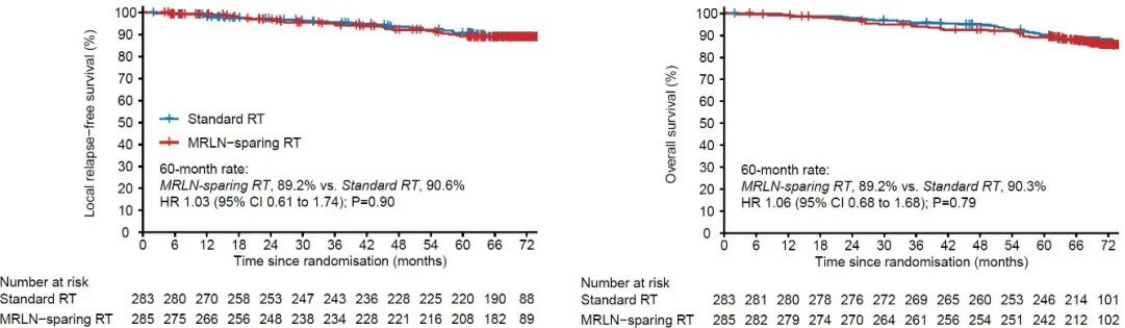
From November 2017 to December 2018, 568 NPC patients were enrolled, with 285 in the medial retropharyngeal nodal region-sparing radiotherapy group and 283 in the standard radiotherapy group. At a median follow-up of 70 months, the 5-year local recurrence-free survival rates (89.2% vs. 90.6%; stratified hazard ratio 1.03; P=0.90) and overall survival rates (89.2% vs. 90.3%; stratified hazard ratio 1.06; P=0.79) were comparable between the two groups.
Safety results demonstrated that in the medial retropharyngeal nodal region-sparing radiotherapy group, the incidence of grade 1 or higher dysphagia (22% vs. 32%; P=0.01) and grade 2 or higher xerostomia (16% vs. 25%; P=0.02) were significantly reduced, and swallowing-related quality of life was markedly improved (mean difference −11.9; P<0.001).
Reducing Harm! Lower Doses, Reduced Pathological Damage to Pharyngeal Muscles
“Medial retropharyngeal region-sparing radiotherapy” dramatically reduced the percentage of pharyngeal constrictor muscle volume receiving >50 Gy from 63% in the standard group to 8%. This dosimetric optimization translated into clear histopathological benefits. MRI-based dynamic measurements of pharyngeal constrictor muscle thickness showed that, compared with the standard radiotherapy group, the sparing group exhibited significantly reduced early edema and late atrophy of both the superior and middle pharyngeal constrictors: at 3 months post-radiotherapy, the mean thickness of the superior constrictor (4.96 vs. 5.09 mm, P=0.04) and middle constrictor (5.39 vs. 5.56 mm, P=0.03) was thinner; at 5 years post-radiotherapy, the mean thickness of the superior constrictor (1.80 vs. 1.65 mm, P=0.005) and middle constrictor (2.34 vs. 2.15 mm, P=0.01) was thicker.
Significant Improvement! Pharyngeal Phase Swallowing from Obstruction to Fluency
The reduction in pathological changes to the pharyngeal constrictors ultimately manifested at the functional level as a significant improvement in pharyngeal constrictor function. Videofluoroscopic swallowing studies showed that, compared with the standard radiotherapy group, the medial retropharyngeal region-sparing radiotherapy group had significantly lower frequencies of pharyngeal phase impairment indicators, including vallecular residue (74% vs. 100%; P<0.001), piriform sinus residue (48% vs. 73%; P=0.01), posterior pharyngeal wall residue (11% vs. 27%; P=0.01), pharyngeal transit time >1.0 second (2% vs. 11%; P=0.03), and aspiration (12% vs. 29%; P=0.03).
The 5-year follow-up results of this study not only further consolidate the long-term efficacy of medial retropharyngeal region-sparing radiotherapy, but also, through a stepwise validation framework of “dose-volume–histopathology–functional outcome,” elucidate the underlying mechanism by which this toxicity-reducing technique of “medial retropharyngeal region-sparing radiotherapy” protects swallowing function: by reducing the radiation dose and volume to the pharyngeal constrictor muscles, it mitigates histopathological changes such as early edema and late atrophy, thereby improving pharyngeal phase-related swallowing function, and completing the evidence chain of how this technique translates dosimetric advantages into functional benefits.
Professor Mao Yanping, Academician Ma Jun, Associate Researcher Liang Xiaoyu, Professor Tang Linglong, and Professor Sun Ying from Sun Yat-sen University Cancer Center are the co-corresponding authors of the paper. The co-first authors are Dr. Wang Shunxin, Associate Chief Physician Tao Yalan, Chief Physician Zhou Guanqun, and Professor Xie Fangyun from Sun Yat-sen University Cancer Center, along with Chief Physician Gao Tiansheng from Wuzhou Red Cross Hospital and Chief Physician Zhang Ning from Foshan First People's Hospital.

