


“Few single studies can change the paradigm of gynecologic care, but a clinical trial in The New England Journal of Medicine seems to have done just that, perhaps solving one of the major mysteries in women’s health.”
The study concerned bacterial vaginosis (BV). Researchers followed 164 heterosexual couples in which the woman had BV. The women were treated with first-line antibiotics, and half of the men were also given both oral and topical antibiotics.
Researchers found partner treatment worked so well that the trial had to be stopped early so that all participants could receive treatment. The conclusion was that BV may be sexually transmitted and men should participate in treatment as well.
BV is one of the most common diseases in women. Most patients are 14 to 44 years old, reported prevalence in China is 15% to 45%, and recurrence is common. For a long time, BV has been treated clinically as a gynecologic disease affecting only women, but this study argues that male partners should be treated as well to prevent recurrence.
After publication, the American College of Obstetricians and Gynecologists updated its clinical guidance, recommending for the first time treatment for male partners of patients with recurrent BV. Medical institutions in California, New York City, and other places in the United States have made similar recommendations.
“This study offers a very valuable insight. It may update many obstetricians’ and gynecologists’ understanding and may bring new hope for reducing BV recurrence in the future,” Dr. Lu Zhang, associate chief physician in the Cervical Disease Department of the Obstetrics and Gynecology Hospital of Fudan University, told MedJ after reading the paper.

Treating both partners sharply lowers recurrence
“The vagina is a microbial environment. BV has traditionally been understood as infection caused by imbalance of the vaginal flora,” Dr. Zhang said. It mainly results from a decrease in lactobacilli and overgrowth of facultative anaerobes and anaerobes.
Some patients have clear symptoms, including increased vaginal discharge, odor, itching, or burning. In 10% to 40% of patients, BV is a silent disease with atypical symptoms and easy to miss.
If not treated promptly, it can lead to pelvic inflammatory disease, infertility, and increased risk of infection with sexually transmitted pathogens such as HIV. BV during pregnancy can also result in miscarriage, preterm birth, neonatal infection, and other adverse pregnancy outcomes.
An even more serious problem is its high recurrence rate. “More than 50% of patients recur within three to six months after adequate antibiotic therapy. Clinically, all we can do is treat them again with the same drugs,” said Lenka Vodstrcil, the first author of the NEJM study and a senior research fellow at the Melbourne Sexual Health Centre, Monash University, Australia. Many patients repeatedly use antibiotics, which can drive resistance.
Dr. Zhang told MedJ that given the high recurrence rate, some scholars previously proposed that male partners may carry the pathogen and transmit it back to women through intimate contact, leading to relapse.
However, previous studies in male partners of BV patients found that whether men used oral antibiotics did not affect women’s recurrence outcomes. As a result, clinicians generally did not intervene in men when treating BV.
The Monash University team took a different angle: would simultaneous oral and topical antibiotics for men work better than treating women alone?
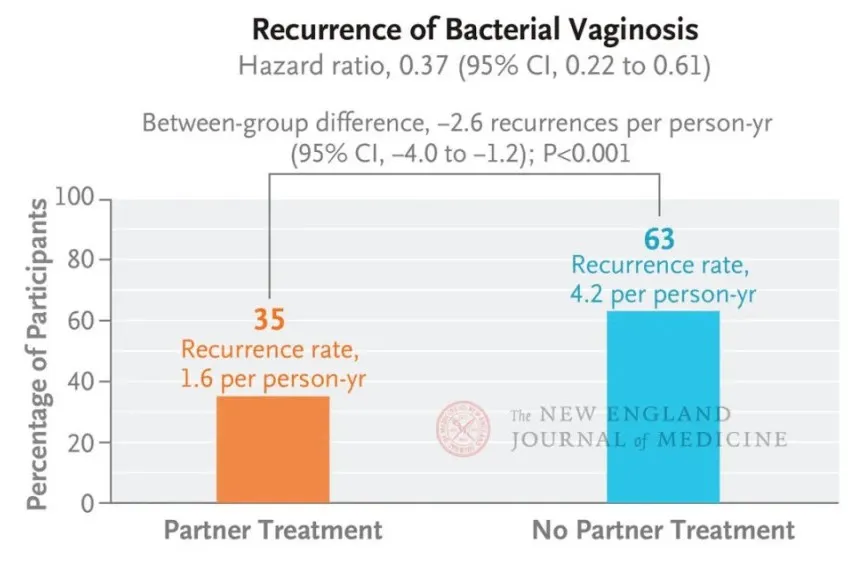
“The results were very positive.” In a paper published by NEJM on March 6, 2025, the study enrolled 164 heterosexual couples and divided them into two groups, with all women receiving a first-line antimicrobial regimen.
What differed was that male partners in the both-treated group received combination therapy: oral metronidazole 400 mg plus 2% clindamycin cream applied locally to the genital area, twice daily for seven days. Men in the control group received no intervention.
“The primary outcome was recurrence in women within 12 weeks. But the data safety and monitoring committee stopped the trial early because the difference was so clear,” Lenka Vodstrcil explained. Recurrence of BV in women was 35% in the both-treated group versus 63% in the control group.
“Our study shows that treatment of BV should be a shared responsibility. It offers a new strategy for preventing BV recurrence and is of major clinical significance,” the article said. Compared with the standard approach of treating women alone, clinical practice should emphasize BV testing in men and recommend both oral and topical antibiotics for male partners.
Breaking the old mindset of treating only women?
“Since the study began, nearly 300 men have received concurrent treatment, and there have been no reports of anyone stopping because of severe drug side effects,” said Catriona Bradshaw, another study author and head of the Genital Microbiota and Mycoplasma Group at Monash University.
She said the Melbourne Sexual Health Centre has already changed its clinical workflow. If a woman tests positive for BV, doctors will propose treating both partners.
In October 2025, the American College of Obstetricians and Gynecologists updated its clinical guidance to include concurrent partner treatment for BV, saying the move was intended to change the treatment of recurrent BV.
The updated clinical practice advice states that based on mounting evidence, sexual activity may be one of the high-risk factors for BV. Therefore, in symptomatic recurrent BV, a stable male partner should receive oral and topical antibiotics. For women with symptomatic BV at first diagnosis, male partners should participate in treatment decisions and receive treatment.
“This will fundamentally change clinical practice,” The New York Times quoted a scholar from the U.S. Centers for Disease Control and Prevention’s sexually transmitted disease prevention division as saying.
Dr. Zhang believes the NEJM study was rigorously designed and provides high-level evidence, but one paper with a limited sample size is still not enough to change clinical practice on its own.
“The evidence is still a bit thin. In the future, we may need more clinical trials designed on this basis, with more centers participating and more evidence collected, to support the idea of treating both partners,” Dr. Zhang said.
Notably, an editorial published alongside the NEJM study pointed out that beyond prompting a paradigm shift in care, the study also supports another point: BV, which has not been classified as a sexually transmitted disease, can be transmitted through sexual activity.
Several other studies have focused on BV prevention and treatment of both partners. Some suggest that the male urethral microbiome is a warning indicator for BV in female partners. Others say circumcision status in men is one of the risk factors for BV infection and recurrence.
In the NEJM study, researchers also summarized a set of high-risk factors for BV recurrence. In addition to a prior history of BV in women, having a stable male partner and having a male partner who was not circumcised were included, supporting concurrent treatment of both partners.
Is BV a sexually transmitted disease?
“Up to now, BV has not been treated clinically as a sexually transmitted disease,” Dr. Zhang stressed. The clearly observed triggers in practice are mainly factors that alter the balance of the vaginal flora, including vaginal douching and smoking, which disrupt the acidic vaginal environment and allow anaerobes to proliferate.
In fact, BV is not caused by a single pathogen. Rather, it is more like an ecological shift in the vaginal microbiota, the lush community of bacteria around the genital tract.
China’s latest Guidelines for the Diagnosis and Treatment of Bacterial Vaginosis (2021 revision) state that the cause of BV remains unclear, may be related to multiple sexual partners and other factors, and that pathogens can be detected on the male genitalia.
Prof. Jeffrey Klausner, professor of medicine and public health at the Keck School of Medicine of USC, does not agree with classifying BV as sexually transmitted.
He said the definition of sexually transmitted infection has evolved continuously. Human papillomavirus was classified as an STI in the 1980s, but later it was found that the virus could remain under fingernails and be transmitted that way.
Some viruses not usually regarded as sexually transmitted, such as Ebola and Zika, can also survive in semen for days and spread through intimate contact.
According to the World Health Organization definition, all infectious diseases closely related to sexual behavior and sexual contact are collectively referred to as sexually transmitted diseases. But in BV, besides possible sexual transmission, condoms, smoking, hormones, menstruation, and even yoga pants may all promote bacterial overgrowth and trigger disease.
Therefore, although the medical community is beginning to bring BV into the scope of treating both partners, it has not classified BV as a sexually transmitted disease.
“If BV were classified as a sexually transmitted infection, it might stigmatize the disease and reduce patients’ willingness to seek care,” Dr. Zhang warned. Stigma around HPV once caused some women to avoid screening and treatment, aggravating the burden of cervical-cancer prevention and control.
She added that for recurrent BV there is still no universally accepted definition or best management plan, and clinical practice needs better responses. “That is the main significance of the NEJM study.”

