


The ESMO 2026 Annual Meeting was held Oct 23 to 27, 2026, in Madrid, Spain. On Oct 25, Prof. Shun Lu of Shanghai Chest Hospital, Shanghai Jiao Tong University, presented the primary results of the global phase 3 SAFFRON study (LBA6) in the Presidential Symposium, published simultaneously in the New England Journal of Medicine.
 Fig.1. Prof. Shun Lu Presenting the SAFFRON Results at the ESMO 2026 Presidential Symposium
Article Key Points
- Phase 3, n=338: osimertinib plus savolitinib versus platinum-pemetrexed after progression on osimertinib
- Population required MET overexpression (MET 3+ in at least 90% of tumor cells) or MET amplification (10 or more copies)
- Primary endpoint met: BICR median PFS 7.6 versus 5.4 months (HR 0.55, 95% CI 0.42-0.72, P<0.001)
- OS positive at first interim analysis: median 17.8 versus 12.9 months (HR 0.68, 95% CI 0.50-0.91, P=0.010)
- MET overexpression subset: median PFS 8.5 versus 5.6 months (HR 0.51); MET amplification subset HR 0.48
- Grade 3 or higher TEAEs 64% versus 63%; grade 3 or higher TRAEs 40% versus 52%
- One treatment-related death in the combination arm
- Evidence status: presented as LBA6 at ESMO 2026 and published simultaneously in NEJM; peer reviewed
Background: MET Driven Resistance After Osimertinib
In first-line treatment of advanced EGFR-mutated NSCLC, osimertinib is effective, but most patients eventually develop resistance. Dysregulation of the MET signaling pathway is one of the key mechanisms, and it has been reported that up to 34% of patients develop MET overexpression or MET amplification after progression on osimertinib. This group has a poor prognosis and very limited targeted treatment options.
In the phase 2 SAVANNA study, osimertinib plus savolitinib produced durable and clinically meaningful responses in patients with MET amplification. The global phase 3 SAFFRON study was conducted to confirm the efficacy and safety of this combination versus platinum doublet chemotherapy.
Study Design
The study enrolled patients with locally advanced or metastatic EGFR-mutated NSCLC whose disease had progressed on osimertinib. A central laboratory assessed MET overexpression by immunohistochemistry (IHC), defined as MET 3+ in at least 90% of tumor cells, and MET amplification by FISH, with a cutoff of 10 or more copies.
Eligible patients were randomized 1:1 to osimertinib 80 mg once daily plus savolitinib 300 mg twice daily, or platinum (cisplatin or carboplatin) plus pemetrexed for 4 cycles followed by pemetrexed maintenance.
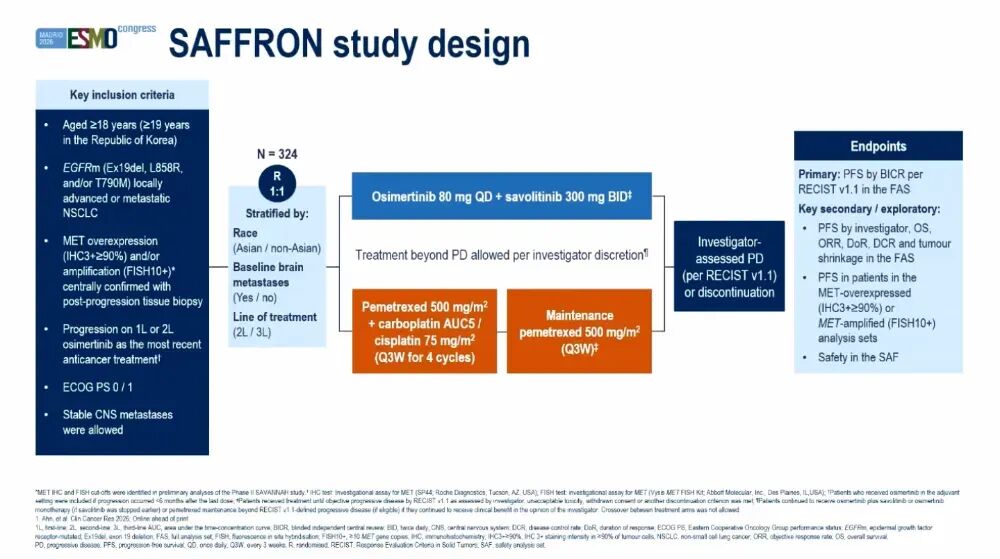 Fig.2.SAFFRON Study Design
The primary endpoint was PFS assessed by blinded independent central review (BICR). Key secondary endpoints included investigator-assessed PFS, overall survival (OS), objective response rate (ORR), disease control rate (DCR), depth of tumor shrinkage and safety.
Efficacy: PFS and OS Both Positive
A total of 338 patients were randomized, with 171 in the experimental group and 167 in the control group.
For the primary endpoint, median PFS by BICR assessment in the overall population was 7.6 months in the osimertinib plus savolitinib group versus 5.4 months in the chemotherapy group (HR 0.55, P<0.001), a 45% reduction in the risk of disease progression or death. In the MET overexpression analysis set, median PFS was 8.5 months versus 5.6 months (HR 0.51). In the MET amplification analysis set, median PFS was 7.6 months versus 4.2 months (HR 0.48).
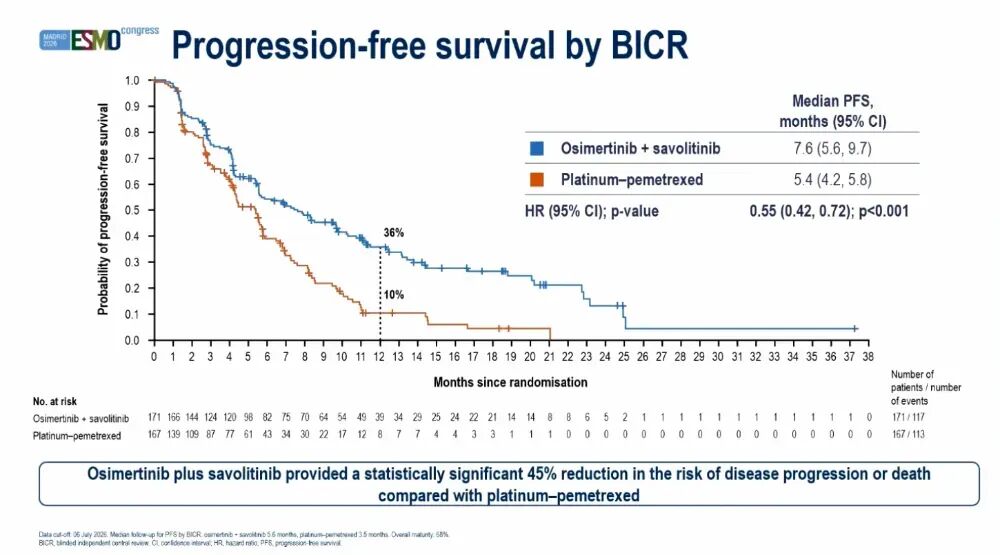 Fig.3.PFS assessed by BICR
OS had reached a positive result at the first interim analysis. Median OS was 17.8 months in the experimental group versus 12.9 months in the control group (HR 0.68, P=0.01), an improvement of 4.9 months in median OS with a reduction in the risk of death. At the data cutoff, 45 patients in the experimental group were still receiving treatment, compared with 2% in the control group.
Safety
Prof. Lu noted that the safety profile of the combination was consistent with the known safety profiles of the two agents individually, with no new or unexpected safety signals identified.
In the safety analysis, grade 3 or higher treatment-related adverse events (TRAEs) occurred in 40% of patients in the experimental group, lower than the 52% in the control group. Rates of grade 3 or higher adverse events were comparable between groups (64% versus 63%). The most common any-grade adverse events in the experimental group were peripheral edema, anemia and diarrhea. One treatment-related death occurred in the osimertinib plus savolitinib group.
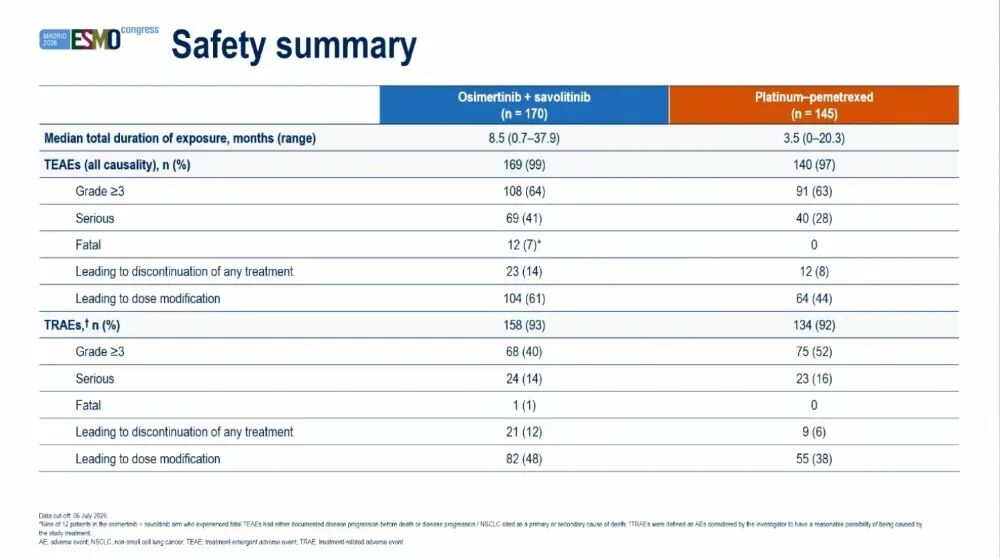 Fig.4.SAFFRON Study Safety Summary
Conclusions
Prof. Lu summarized that SAFFRON is the first global phase 3 trial to demonstrate statistically significant and clinically meaningful improvements in both PFS and OS for osimertinib plus savolitinib versus platinum chemotherapy in patients with EGFR-mutated advanced NSCLC with MET overexpression or amplification after progression on osimertinib. The results establish the value of an oral, biomarker-directed approach for this population. By targeting both EGFR and MET, the combination addresses a resistance mechanism that is otherwise difficult to treat, and positions osimertinib as a backbone across lines of therapy.

