


Milestone
The milestone is full NMPA approval of ruxolitinib phosphate cream for children and adults aged 12 years or older with nonsegmental vitiligo involving the face. It is the first and only approved targeted therapy for vitiligo in China, and that distinction is more than a label claim. Vitiligo has historically been managed through topical corticosteroids, calcineurin inhibitors, phototherapy and, in selected stable disease, surgery. Those approaches can work, but they are often slow, variably effective and prone to relapse.
Disease context and unmet need
Vitiligo is a chronic acquired depigmenting disorder driven by a complex interplay of autoimmunity, genetics and environmental triggers. China has about 10.3 million patients with vitiligo, including roughly 8.2 million with nonsegmental disease. The burden is not only dermatologic. Visible lesions on the face, neck and hands create psychosocial morbidity that can be profound, especially in adolescents and young adults. That matters because efficacy thresholds in vitiligo are not merely cosmetic; they influence treatment adherence, mental health and quality of life.
Mechanistic rationale
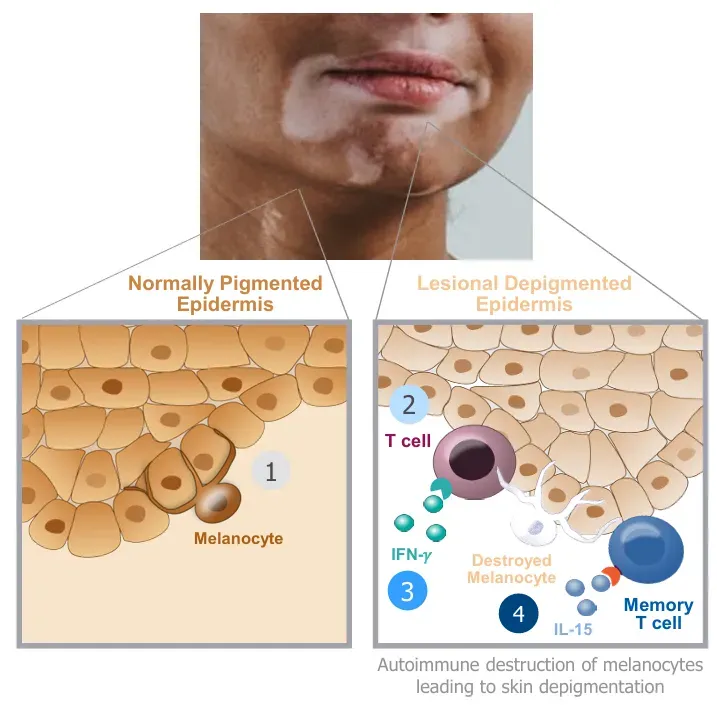
Ruxolitinib is a JAK1/JAK2 inhibitor. In vitiligo, JAK-STAT signaling participates in the inflammatory cascade that drives melanocyte loss, in part through interferon-gamma-associated immune activation. A topical JAK inhibitor is therefore mechanistically attractive because it aims to locally suppress the autoimmune circuit underlying depigmentation without relying on systemic immunosuppression. That makes it more than an incremental topical reformulation; it is a mechanism-based redefinition of therapy for a disease that previously lacked a truly targeted approved option.
Clinical evidence
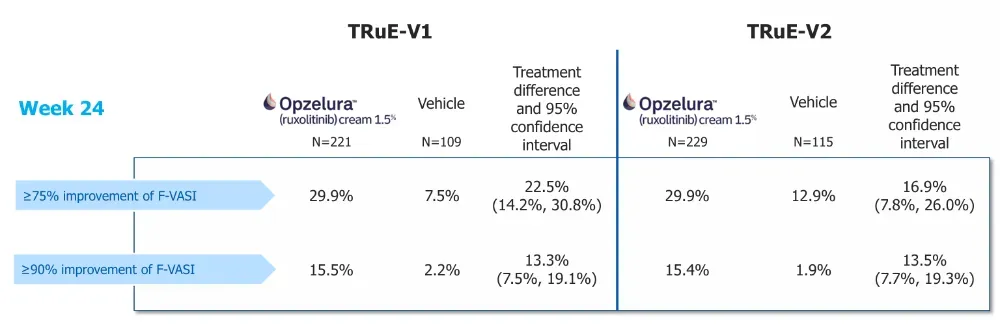
The pivotal phase III TRuE-V1 and TRuE-V2 studies provided the core evidence. At week 24, the proportion of patients achieving at least 75% improvement in facial Vitiligo Area Scoring Index reached 29.9% with ruxolitinib cream, compared with 7.5% and 12.9% in the respective vehicle groups. Continued treatment to week 52 produced sustained improvement, supporting the idea that repigmentation deepens over time rather than plateauing early. Those data are important because vitiligo therapies are often judged by slow kinetics and incomplete visible response. A reproducible facial repigmentation signal in pivotal trials therefore carries real clinical weight.
Safety and practical differentiation
Real-world experience from Hainan Boao and other Chinese centers included treatment in more than 7,000 patients before national approval, without new safety risks, treatment discontinuations due to adverse events or drug-related serious adverse events in collected safety monitoring. Such data do not replace randomized safety evaluation, but they matter because this is a chronic-use topical therapy in a largely ambulatory population. If tolerability remains favorable, the cream could gain practical advantage over long courses of topical steroids or cumbersome phototherapy schedules.
Competitive and market positioning
The approval also arrives into a broader innovation cycle. More than twenty vitiligo drug programs are under development globally, including JAK inhibitors, PDE4 inhibitors and IL-15-directed approaches. IL-15 is particularly interesting because it may address tissue-resident memory T cells and therefore recurrence biology, while domestic programs such as CKBA ointment are exploring non-immunosuppressive mechanisms. Even so, ruxolitinib has first-mover advantage as the first approved targeted therapy in China and already has meaningful commercial validation, with global cream sales reaching $510 million in 2024.
Outlook
Ruxolitinib cream is unlikely to be the last important vitiligo therapy, but it may be the product that proves the category can support targeted innovation. Its significance lies in converting mechanistic insight into a visible clinical endpoint patients value deeply. The next questions are whether repigmentation durability persists after treatment adjustment, how reimbursement and access evolve, and whether future agents aimed at relapse biology can extend benefit further. For now, the Chinese approval marks a genuine therapeutic upgrade: vitiligo has moved from empiric local control toward precision-guided intervention.

