


For two decades, pancreatic surgeons have debated a single question: for a high-stakes operation requiring the removal of five abdominal organs, are open or robotic techniques better?
On 1 July, the British Medical Journal (BMJ) published findings from a 4.5-year randomized trial across seven Chinese centers, led by Shanghai’s Ruijin Hospital. For the first time, the study provides high-level evidence that, in appropriately selected patients, robotic pancreaticoduodenectomy (RPD) is not inferior to open Whipple (OPD) and may substantially accelerate postoperative recovery.
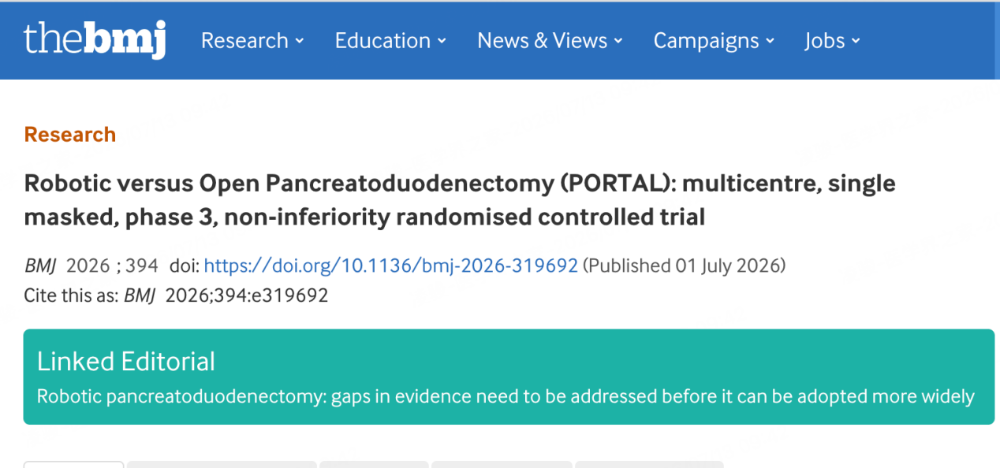
The PORTAL trial was led by Prof. Shen Baiyong of the Pancreatic Disease Center at Ruijin Hospital, and is the first robotic pancreatic multicenter study to appear in any of the four leading medical journals.
A BMJ editorial accompanying the publication noted: “This study provides the most convincing evidence to date that RPD accelerates postoperative recovery, and represents an important milestone in the development of RPD.” Speaking to MedJ, Prof. Shen added: “Which centers, which surgeons, and which patients are appropriate for robotic resection? Our study answers these questions, providing a referenceable answer for clinicians and regulators worldwide.”

Prof. Shen Baiyong (Middle)
A Long-Unresolved Clinical Question
Pancreatic cancer is among the most lethal of malignancies, often called the King of Cancers for its insidious onset and aggressive course. In China, approximately 119,000 new cases and 106,000 deaths from pancreatic cancer are reported each year.
Pancreaticoduodenectomy, commonly known as the Whipple procedure, remains the gold standard for resectable tumors of the pancreatic head. Since the first reported robotic Whipple (RPD) in 2002, the question of whether RPD outperforms the traditional open Whipple (OPD) has remained unresolved.
Prof.Shen explained to MedJ that RPD’s clear theoretical advantage is its minimally invasive nature. Where open Whipple requires a 20 to 30 cm incision that fully divides the abdominal wall musculature, RPD needs only a few small ports through which the camera and instruments are introduced to perform fine dissection deep in the abdomen.
“This substantially reduces pain, bleeding, and infection risk, and also avoids the tumor compression that can occur with manual retraction in open surgery,” Prof. Shen said.
But the very feature that makes RPD appealing is also the source of the central concern. Whipple is among the most complex and difficult operations in abdominal surgery, requiring removal of one-quarter of the stomach, the duodenum, the gallbladder, the common bile duct, and the head of the pancreas, followed by three reconstructions: pancreaticojejunostomy, cholangiojejunostomy, and gastrojejunostomy. As Prof. Shen noted, the operation effectively combines the complication profiles of gastric, biliary, and pancreatic cancer surgery in a single procedure, with pancreatic fistula from an imperfect pancreaticojejunal anastomosis being the most dangerous.
“Whether such an operation is suitable for a robotic approach has remained unsettled globally, and the major guidelines hedge on it,”Prof. Shen said. “The core concern is that the operation is simply too extensive, too complex, and too prone to complications to be done well without opening the abdomen.” The only way to resolve such a question, he added, is a high-quality randomized controlled trial.
The “Human-Machine Race”
In 2020, Ruijin Hospital’s Pancreatic Disease Center — the world’s largest single-institution platform for pancreatic disease — initiated the PORTAL study. Six additional top-tier pancreatic centers in China joined the trial, including Shanghai Changhai Hospital and Sir Run Run Shaw Hospital, Zhejiang University, launching a 4.5-year “human-machine race.”
The trial enrolled 254 patients with a mean age of just over 60 years; 132 were randomized to robotic surgery and 122 to open Whipple. All operating surgeons had completed standardized training in both robotic and open pancreaticoduodenectomy and had substantial clinical experience with each.
Prof.Shen told MedJ that, in real-world practice, the learning curve for RPD is considerably longer than for OPD, which means institutions must invest more in training upfront. “Is that investment worth it? The only measure is whether, in the long run, the patient has a stable benefit and whether RPD delivers health-economic value,” he said. This, too, was among the goals of the trial.
The results showed that, on secondary endpoints — including surgical and oncologic outcomes — RPD performed comparably to OPD. On the core radical-resection metrics, including complete tumor removal and lymph node harvest, RPD matched OPD, allaying concerns that a minimally invasive approach might compromise oncologic efficacy.
On safety, there were no statistically significant differences between the two groups in postoperative bleeding, pancreatic fistula, bile leak, or the need for reoperation — that is, robotic surgery did not add any incremental risk.
The most important finding, however, came from the primary endpoint: time to recovery. Prof. Shen explained that, traditionally, Whipple outcomes are judged by how cleanly the tumor is removed and how many complications occur. PORTAL, by contrast, chose patient recovery time as the primary endpoint, with the explicit aim of shifting the treatment mindset from “disease-centered” to “patient-centered.” “We don’t only want to know whether the operation itself was well done; we want to know whether minimally invasive RPD truly gives patients a better treatment experience and reduces their suffering,” Prof. Shen said.
Measured from the day of surgery to the point at which recovery milestones were met, patients in the OPD group required a mean of 16.0 days, while those in the RPD group required only 12.1 days. “Achieving the same surgical result, robotic surgery shortened the average hospital stay of just over two weeks by a further 3.9 days. That’s a clinically meaningful gain — not only in patient comfort, but in relieving the bed-turnover pressure on hospitals,”Prof. Shen said.
The study also noted that, in the open surgery group, the variation in total treatment cost across patients was largely driven by variation in complications. The investigators suggested that, although the overall complication burden did not differ statistically between RPD and OPD, a subset of open-surgery patients experienced more severe complications, leading to longer stays and substantially higher costs.
Why Had No One Done This Before?
Prof. Shen identified two major challenges. The first came from the operation itself: the number of centers worldwide that can systematically perform high-volume, high-quality RPD is small. But the harder challenge, he said, was patient enrollment.
Procedures like pancreaticoduodenectomy often bring patients into the hospital with a pre-existing preference for a particular surgical approach. The PORTAL trial used a single-blind design, in which patients were not told which group they would be randomized to before consent. “This means only patients who have enough trust in the hospital and the surgeon will accept random assignment to a surgical approach,” Prof. Shen said.
Ruijin Hospital’s Pancreatic Disease Center is one of the earliest institutions in the world to perform robotic pancreatic surgery, and its cumulative robotic pancreatic surgery volume has now approached 5,000 cases. The team has also led the development of most of the technical standards for robotic pancreatic minimally invasive surgery, including the procedural steps and learning curve for RPD (Annals of Surgery, 2021) and the surgical benefit (JAMA Surgery, 2020). “It is that case volume and surgical experience that gave us the basis to select appropriate patients and to lead a 4.5-year randomized study,” Prof. Shen said.
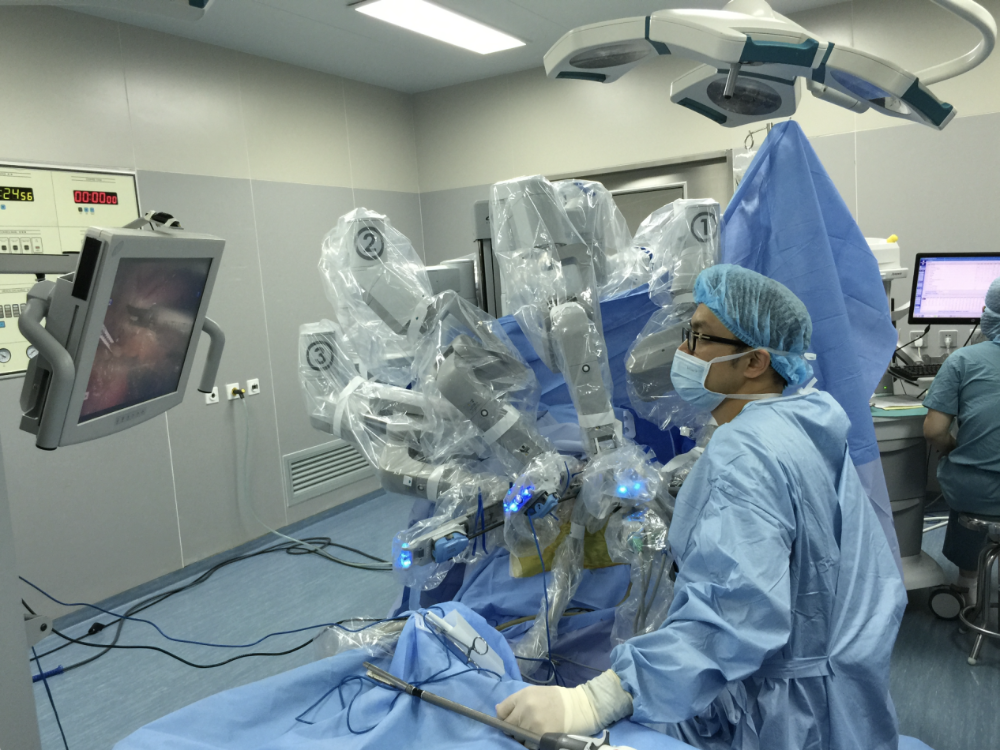
In a global context, the implications of the study extend beyond the narrow question of “is robotic surgery better.” It also offers a referenceable basis for regulators in China and elsewhere, and may help shape future clinical guidelines. Prof. Shen emphasized that robotic pancreaticoduodenectomy is not appropriate for every patient or every surgeon: patients with later-stage tumors or major vascular invasion are not candidates for a robotic approach, and centers with too low an annual case volume are unlikely to be able to guarantee quality and safety.
“Our study is the first to clearly identify which patients are appropriate for robotic surgery, and which surgeons and centers have the qualifications to perform it,”Prof. Shen said. “This means that health authorities can, in the future, regulate robotic pancreaticoduodenectomy along three dimensions — appropriate indications, surgeon credentials, and center annual case volume — which is the most practical safeguard for patient safety.”
He acknowledged, however, that the trial still lacks one critical result: long-term oncologic benefit for patients. “What we can say for now is whether patients recover faster, but the most fundamental question — does robotic surgery allow patients to live longer? — still has no answer,” Prof. Shen said. Long-term oncologic outcomes, including disease-free survival and overall survival in pancreatic cancer, will be the central focus of the team’s next study.
The basis for his confidence comes from a set of retrospective data: among patients who underwent open surgery, just over 60% were able to complete the full 8-cycle adjuvant chemotherapy regimen, while in the robotic surgery group, the figure reached 74%. “This is largely because the RPD operation is less traumatic, patients’ immune function is not obviously compromised, they recover faster, and they tolerate chemotherapy better afterward,” Prof. Shen said. “So I expect that long-term oncologic benefit will be a question we can answer in our next study — and the result will very likely be positive.”
If this 4.5-year “human-machine race” has convinced the global surgical community that robots can perform the most difficult pancreatic operation, then the next race will not be measured by the recovery curve at the bedside but by whether patients live longer and better as a result. Only then, the article suggests, will the question of whether robotic surgery is truly better than traditional open surgery be definitively answered.

