


On the morning of November 10, Prof. Jian’an Wang, an academician of the Chinese Academy of Sciences and president of the Second Affiliated Hospital of Zhejiang University School of Medicine (SAHZU), used the gap between two conferences to return to his office, sit in front of a screen and open the remote surgical control system.
At the other end of the screen, 4,213 km away in a hospital in Karamay, Xinjiang, a 53-year-old Kazakh patient lay in the catheterisation laboratory. The patient had severe coronary artery disease, with the left anterior descending artery badly blocked and frequent chest pain in recent weeks. Wang moved the controls lightly, remotely operating a vascular interventional surgery robot, with Dr. Changling Li, chief physician and deputy director of the Department of Cardiovascular Medicine, assisting at the other end. In less than half an hour, a 3.0 mm by 24 mm drug-eluting stent was deployed, the narrowed vessel reopened and the patient’s chest pain eased.
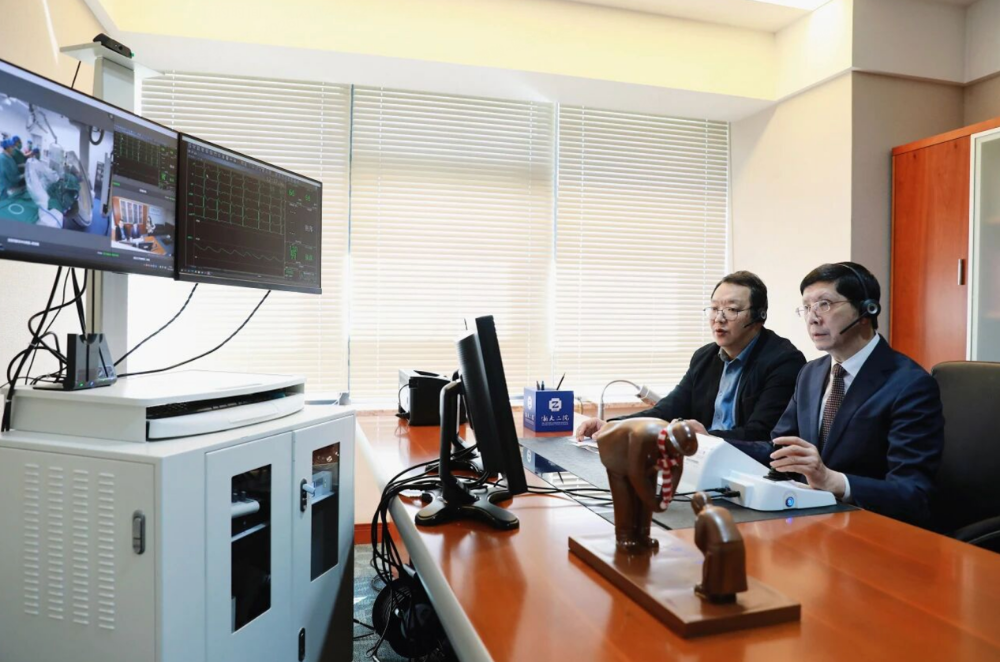
“From a technical point of view, remote surgical operation is already very close to what the physician achieves on site,” Wang told MedJ. “In the future, the robot may even be more precise than a physician operating directly.”
Article Key Points
• Coronary intervention performed remotely 4,213 km away with a vascular interventional robot
• A 3.0 mm by 24 mm drug-eluting stent was deployed in under 30 minutes and chest pain eased
• Robot accuracy: 0.5 mm translation, 0.1 degree rotation; packet loss under 0.01%, latency under 200 ms
• SAHZU performs about 16,000 to 20,000 PCI cases a year; a county hospital may do tens to hundreds
• Wang: complex cases still need the operating physician present, and the robot has technical limits
Surgery Across 4,000 Kilometres
Coronary stenting depends on a thin guidewire. The physician advances it through the coronary vessels, steering it through the narrowed lesion, and then delivers the stent to the correct position.
Doing this across more than 4,000 km means clearing two hurdles: whether the “hand” of the robot is accurate enough, and whether the signal is stable enough.
Wang said the robotic system in use now reaches a translational accuracy of 0.5 mm and a rotational accuracy of 0.1 degree, and that translation and rotation can be performed at the same time without interfering with each other. “Even a physician operating on site manipulates the guidewire at this precision.”
On the signal side, the remote system used for this procedure had a packet loss rate below 0.01%, less than one in ten thousand, and an average latency below 200 ms. “The delay is already imperceptible to the eye,” Wang said.
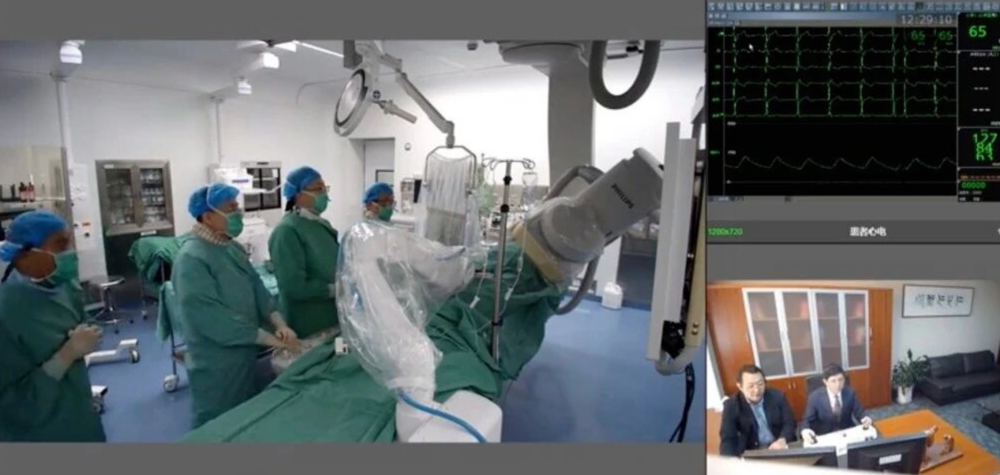
He explained why the hospital pursued remote surgery in the first place. SAHZU performs about 16,000 to 20,000 percutaneous coronary intervention (PCI) cases a year, whereas a county hospital may perform only a few dozen to a few hundred. Training volume differs, and for complex lesions the treatment outcome can differ with it.
“In this procedure, the local doctor only has to puncture the radial artery and place the catheter; the remaining steps are completed remotely by us,” Wang said. “Quality specialist expertise is scarce, while patients are spread across the country. If remote robotic operation can reach the level of a physician working on site, then patients in different places can all have access to better medical services.”
Wang acknowledged, however, that remote surgery still has technical boundaries. “Objectively speaking, the treatment of many lesions can now be done with the physician operating remotely. But the robot still has limits, and for extremely complex cases the operating physician still has to be present.”
In his view, it is precisely complex lesions that will show the value of remote surgery in future. “As robot technology matures and the ability to handle complex lesions keeps improving, the value of remote surgery will become more prominent.”
The Robot Will Reach a Precision That Human Hands Cannot Match
This was not the first time SAHZU had practised surgery at a distance.
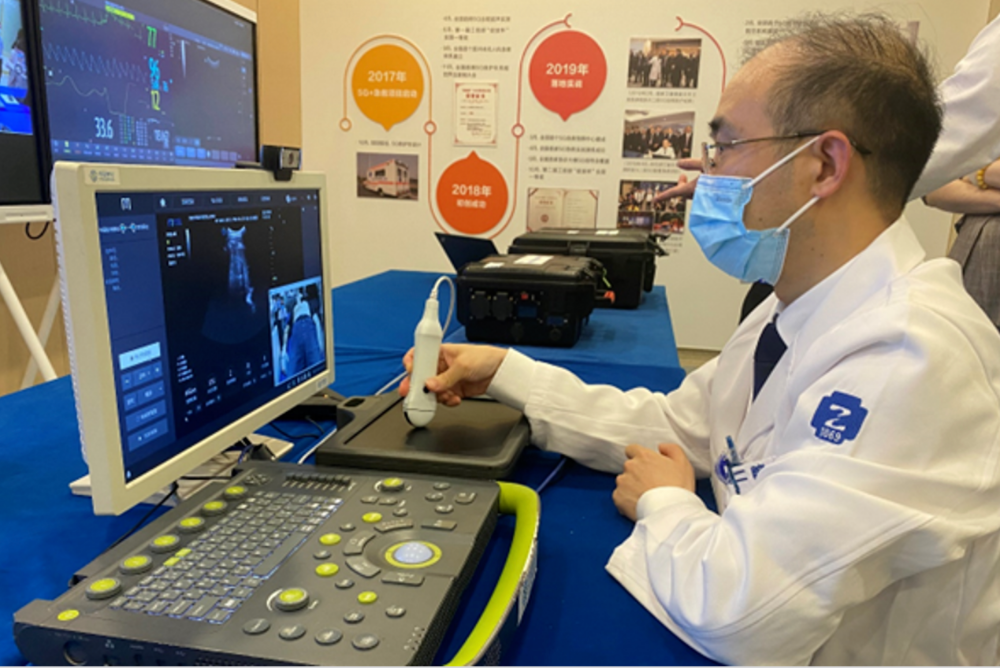
In 2018, the Department of Emergency Medicine at SAHZU carried out the first remote robotic ultrasound consultation in China, used to judge remotely whether trauma patients had pleural effusion and whether the lung had re-expanded.
In 2021, neurosurgery, using 5G and a robot, evacuated an intracranial haematoma for a patient in Songyang County 200 km away, the first such case in China. From remote diagnosis to remote craniotomy, and now to cardiac intervention across 4,213 km, the distance has grown and the procedures have become finer over eight years.
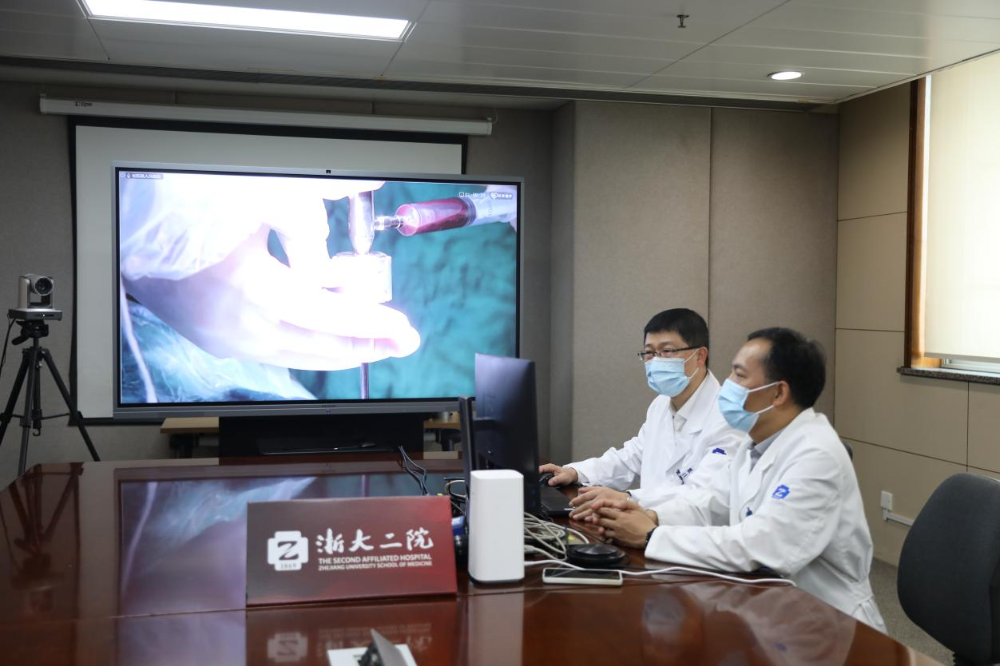
“Remote technology is the direction of modern medicine and will in time become routine,” Wang said, adding that the path is not completed in one step but requires capability to be accumulated step by step. “Even with remote ultrasound, a physician needs specific training to read images accurately at the remote end.”
In Wang’s view, experts at leading hospitals have to engage directly for remote surgery to move from demonstration to routine. Over the years SAHZU has built an integrated platform for clinical work, research and translation, and has steadily advanced the academic development and clinical application of remote surgery.
The vascular interventional robot used for this procedure is one example: SAHZU was deeply involved in its clinical research. “What problems the clinical data reveal, how precision can be improved further, what physicians need when operating in practice, we have to keep putting forward improvement suggestions from a clinical perspective,” Wang said.
He added that SAHZU also works with several domestic robotics companies, engaging from the source of device development to push remote cardiovascular intervention towards industrialisation.
Looking abroad, Wang said that robotic interventional surgery is now also being carried out overseas, but mostly at close range. “Objectively speaking, China’s remote technology is in the first tier and has taken the lead in some areas.”
His judgement on the future is emphatic. “Physicians differ in skill to begin with. What we are aiming for is that the same physician, operating through a remote robot, achieves results consistent with, or even better than, operating on site.”
“When I first encountered interventional robots, I could clearly feel the difference in handling between the robot and direct manual control. Today, handling routine lesions remotely, there is almost no difference at all. I believe the robot will eventually reach a level of precision that human hands cannot match, and that day is not far off,” Wang said.

