


A New Framework for Unresectable Lung Cancer
Lung cancer remains the most commonly diagnosed malignancy and the leading cause of cancer-related mortality in China, and unresectable disease accounts for a substantial share of the clinical burden. The introduction of immune checkpoint inhibitors (ICIs) has reshaped treatment paradigms, particularly when combined with radiotherapy. Two landmark trials have framed the modern standard: PACIFIC, which established consolidation durvalumab after concurrent chemoradiotherapy (cCRT) in locally advanced non-small cell lung cancer (NSCLC), and ADRIATIC, which recently extended the same concept to limited-stage small cell lung cancer (LS-SCLC). A 2026 update to the Chinese Expert Consensus on Radiotherapy Combined with Immunotherapy for Unresectable Lung Cancer, issued by the China Anti-Cancer Association (CACA) and collaborators, now provides more granular guidance across earlier and later stages of disease, including early-stage NSCLC, locally advanced NSCLC, advanced NSCLC with oligo- or brain metastases, and small cell lung cancer (SCLC).
Early-Stage NSCLC: SBRT Stays the Cornerstone
For patients with stage I-II NSCLC who are medically inoperable, stereotactic body radiation therapy (SBRT), also referred to as stereotactic ablative radiotherapy (SABR), remains the curative-intent standard of care, with high local control rates. However, roughly 30%-40% of these patients eventually relapse, motivating interest in adding systemic immunotherapy. The 2025 edition of the consensus had cautiously suggested considering immunotherapy in patients with high-risk features. The 2026 update reverses course, based on interim analyses of two Phase III trials. KEYNOTE-867 evaluated SBRT plus pembrolizumab versus SBRT plus placebo in early-stage NSCLC. The combination did not meet its primary endpoint, and grade 3 or higher treatment-related adverse events (TRAEs) occurred in 20.4% of patients in the experimental arm versus 3.7% in the placebo arm. SWOG/NRG S1914, a similarly designed trial, also failed to show a clear survival benefit.
Consensus Statement 1: SBRT/SABR remains the standard of care for inoperable early-stage NSCLC. Combining immunotherapy with SBRT cannot currently be supported by high-level evidence and should not be used routinely outside clinical trials.
Locally Advanced NSCLC: Refining the PACIFIC Paradigm
Consolidation Immunotherapy Is the Standard
For patients with unresectable locally advanced NSCLC, whether treated with cCRT or sequential chemoradiotherapy (sCRT), consolidation immunotherapy remains the standard of care. The 2026 update endorses two agents with approved indications in this setting: durvalumab (Imfinzi) and sugemalimab (Cejemly). A notable clarification concerns PD-L1 expression. Based on post-hoc analyses of PACIFIC and real-world data from PACIFIC-R, the consensus now explicitly recommends consolidation immunotherapy regardless of PD-L1 status.
Consensus Statement 3: For patients with unresectable locally advanced NSCLC, consolidation immunotherapy after cCRT or sCRT is standard, irrespective of PD-L1 expression.
Timing and Duration of Consolidation
On the basis of PACIFIC and the Japanese TORG1937 (DATE) study, the consensus recommends initiating consolidation within 1-42 days after completion of chemoradiotherapy, with the option to delay if radiation-related toxicities warrant. Duration should be individualized: PACIFIC used 1 year of durvalumab, while GEMSTONE-301 used 2 years of sugemalimab, and the consensus endorses a 1-2 year range, with 2 years of consolidation considered for patients with stage IIIB or IIIC disease.
Reinforcing the Standard Pattern: Do Not Add Immunotherapy Up Front
Two Phase III trials, PACIFIC-2 and CheckMate 73L, tested concurrent immunotherapy with cCRT. Both returned negative results, with no survival benefit and potential compromise of tolerability. The 2026 update reiterates the 2025 stance: concurrent use of ICIs during cCRT is not recommended.
Chemo-Free Strategies for Frail Patients
For elderly or frail patients who cannot tolerate chemotherapy, "subtraction" approaches are being explored. Two single-arm Phase II studies, DUART and SPIRAL-RT, evaluated durvalumab following radiotherapy alone in patients with a median age of 79 years, reporting a median overall survival (OS) of approximately 21 months. These data are hypothesis-generating and require randomized confirmation.
Consensus Statement 8: For patients with unresectable locally advanced NSCLC who are unsuitable for chemotherapy, a chemo-free approach based on the PACIFIC framework may be considered on a case-by-case basis.
EGFR-Mutant Disease: Targeted Consolidation Takes Priority
For patients with EGFR-mutant locally advanced NSCLC, the LAURA trial has reset the treatment landscape. Osimertinib consolidation produced a median progression-free survival (PFS) of 39.1 months versus 5.6 months with placebo (HR=0.16), a striking effect. Subgroup analyses of PACIFIC had earlier suggested that EGFR-mutant patients do not benefit from durvalumab consolidation.
Consensus Statement 9: For patients with EGFR-mutant unresectable locally advanced NSCLC, targeted therapy with osimertinib is the preferred consolidation strategy. Patients with KRAS or other rare driver mutations may still derive benefit from immune consolidation, but this remains to be validated.
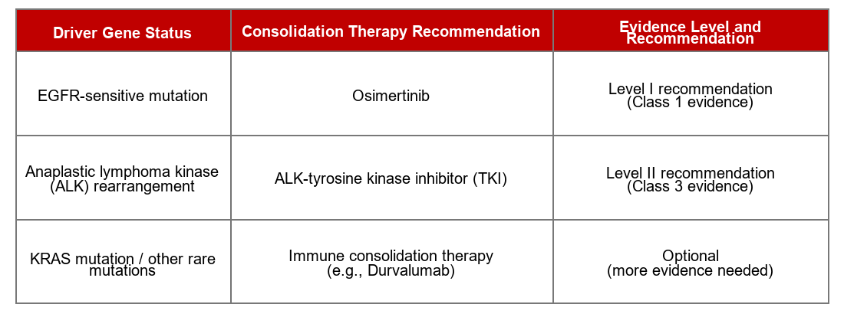
Table .1 .Consolidation Strategies for Unresectable Locally Advanced NSCLC with Positive Driver Genes
Advanced NSCLC: Oligometastatic and Brain Disease
Oligometastasis: A Cautionary Signal
For patients with extracranial oligometastatic NSCLC (≤3 involved organs, ≤5 lesions), the combination of systemic therapy and local radiotherapy has been widely adopted. The Phase II/III NRG-LU002 trial tested comprehensive radiotherapy to all lesions during immune maintenance. The trial was negative for both PFS and OS, and grade 3 or higher pneumonitis occurred in 10% of patients in the radiotherapy arm versus 1% in the control arm.
Consensus Statement 10: For patients with extracranial oligometastatic NSCLC, the added value of radiotherapy on top of immunotherapy remains unproven. Decisions should be individualized following multidisciplinary discussion. Selected subgroups, such as those with low PD-L1 expression, bone metastases, or oligo-progression after systemic therapy, may still be considered for local radiotherapy.
Brain Metastases: Combining ICIs and Radiotherapy
For patients with symptomatic brain metastases, upfront radiotherapy combined with immunotherapy is an emerging strategy. The C-Brain and CTONG2003 studies evaluated camrelizumab plus chemotherapy combined with stereotactic radiosurgery (SRS) or whole-brain radiotherapy, reporting an intracranial objective response rate (ORR) of 78.5%. These findings support the feasibility and activity of combined modality treatment, although larger confirmatory studies are still needed.
Small Cell Lung Cancer: ADRIATIC Changes the Game
Limited-Stage SCLC: A Long-Awaited Breakthrough
The ADRIATIC trial represents the most significant development in LS-SCLC in nearly two decades. Patients who had not progressed after cCRT were randomized to consolidation durvalumab or placebo. Durvalumab produced a median OS of 55.9 months versus 33.4 months with placebo (HR=0.73), the largest survival gain reported in this population.
Consensus Statement 14: In the absence of contraindications, patients with LS-SCLC should receive consolidation immunotherapy after cCRT. Concurrent ICI plus cCRT in LS-SCLC is not currently supported by evidence, and patients should be encouraged to enroll in clinical trials. The consensus also standardizes dosing: radiotherapy is delivered as 45 Gy in 30 fractions (twice daily) or 60-70 Gy in 30-35 fractions (once daily), and consolidation durvalumab is given for 2 years.
Extensive-Stage SCLC: Thoracic Radiotherapy Under Investigation
For extensive-stage SCLC (ES-SCLC), the combination of chemotherapy and immunotherapy is the current first-line standard. The addition of thoracic radiotherapy on top of chemo-immunotherapy lacks high-level evidence. Phase II data, including the ES-SCLC-1st-IIT-SHR1316-CRT study evaluating 30 Gy in 10 fractions during immune maintenance, have suggested potential PFS and OS gains, with a median OS of 21.4 months, but these findings require Phase III confirmation.
Consensus Statement 15: For patients with ES-SCLC receiving chemo-immunotherapy, thoracic radiotherapy may be considered when the potential benefit justifies the risk. Radiation dose should be individualized based on systemic therapy and patient-specific factors.
Outlook
The 2026 Chinese consensus reflects a maturing field: broad access to consolidation
immunotherapy for unresectable lung cancer, but with sharper boundaries around who should receive it, when, and for how long. The success of osimertinib in LAURA and durvalumab in ADRIATIC illustrates that the next gains are likely to come from biomarker-driven, stage-specific strategies rather than one-size-fits-all intensification. Several open questions remain, including the role of concurrent immunotherapy, optimal sequencing for frail and elderly patients, and the integration of radiotherapy in advanced disease, all of which are now active areas of clinical investigation.

