


At the 20th Qianjiang International Cardiovascular Disease Conference (QICC 2026), held November 19-22, 2026 in Hangzhou, MedJ and the congress jointly launched the Qianjiang Dialogues, a series of cross-border panel conversations between cardiovascular experts in China and overseas. Three sessions examined where clinical innovation starts and how evidence is built: the management of hypertension and the prevention of heart failure, the two-way relationship between cancer and cardiovascular disease, and the international validation of Chinese-developed transcatheter valve technology.
Article Key Points
• China has more than 300 million people with hypertension; the control rate is near 20%
• Global heart failure burden exceeds 60 million, with Asia accounting for roughly two-thirds
• A GLS fall above 15% from baseline may flag LV dysfunction before ejection fraction declines
• Cardio-oncology panel called for shifting from reactive toxicity handling to active risk control
• Pure AR TAVR registration study was single-arm with about 150 patients, cannot compare with surgery
Shared Currents: From Blood Pressure Management to Heart Failure Prevention

Prof. Jiguang Wang of Shanghai Ruijin Hospital, Shanghai Jiao Tong University School of Medicine, reported that China has more than 300 million people with hypertension. He noted that the control rate has risen from near zero to about 20%, while awareness remains below 50% and treatment below 40%. He split hypertension management into three dimensions. Awareness depends mainly on patient behavior and health literacy, he said, because many people discount risk when they have no symptoms. Treatment uptake depends heavily on insurance coverage, which now reaches more than 90% of the population in China. Control is the core task of health professionals, he said, and one that depends particularly on community and primary care capacity. On masked nocturnal hypertension, he emphasized the need to examine 24-hour blood pressure patterns, and said wearable devices are making all-day measurement possible, so that hypertension management has entered a digital era.
Prof. Carolyn S.P. Lam of Duke-NUS Medical School, responding, praised China’s achievements in hypertension prevention and control and noted that hypertension is the largest contributor to attributable risk for heart failure. Citing published figures, she said the global heart failure burden exceeds 60 million people and that Asia accounts for roughly two-thirds of that burden. She noted that heart failure starts earlier in Asia, with patients typically in their 50s and 60s compared with their 70s and 80s in Europe and the United States. She described a distinct Asian phenotype of lean diabetic heart failure, in which body mass index is not high and patients appear thin, yet visceral fat is abundant and diabetes is common, creating a metabolically toxic environment of thin outside and fat inside. She called for Asian populations to lead the generation of management evidence in non-obese heart failure, argued that care at this scale cannot be delivered without digital tools and AI support, and told young physicians that “doctors who use AI will replace those who do not.”
The session was moderated by Xiaopu Wang of the Second Xiangya Hospital, Central South University.
Shared Comorbidity: Cardio-Oncology From Passive Response to Active Prevention

Prof. Ying Liu of the First Affiliated Hospital of Dalian Medical University described the cardiovascular comorbidity burden in Chinese patients with cancer at two levels. The disease spectrum has changed, she said, because survival has improved and cardiovascular disease is now the leading non-cancer cause of death in cancer survivors, so cardiovascular management has to run through the full life of the patient. The relationship between the two diseases is also more complex than anticancer drug cardiotoxicity, she said, with the paradigm extending to a bidirectional one: heart failure itself may drive tumor progression through chronic inflammation, and advanced cancer can resemble heart failure syndrome in its metabolic and inflammatory features. The two conditions also share a long list of risk factors, including obesity and metabolic dysfunction, and she said they must be managed as one systemic problem rather than as two independent diseases.
For early surveillance, Liu said a relative fall in global longitudinal strain (GLS) of more than 15% from baseline can flag early left ventricular dysfunction well before ejection fraction declines. She noted that AI-assisted risk screening models still need local calibration, that tertiary hospitals can deploy a full pathway of biomarkers, ultrasound GLS and AI analysis, and that primary care needs a simplified initial screening route, with the key requirement being that the tool matches the setting.
Prof. Eric Yang of UCLA Medical Center said the most demanding and most attractive feature of cardio-oncology is that the pace of progress in cancer treatment has outrun that in cardiovascular medicine. According to him, roughly 12 to 13 immunotherapy drugs are in clinical use in the United States, while the number of agents available in China is about twice that. He argued that cardiovascular colleagues must treat cancer as a chronic condition, because many patients with cancer may live longer than patients with heart failure. In practice, he said, antihypertensive and lipid-lowering therapy is often underused in patients with cancer, where attention goes to the cancer and cardiovascular risk factors go unaddressed, which he said does not hold for many curable cancers. He proposed that management shift from a passive response to toxicity toward active prevention, meaning control of low-density lipoprotein, blood pressure, exercise and diet before and during anticancer treatment, which he said may lower cardiovascular risk and may also lower the risk of cancer recurrence.
He added that the risk is not confined to heart failure. Vascular endothelial growth factor (VEGF) inhibitors can cause hypertension, some tyrosine kinase inhibitors accelerate atherosclerosis, and immune checkpoint inhibitors can rarely cause myocarditis, he said, adding that “we must attend to the full spectrum of disease, not only ejection fraction.” He called for more prospective data to identify which patients are at higher risk.
The session was moderated by Xuhui Zheng of the First Affiliated Hospital of Nanjing Medical University.
Leading the Tide: From Chinese Devices to Global Standards
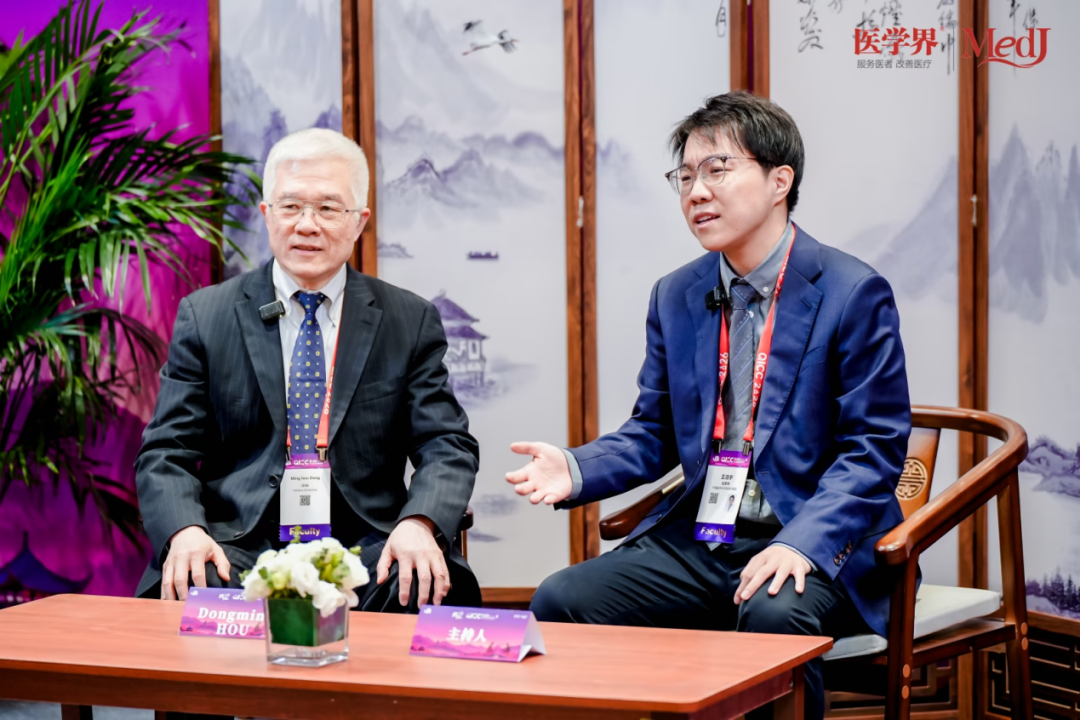
Prof. Dongming Hou of Indiana University examined the international path for Chinese-developed devices from the perspective of global structural heart intervention. Taking transcatheter aortic valve replacement (TAVR) for pure aortic regurgitation as an example, he noted that conventional devices face difficulty because the leaflets lack calcification, and that Chinese-developed devices using U-shaped anchoring elements offer a different design approach. He emphasized, however, that what the international community values is not ingenuity alone but a clearly defined unmet clinical need, reproducibility, safety, efficacy data and transparency of complications, durability, and credible multicenter evidence. “A device may originate in China, but its clinical value must be demonstrated to global standards,” he said.
On the path from innovation to clinical use, he proposed three priorities: to design evidence for a clinical problem rather than for regulatory approval alone; to make the procedure reproducible, with training that covers alternative fluoroscopic angles, recognition of instability and balloon strategy; and to bring international investigators and regulators in early. He noted that the premarket multicenter single-arm study of TAVR for pure aortic regurgitation enrolled only about 150 patients, and that single-arm results cannot establish comparative effectiveness against surgery, which he described as a Class I recommendation in ACC/AHA guidelines. Large international randomized trials will be needed, he said, to demonstrate noninferiority in appropriately selected patients with operable severe aortic regurgitation. Whether asymptomatic patients with severe aortic regurgitation benefit from early intervention, he added, is another important direction for future research.
On the move from participating in global trials to leading the generation of global evidence, Hou said leadership begins with identifying important unanswered clinical questions, designing studies, coordinating international sites, and taking responsibility for endpoint definitions, data quality, interpretation and publication. “We should not only export original devices, we should also lead the trials that shape treatment strategy,” he said. “In short, original devices and original evidence can come from China, but global clinical influence matters more.”
The session was moderated by Haoyu Wang of Fuwai Hospital, Chinese Academy of Medical Sciences.
In Closing
The three conversations addressed global sharing and full-course management in hypertension and heart failure, the two-way comorbidity and active prevention in cardio-oncology, and the global validation of Chinese-developed devices in structural heart disease. The recurring thread was that medical innovation should start from real clinical problems, rest on rigorous and reproducible evidence, and end in care that patients can actually access.

