


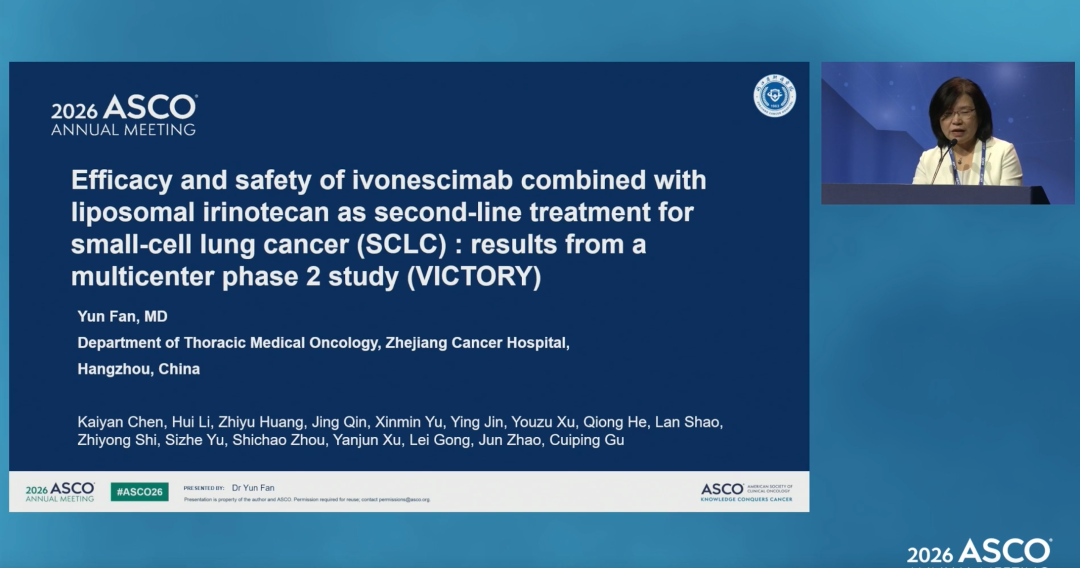
The 2026 American Society of Clinical Oncology (ASCO) Annual Meeting is in full swing! Chinese expert teams presented multiple original studies. A phase 2 multicenter study led by Zhejiang Cancer Hospital was presented as an oral report.
The study evaluated the efficacy and safety of the novel PD-1/VEGF bispecific antibody ivonescimab in combination with liposomal irinotecan in patients with small cell lung cancer (SCLC) who had progressed on first-line chemo-immunotherapy, offering a new clinical option for second-line treatment of this difficult-to-treat population. At the meeting, Prof. Yun Fan from Zhejiang Cancer Hospital presented the latest study results, drawing great attention from international colleagues.
Between sessions, MedJ interviewed Prof. Fan at the meeting. The key data and her interpretation are summarized below.
Study Interpretation
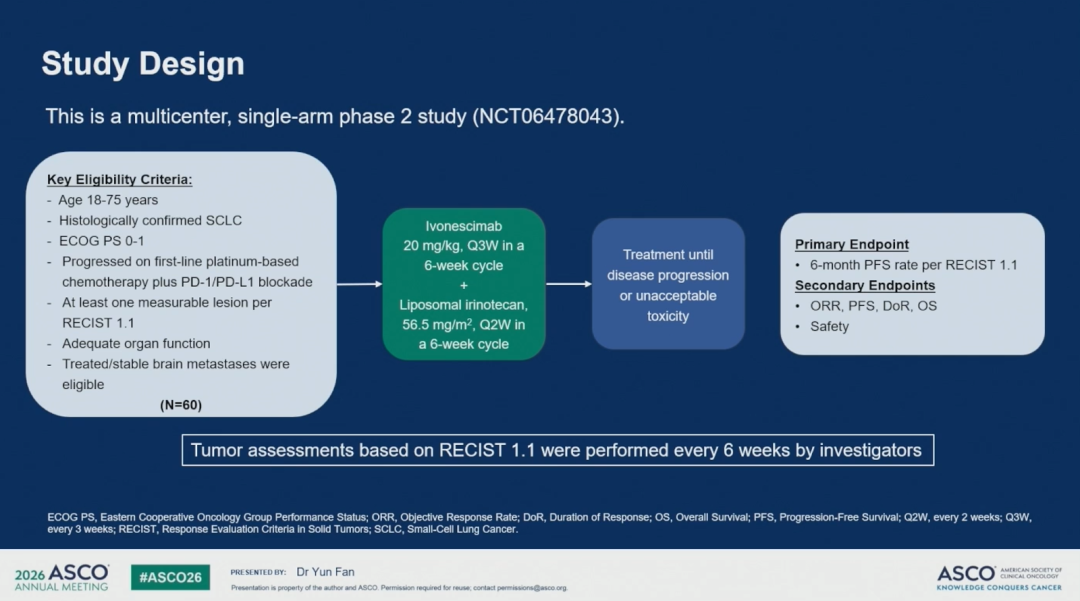
This multicenter, single-arm, phase 2 study enrolled 60 SCLC patients who had disease progression during or after platinum-based chemo-immunotherapy. Baseline data showed a median age of 62.0 years, 53 patients (88.3%) had an ECOG PS of 1, 35.0% had liver metastases, 26.7% had brain metastases, and 63.3% had a chemotherapy-free interval (CFI) >90 days.
Patients received ivonescimab (20 mg/kg IV on day 1, every 3 weeks) plus liposomal irinotecan (56.5 mg/m² IV on day 1, every 2 weeks) until disease progression or unacceptable toxicity. The primary endpoint was the 6-month progression-free survival (PFS) rate.
▌ Core results: Significant PFS benefit
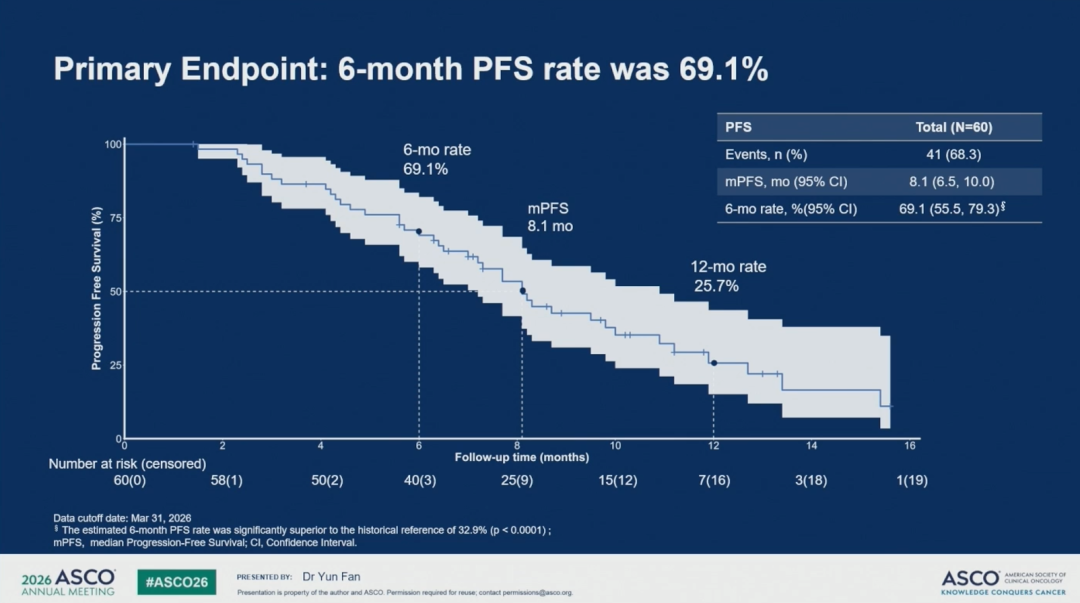
As of the data cutoff (March 31, 2026), the median follow-up duration was 11.4 months (95% CI: 9.7-13.1). The 6-month PFS rate was 69.1% (95% CI: 55.5-79.3), median PFS was 8.1 months (95% CI: 6.5-10.0), and median overall survival (OS) was not reached (NR, 95% CI: 12.6-NE), demonstrating a strong trend toward long-term survival benefit. The objective response rate (ORR) was 61.7% (95% CI: 48.2-73.9; all partial responses), and the disease control rate (DCR) was 96.7% (95% CI: 88.5-99.6).
In subgroup analyses, platinum-sensitive patients (CFI ≥90 days) had a median PFS of 8.3 months (95% CI: 6.3-11.2), while platinum-resistant patients (CFI <90 days) achieved a median PFS of 7.7 months (95% CI: 4.4-9.8), demonstrating benefit in both populations.
▌ Manageable safety profile with no new safety signals
The incidence of grade ≥3 treatment-related adverse events (TRAEs) was 36.7% (n=22). TRAEs led to irinotecan dose reduction in 26.7% (n=16), ivonescimab discontinuation in 11.7% (n=7), and irinotecan discontinuation in 6.7% (n=4). The incidence of immune-related adverse events (irAEs) was 36.7% (8.3% grade 3), with no grade ≥4 irAEs or treatment-related deaths reported. Overall, the safety profile was tolerable and clinically manageable.
▌ Filling the second-line treatment gap: PD-1/VEGF bispecific combination offers a new path for refractory SCLC
This phase 2 study demonstrated that in SCLC patients who had failed first-line platinum-based chemo-immunotherapy, the PD-1/VEGF bispecific antibody ivonescimab in combination with liposomal irinotecan provided a striking PFS benefit and improved tumor response, with a generally manageable safety profile. Based on the encouraging antitumor activity, this combination holds promise as a new treatment option for patients with refractory SCLC. Further results from ongoing randomized controlled trials are eagerly awaited.
Prof. Yun Fan Interprets the VICTORY Study Results
MedJ: Could you briefly introduce the main content of the VICTORY study presented at ASCO? What are the highlights of the study design and main findings?
Prof. Fan: The VICTORY study, a multicenter, single-arm, phase 2 trial presented at ASCO, aimed to evaluate the efficacy and safety of ivonescimab plus liposomal irinotecan in SCLC patients who progressed on first-line chemo-immunotherapy. The study design has three main highlights: ① a precise focus on the clinically challenging population with relapsed/refractory SCLC; ② the innovative combination of a bispecific antibody with a nano-delivery chemotherapeutic; ③ rigorous and scientifically sound study design and statistical methods.
Results: A total of 60 patients were enrolled. The primary endpoint, 6-month PFS rate, was 69.1%, with a median PFS of 8.1 months. The ORR was 61.7% and the DCR was 96.7% — truly impressive clinical efficacy. Subgroup analysis showed benefit in both platinum-sensitive and platinum-resistant patients, effectively breaking the treatment bottleneck for the platinum-resistant population.
Safety: Overall tolerability was good, with a low incidence of serious adverse events and no treatment-related deaths.
MedJ: What was the background for launching this study? What impact might it have on clinical practice?
Prof. Fan: SCLC is characterized by high malignancy, rapid doubling time, and a strong tendency to relapse and metastasize. After progression on first-line platinum-based chemotherapy plus immunotherapy, second-line treatment options are very limited. Conventional chemotherapy achieves response rates of only 15%-25%, with median PFS typically 3-4 months and OS around 6-8 months — a major clinical challenge.
Ivonescimab, as a bispecific antibody targeting PD-1 and VEGF, has already achieved positive results in several large phase 3 trials in advanced non-SCLC. Liposomal irinotecan utilizes nano-delivery technology to achieve passive targeted accumulation in tumor tissue, offering both enhanced efficacy and reduced toxicity. Their mechanisms are highly complementary, with strong synergistic antitumor potential, providing a solid scientific basis for exploring this combination in the second-line setting.
The VICTORY study‘s 8.1-month median PFS and 61.7% ORR directly surpass the limitations of traditional second-line therapies, potentially offering a new second-line treatment approach for patients who have failed first-line chemo-immunotherapy. Importantly, this regimen successfully addresses the clinical challenge of platinum resistance. Even in this platinum-resistant population — patients with an extremely poor prognosis — the regimen maintained a 6-month PFS rate above 68%, effectively filling a treatment gap and offering renewed hope for survival.
MedJ: SCLC is known as an “immune-cold” tumor. Although previous phase 1L immunotherapy+chemo studies have shown some PFS benefit, the overall improvement has been limited. What do you see as the greatest challenge facing immunotherapy in SCLC? Do bispecific antibodies (e.g., PD-1/VEGF, PD-L1/TIGIT) represent a new breakthrough direction?
Prof. Fan: The greatest challenges for immunotherapy in SCLC are, first, the disease’s inherently aggressive, rapidly progressive, and drug-resistant heterogeneity. After first-line standard chemo-immunotherapy, the tumor microenvironment often evolves into a complex immunosuppressive state. Second, conventional single-target immunotherapies have a narrow mechanism of action and struggle to simultaneously activate immunity while improving abnormal tumor vasculature or reversing immune escape — a key reason for the limited benefit from first-line chemo-immunotherapy and the difficulty of achieving efficacy in later lines.
Based on the VICTORY study results, bispecific antibodies do represent a promising new direction for immunotherapy in SCLC. As a typical “immune-cold” tumor, SCLC is often accompanied by significant abnormal tumor angiogenesis, which acts as a physical barrier to immune cell infiltration. Bispecific antibodies like PD-1/VEGF and PD-L1/TIGIT can simultaneously block two core signaling pathways, achieving mechanistic synergy. Taking ivonescimab as an example: on one hand, by inhibiting VEGF, it promotes normalization of tumor vasculature, effectively remodeling and improving the tumor microenvironment. Combined with the strong tumor permeability of liposomal irinotecan, this allows drugs and immune cells to infiltrate deeper into the tumor, breaking through the physical barrier of the “cold” tumor. On the other hand, it blocks the PD-1 pathway, reactivating T cells‘ killing activity against the tumor, ultimately producing a synergistic antitumor effect. The excellent data from this study preliminarily confirm the clinical potential of this new immunotherapy strategy. Several PD-1/VEGF bispecific antibodies are already being evaluated in phase 3 trials for first-line treatment of extensive-stage SCLC, suggesting that bispecific antibody-based combination strategies may reshape the current treatment paradigm for SCLC and represent a highly promising direction for clinical translation.

