


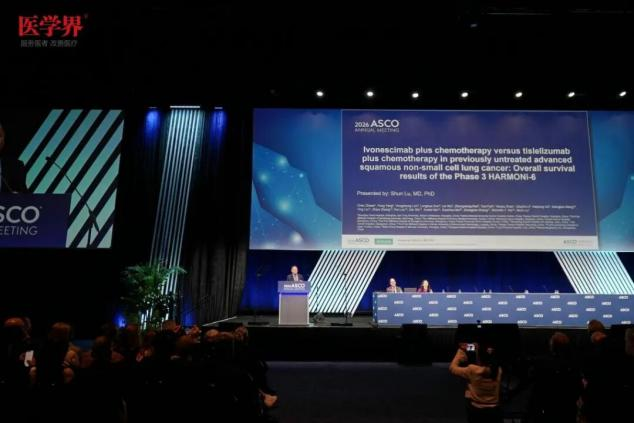
The 2026 American Society of Clinical Oncology (ASCO) Annual Meeting is in full swing! At 2:47 AM local time on May 31, the phase 3 HARMONi-6 trial led by Prof. Shun Lu from Shanghai Chest Hospital, Shanghai Jiao Tong University School of Medicine, was presented as a plenary session report, releasing the interim overall survival (OS) results of ivonescimab plus chemotherapy versus tislelizumab plus chemotherapy in previously untreated advanced squamous non-small cell lung cancer (sq-NSCLC).
Study Design: Addressing the Core Issues in First-Line Advanced Squamous NSCLC
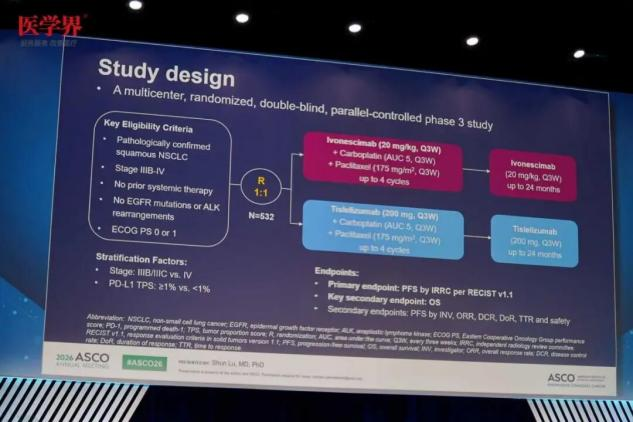
HARMONi-6 is a multicenter, randomized, double-blind, parallel-controlled phase 3 clinical trial that enrolled 532 patients with previously untreated advanced squamous NSCLC. Enrolled patients had pathologically confirmed disease, stage IIIB-IV, no EGFR mutations or ALK rearrangements, and ECOG PS of 0 or 1. The study imposed no restrictions on PD-L1 expression levels, making it more representative of the real-world advanced squamous NSCLC population.
Patients were randomly assigned 1:1 to receive either ivonescimab plus chemotherapy or tislelizumab plus chemotherapy. The ivonescimab arm received ivonescimab 20 mg/kg Q3W plus carboplatin AUC 5 and paclitaxel 175 mg/m² Q3W for up to 4 cycles, followed by ivonescimab maintenance therapy for up to 24 months. The control arm received tislelizumab 200 mg Q3W plus the same chemotherapy regimen, followed by tislelizumab maintenance therapy for up to 24 months.
OS Benefit Elevates the "Bispecific Antibody + Chemotherapy" Regimen to a New Height
In the previously reported interim PFS analysis, HARMONi-6 had already met its primary endpoint. The median PFS was 11.14 months in the ivonescimab plus chemotherapy arm versus 6.90 months in the tislelizumab plus chemotherapy arm (HR=0.60, P<0.0001), indicating that ivonescimab plus chemotherapy reduced the risk of disease progression or death by 40%. However, for first-line advanced lung cancer treatment, it is OS that truly determines the height of a regimen.
The OS interim analysis presented at ASCO represents the most substantial result of HARMONi-6. As of the data cutoff on February 27, 2026, the median follow-up duration was 21.36 months. The results showed that in the intention-to-treat (ITT) population, the median OS was 27.9 months in the ivonescimab plus chemotherapy arm versus 23.7 months in the tislelizumab plus chemotherapy arm (HR=0.66, 95% CI: 0.50–0.87, P=0.0017), meeting the prespecified statistical significance boundary. This means that compared with tislelizumab plus chemotherapy, ivonescimab plus chemotherapy reduced the risk of death by 34%.
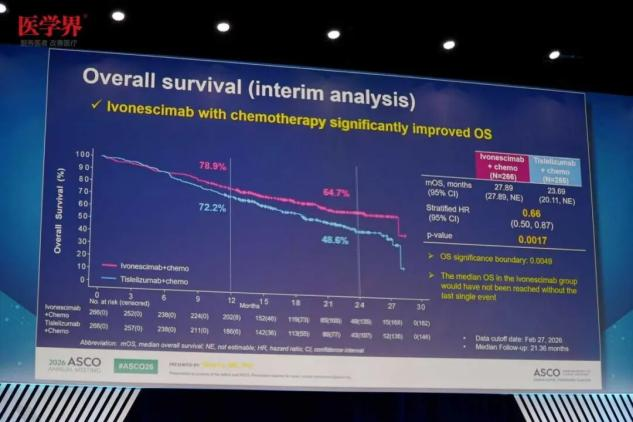
More notably, the survival advantage of ivonescimab plus chemotherapy is not merely reflected in the median OS numbers. In terms of long-term survival rates, the 12-month OS rate in the ivoneslizumab plus chemotherapy arm was 78.9% versus 72.2% in the control arm; the 24-month OS rates were 64.7% and 48.6%, respectively. That is, at 2 years of treatment, nearly two-thirds of patients in the ivonescimab plus chemotherapy arm remained alive, compared with less than half in the control arm.
As follow-up time lengthened, the OS curves between the two arms gradually separated, suggesting that the benefit from ivonescimab plus chemotherapy may not be a transient advantage from short-term remission but rather a more durable long-term survival benefit.
Benefit Consistent Across Subgroups, Independent of PD-L1 Expression
Subgroup analyses of HARMONi-6 demonstrated that the OS benefit of ivonescimab plus chemotherapy was consistent across different PD-L1 expression levels. In patients with PD-L1 TPS <1%, the OS HR was 0.64; in those with PD-L1 TPS ≥1%, the OS HR was 0.68. Further stratification showed an OS HR of 0.67 in patients with TPS 1%-49% and 0.64 in those with TPS ≥50%. These findings indicate that ivonescimab plus chemotherapy provides a consistent trend of OS improvement regardless of whether patients are PD-L1 negative, low-positive, or high-positive.
It is worth noting that the proportion of subsequent anti-tumor therapy was generally similar between the two arms. The rates of subsequent immunotherapy were 13.9% in the ivonescimab arm and 19.2% in the tislelizumab arm; subsequent targeted therapy rates were 12.4% and 17.3%, respectively; and subsequent ADC therapy rates were 4.5% and 5.6%, respectively. This suggests that the observed OS difference is unlikely to be driven primarily by imbalance in subsequent treatment.
Progression to the Next Stage: China‘s Bispecific Antibody Leads Breakthroughs in Squamous NSCLC Treatment
The safety profile of the ivonescimab plus chemotherapy regimen was generally manageable, with a safety profile consistent with that reported in previous studies.
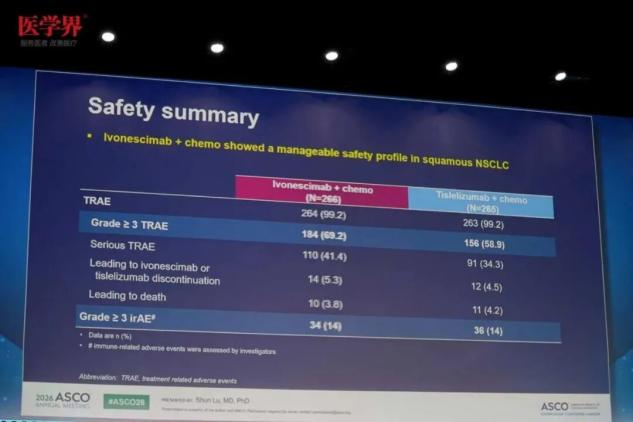
This interim OS analysis showed that the safety profile of ivonescimab plus chemotherapy was generally manageable. The incidence of grade ≥3 treatment-related adverse events (TRAEs) was 69.2% in the ivonescimab plus chemotherapy arm versus 58.9% in the tislelizumab plus chemotherapy arm. The rates of adverse events leading to treatment discontinuation or death were similar between the two arms.
In terms of adverse event types, common TRAEs included alopecia, anemia, decreased neutrophil count, decreased white blood cell count, proteinuria, decreased platelet count, decreased appetite, and elevated liver enzymes. Among these, VEGF-related adverse events such as proteinuria, bleeding, and hypertension were more frequent in the ivonescimab arm, but most were grade 1–2. Previous PFS analyses also demonstrated that the overall safety of ivonescimab plus chemotherapy was manageable, with no new safety signals identified.
Conclusion: As a Chinese-originated anti-PD-1/VEGF bispecific antibody, ivonescimab demonstrated breakthrough efficacy in the HARMONi-6 study. Compared with tislelizumab plus chemotherapy, ivonescimab plus chemotherapy significantly prolonged OS (27.9 vs. 23.7 months), reduced the risk of death by 34% (P=0.0017), and increased the 2-year OS rate to 64.7%. The benefit was consistent regardless of PD-L1 expression level. The safety profile was favorable. This study marks a major breakthrough for Chinese-originated anti-PD-1/VEGF bispecific antibody in first-line treatment of squamous NSCLC and is expected to reshape clinical practice.

