


From March 25 to 28, 2026 local time, the European Lung Cancer Congress (ELCC) was held in Copenhagen, Denmark. As a global academic benchmark in the lung cancer field, the meeting focused on innovative advances in the diagnosis and treatment of all types of lung cancer, offering frontline clinical insights to physicians worldwide.
At 8:30 a.m. local time on March 27, Prof. Wu Lin of Hunan Cancer Hospital delivered an impressive presentation in the Mini Oral session. The phase III trial led by his team, “Subcutaneous versus intravenous toripalimab combined with chemotherapy for first-line treatment of recurrent or metastatic non-squamous non-small cell lung cancer (NSCLC): a randomized phase III trial,” focused on formulation innovation in PD-1 inhibitors and offered a more convenient new option for first-line treatment of non-squamous NSCLC. MedJ has therefore summarized the study and invited Prof. Wu Lin to share the considerations behind the research and its clinical application prospects.
A phase III study of subcutaneous toripalimab addresses the pain points of intravenous administration
NSCLC is the most common type of lung cancer, and non-squamous NSCLC accounts for about 70% of cases. First-line treatment for recurrent or metastatic non-squamous NSCLC is mainly based on PD-1 inhibitors combined with chemotherapy. At present, the intravenous formulation of toripalimab has been approved in China for this indication, but long-term clinical practice has revealed many pain points in intravenous PD-1 administration, creating an urgent need for formulation innovation to optimize the treatment experience and the allocation of medical resources.
To address this clinical need, Prof. Wu Lin’s team initiated this multicenter, open-label, randomized, controlled, non-inferiority phase III trial (NCT06505837). The study head-to-head compared subcutaneous and intravenous toripalimab combined with chemotherapy in first-line treatment of recurrent or metastatic non-squamous NSCLC, evaluating drug exposure, efficacy, and safety, and providing high-level evidence for the clinical application of the subcutaneous formulation.
The study enrolled 396 participants from 72 centers in China. All had histologically or cytologically confirmed recurrent or metastatic non-squamous NSCLC without sensitizing EGFR mutations or ALK fusions, and they were randomized 1:1 to the subcutaneous group or the intravenous group, with 198 patients in each arm. Both groups received pemetrexed (500 mg/m²) plus carboplatin (AUC=5) or cisplatin (75 mg/m²) for up to four cycles. Patients without disease progression then continued maintenance therapy with the corresponding toripalimab formulation plus pemetrexed.
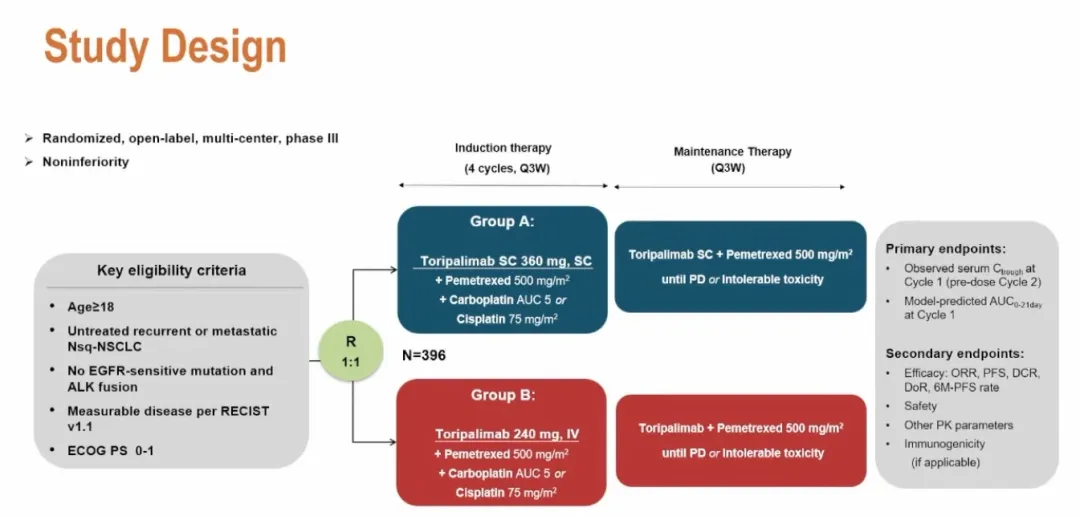
The primary endpoints were measured trough concentration (Ctrough) at the end of cycle 1 and the area under the concentration-time curve from day 0 to day 21 of cycle 1 (AUC0-21day) simulated using a population pharmacokinetic model. Secondary endpoints included efficacy indicators such as objective response rate (ORR), disease control rate (DCR), and PFS, as well as safety.
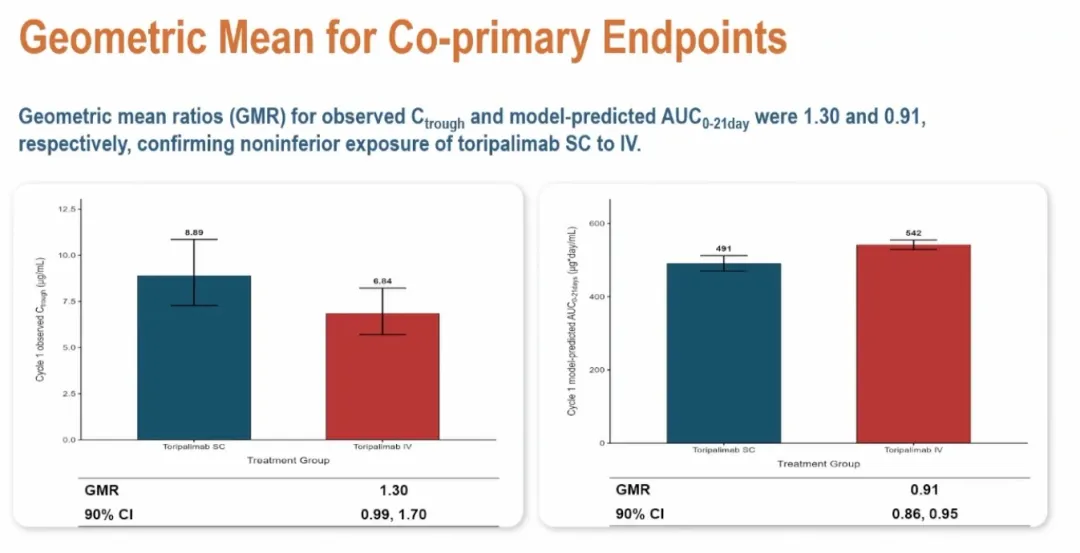
As of the data cutoff on July 18, 2025, median follow-up was 7.1 months. The key findings showed that drug exposure in the subcutaneous group met the non-inferiority criterion versus the intravenous group. The geometric mean ratio for measured Ctrough was 1.31 (90% CI: 1.00-1.72), and the geometric mean ratio for simulated AUC0-21day was 0.90 (90% CI: 0.86-0.95), both satisfying the prespecified non-inferiority margins.
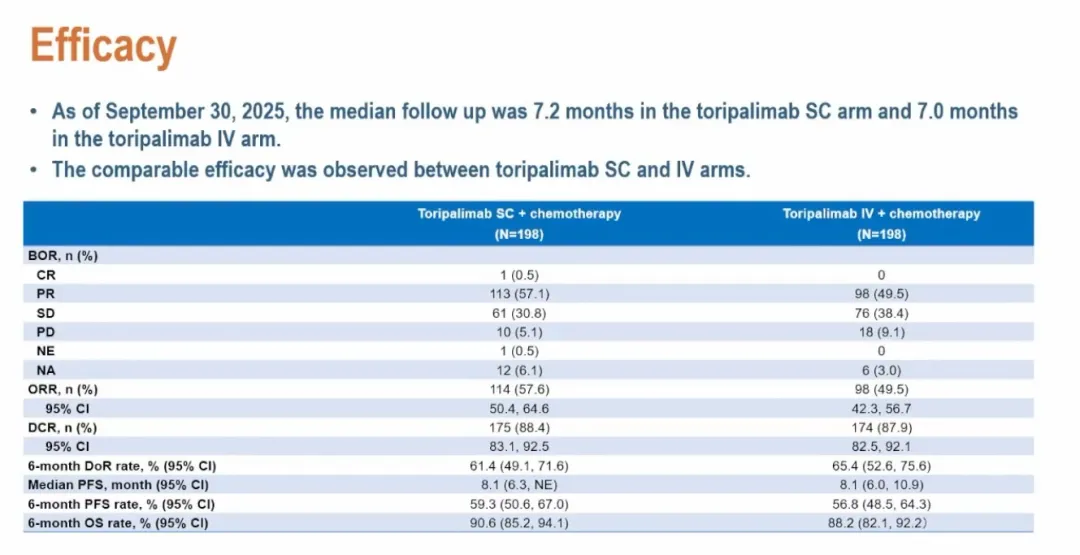
In terms of efficacy, the two groups performed highly consistently: ORR was 57.6% in the subcutaneous group and 49.5% in the intravenous group, showing a numerical advantage for the subcutaneous arm; DCR was 88.4% and 87.9%, respectively; median PFS was 8.1 months in both groups; and the 6-month PFS rates (59.3% vs 56.8%) and 6-month OS rates (90.6% vs 88.2%) were also essentially consistent, confirming that the efficacy of the subcutaneous formulation was not inferior to that of the intravenous formulation.
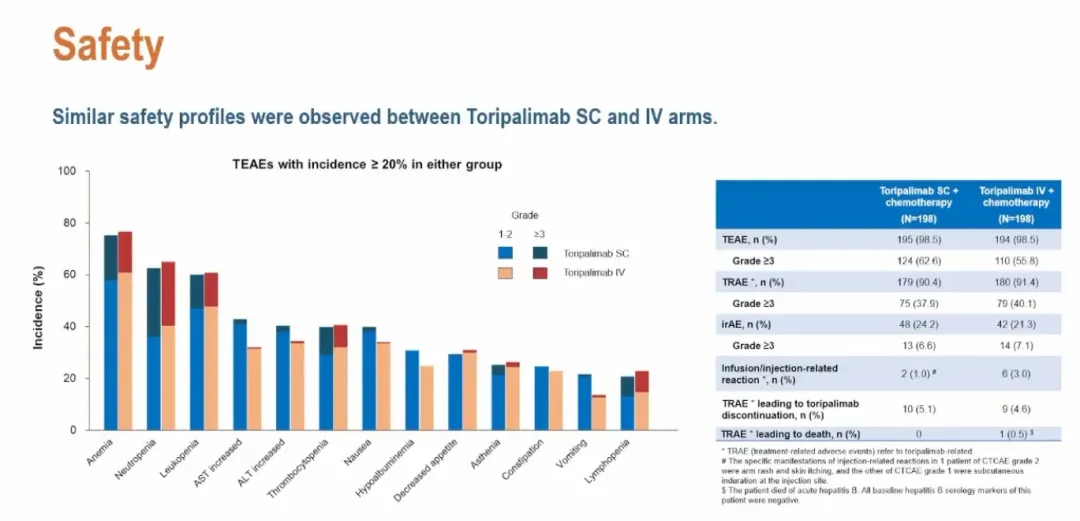
Safety was also similar between the two groups. The incidence and severity of treatment-related adverse events (TRAEs) and immune-related adverse events (irAEs) showed no obvious differences: in the subcutaneous group, TRAEs occurred in 90.4% of patients, grade 3 or higher TRAEs in 37.9%, irAEs in 24.2%, and grade 3 or higher irAEs in 6.6%; the corresponding figures in the intravenous group were 91.4%, 40.1%, 21.3%, and 7.1%. Notably, injection-related reactions occurred in only 1.0% of the subcutaneous group (2 cases, both grade 1-2, manifesting as local induration, rash, and pruritus), which was lower than the 3.0% seen in the intravenous group. No new or unexpected adverse reactions were observed, and overall safety was manageable.
At present, the marketing application for the subcutaneous formulation of toripalimab has been accepted by the National Medical Products Administration (NMPA). If approved, it will offer a more convenient and more accessible treatment option for first-line therapy in recurrent or metastatic non-squamous NSCLC.
Expert in-depth interpretation: the value of formulation innovation and prospects for clinical transformation
MedJ: From a clinician’s perspective, what unmet clinical pain points does traditional intravenous PD-1 inhibitor therapy have in long-term treatment? What was the original intention behind your team’s development of the subcutaneous toripalimab formulation?
Prof. Wu Lin: From a clinician’s perspective, traditional intravenous PD-1 inhibitor therapy has three major unmet pain points in long-term treatment, and these are exactly why we initiated the study of the subcutaneous formulation. First, the need for long-term treatment convenience has not been met. Patients with cancer need long courses of therapy, usually lasting one to two years, while intravenous formulations require more than 30 minutes for each administration. Patients must travel to the hospital frequently and wait in line, which creates major time, financial, and physical burdens for elderly patients, those with poor performance status, or those living in remote areas. Some patients even discontinue treatment because they cannot sustain repeated hospital visits, which affects outcomes. Second, the need to optimize medical resources has not been met. Intravenous immunotherapy occupies infusion room space and consumes large amounts of nursing time and manpower in oncology hospitals, while also carrying potential risks such as infusion reactions and hospital-acquired infection. By contrast, the subcutaneous formulation does not require complex preparation or infusion equipment and can free infusion-room resources so that medical staff can devote more effort to core work such as disease assessment and treatment adjustment. Third, the need for access in primary care settings has not been met. Many NSCLC patients in China live in grassroots regions, but local medical institutions often lack infusion facilities and specialized nursing staff, which seriously restricts the wider use of immunotherapy.
Prof. Wu Lin: Against these pain points, the subcutaneous formulation of toripalimab offers clear advantages. It can be administered in just one minute, without venipuncture, and can be given directly in the outpatient clinic, greatly reducing the time burden on both patients and healthcare staff. At the same time, it can significantly reduce the burden of seeking care, improve adherence to long-term treatment, and help avoid interruptions that could compromise efficacy. In addition, after simple training, clinicians and nurses in primary care institutions can master subcutaneous administration without needing complicated infusion equipment, helping immunotherapy reach grassroots settings. Therefore, the core of our research is to be patient-centered: through formulation innovation, we aim to optimize the treatment experience and allocate medical resources more rationally without compromising efficacy or safety, so that patients can receive a treatment option with unchanged efficacy but a better experience.
MedJ: The study used a head-to-head design to compare drug exposure, efficacy, and safety between the subcutaneous formulation and the already marketed intravenous formulation. As the principal investigator, could you share the considerations behind this design? What were the most noteworthy highlights in the primary endpoint data released at this ELCC meeting?
Prof. Wu Lin: This was a multicenter, open-label, randomized, controlled, non-inferiority study. The choice of a non-inferiority design was mainly based on international regulatory consensus and the development experience of similar drugs. Regulatory authorities such as the Center for Drug Evaluation and the U.S. Food and Drug Administration recognize pharmacokinetic non-inferiority designs for switching from intravenous to subcutaneous formulations, and phase III studies of subcutaneous formulations for drugs such as atezolizumab, pembrolizumab, and nivolumab have used the same principle. Because the route of administration differs, intravenous administration enters the bloodstream directly whereas subcutaneous administration requires an absorption process, so the pharmacokinetic curves of the two formulations cannot be exactly identical and are not suitable for an equivalence design.
Prof. Wu Lin: The study had two primary endpoints: measured trough concentration at the end of cycle 1 and the day 0-21 area under the concentration-time curve in cycle 1 simulated with a population pharmacokinetic model. These endpoints were chosen partly by reference to the design of international studies of similar agents and partly because the cycle-1 pharmacokinetic endpoints are better able to avoid changes in exposure caused by time-dependent clearance, thereby providing a more objective reflection of differences in drug exposure between the two formulations.
Prof. Wu Lin: Three highlights in the data presented at ELCC deserve special attention. First, drug exposure met the non-inferiority standard. In the subcutaneous group, the geometric mean ratio for Ctrough in cycle 1 was 1.31 and the geometric mean ratio for AUC0-21day was 0.90. The lower limits of the 90% confidence intervals for both endpoints exceeded the non-inferiority margin of 0.8, clearly proving that drug exposure with the subcutaneous formulation was fully comparable to that of the intravenous formulation and providing a solid pharmacokinetic foundation for consistent efficacy and safety. In addition, the population pharmacokinetic model we used was robust, and the simulated AUC showed good comparability with the true AUC, further confirming the reliability of the results.
Prof. Wu Lin: Second, efficacy was highly consistent with the intravenous formulation. The core efficacy indicators fully demonstrated comparable efficacy: ORR was 57.6% (95% CI: 50.4%-64.6%) in the subcutaneous group and 49.5% (95% CI: 42.3%-56.7%) in the intravenous group, with a numerical advantage in the subcutaneous arm; DCR was 88.4% and 87.9%, respectively; median PFS was 8.1 months in both groups; and the 6-month PFS rates (59.3% vs 56.8%) and 6-month OS rates (90.6% vs 88.2%) were also broadly similar. Combined with the pharmacokinetic non-inferiority results, these data form a complete chain of evidence supporting consistent efficacy and show that the subcutaneous formulation can fully substitute for the intravenous formulation in terms of efficacy.
Prof. Wu Lin: Third, safety was similar and injection-related reactions were milder. There were no obvious differences between the two groups in treatment-related adverse events and immune-related adverse events, either in overall incidence or in grade 3 or higher severity, and the adverse-event spectrum was also consistent, with the common toxicities expected from chemotherapy plus immunotherapy. Notably, the incidence of injection-related reactions in the subcutaneous group was only 1.0%, with just two grade 1-2 cases manifesting mainly as local induration, rash, and skin pruritus. This was lower than the 3.0% seen in the intravenous group, and all reactions were mild, required no special treatment, and were not accompanied by any new or unexpected adverse events. Overall safety was manageable and patient tolerability was favorable.
MedJ: Based on these positive results, the marketing application for subcutaneous toripalimab has been accepted by the NMPA. In your view, if this formulation is approved and adopted in clinical practice, how will it change treatment patterns for lung cancer patients in China? What far-reaching impact could it have on patient-centered whole-course cancer management and on tiered diagnosis and treatment?
Prof. Wu Lin: I believe that if subcutaneous toripalimab is approved and applied in clinical practice, it will be much more than simply a different route of administration. It will fundamentally change the NSCLC treatment model from four dimensions—patient experience, clinical workflow, medical resources, and accessibility in primary care—with the core goal of upgrading care in a patient-centered way. It will also have far-reaching implications for whole-course cancer management and for tiered diagnosis and treatment.
Prof. Wu Lin: First, it can greatly reduce the burden on patients and their families and improve adherence. Immunotherapy for NSCLC is a long-term process. The subcutaneous formulation can be injected in one minute and administered in the outpatient clinic, without prolonged waiting, which substantially reduces patients’ time and financial costs and helps them adhere to long-term therapy. The benefits of immunotherapy depend precisely on sustained treatment. At present, we still recommend hospital-based administration, but with accumulated experience and more data, home injection may also become possible in the future, further improving convenience.
Prof. Wu Lin: Second, it can optimize hospital efficiency and release medical resources. As outcomes improve and survival lengthens in lung cancer, the contradiction between limited medical resources and the demand for long-term treatment is becoming increasingly prominent. The subcutaneous formulation requires neither drug preparation nor complicated infusion equipment and can be administered directly in the clinic, effectively releasing infusion-room resources and allowing medical staff to focus more on disease assessment, treatment adjustment, and adverse-event management. At the same time, the full-chain cost of the subcutaneous formulation is lower and adverse reactions are fewer, which also helps channel limited resources toward patients with severe advanced disease and achieve more rational allocation of healthcare resources.
Prof. Wu Lin: Third, it can promote the downward extension of immunotherapy to grassroots settings and help standardize NSCLC care nationwide. The subcutaneous formulation of toripalimab is simple to administer, can be mastered by primary-care staff after basic training, and is also more convenient to store and transport in prefilled syringe form. This will allow local hospitals to deliver standardized immunotherapy smoothly, enabling NSCLC patients in remote and grassroots areas to receive high-quality treatment close to home, narrowing gaps in care between regions and hospital levels and promoting more homogeneous NSCLC management across the country.
Prof. Wu Lin: Fourth, it can drive an upgrade in administration patterns and achieve a patient-centered transformation in care. It will shift cancer immunotherapy from an intravenous-infusion-dominant model to a diversified “intravenous plus subcutaneous” choice. Patients with good performance status and convenient access to care may continue to choose the intravenous formulation, while elderly patients, those with poor performance status, those in remote areas, or those requiring long-term treatment may preferentially choose the subcutaneous formulation. At the same time, as one of the few PD-1 subcutaneous formulations globally that does not require hyaluronidase, its successful development also provides an important reference for formulation innovation in other domestic immunotherapies. In the future, we may even explore entirely subcutaneous combination regimens such as subcutaneous immunotherapy plus subcutaneous chemotherapy, making NSCLC treatment simpler and more convenient and ultimately enabling patient self-administration at home. This is also an important direction for the development of patient-centered care.
Prof. Wu Lin: From the perspective of tiered diagnosis and treatment and whole-course cancer management, the wider use of the subcutaneous formulation will help grassroots institutions take on more of the long-term treatment and follow-up of NSCLC patients, allowing major specialist cancer centers to focus more on difficult and severe cases, complex diagnosis and treatment, and research work, thereby forming a system with clear division of labor and efficient coordination. At the same time, patients will be able to complete long-term treatment in medical institutions closer to home, reducing the burden of travel while improving continuity and management quality, truly realizing patient-centered whole-course cancer management and allowing more NSCLC patients to benefit.

