


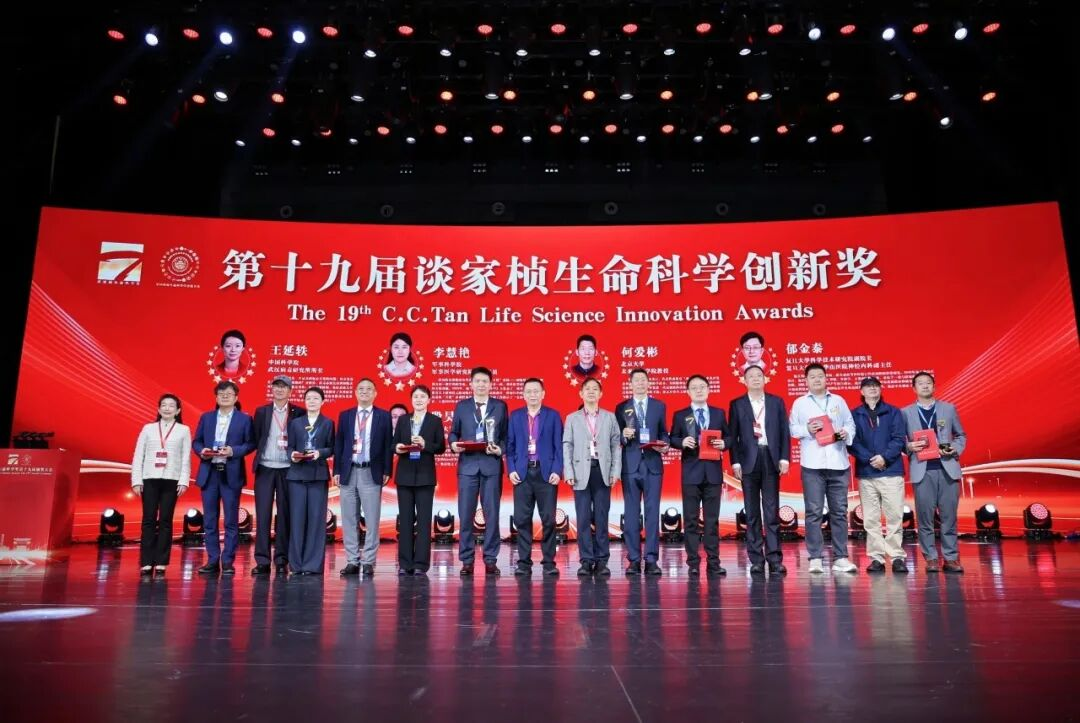
Prof. Jintai Yu of the Department of Neurology at Huashan Hospital, Fudan University, received the Life Science Innovation Award at the 19th C.C. Tan Life Science Awards ceremony, held on the morning of November 14, 2026 in Xianghui Hall on the Handan Campus of Fudan University. Prof. Zihe Rao, an academician of the Chinese Academy of Sciences and chair of the awards committee, presided over the ceremony, and Prof. Li Jin, president of Fudan University and an academician of the Chinese Academy of Sciences, delivered the welcome remarks.
Article Key Points
• Prof. Jintai Yu of Huashan Hospital receives the 19th C.C. Tan Life Science Innovation Award
• Prize created in May 2008 on the initiative of C.C. Tan and approved by the Ministry of Science and Technology
• Yu leads neurodegenerative disease cohorts and data repositories and works on Alzheimer’s disease prevention
• He reported on possible routes to preclinical intervention in Alzheimer’s disease
• Fellow laureates gave reports on haematology, rare disease, IO2.0 and brain-computer interfaces
The C.C. Tan Life Science Prize
The C.C. Tan Life Science Prize was established in May 2008 on the initiative of Prof. C.C. Tan (Jiazhen Tan), an academician of the Chinese Academy of Sciences and a founder of modern genetics in China, and with the approval of the Ministry of Science and Technology of the People’s Republic of China. It is regarded as one of the most influential and credible academic awards in the life sciences in China. It comprises the Life Science Achievement Award, the International Life Science Award, the Clinical Medicine Award, the Life Science Industrialisation Award and the Life Science Innovation Award, and plays a part in encouraging original innovation, identifying young talent and promoting interdisciplinary integration.
Speaking as the representative of the awardees, Yu said that what he takes from C.C. Tan’s spirit of “seeking truth, innovation and dedication”is doing careful research, solving patients’ practical problems and training young people properly. Since he became involved with Alzheimer’s disease research as a graduate student in 2007, his plainest aim has been to have the disease detected earlier: “to let patients keep as much of their memory and their independence in daily life as possible. May every effort from now on bring more hope to patients and their families.” He added that Tan once said that “wealth is students”, and that this would spur him to shoulder responsibility and to create an environment in which the next generation can explore without anxiety, so that the enterprise of science keeps moving forward.
The Award Forum at Huashan Hospital
On the afternoon of November 14, one of the C.C. Tan Life Science Prize forums was held at Huashan Hospital. Rong Wu, a research fellow and deputy president of the hospital, chaired the session and addressed it, with Prof. Tong Chen, deputy dean of the hospital’s Medical Research Institute, and Dr. Shu Chen, director of the research office, moderating. Prof. Depei Wu and Prof. Zhiying Wu, laureates of the C.C. Tan Clinical Medicine Award, gave keynote reports titled “Clinical needs driving scientific innovation: the transmission and development of the Suzhou haematology discipline” and “From disease gene discovery to precision intervention in rare disease”. Dr. Yu Xia delivered a report on “From Chinese innovation to global value translation: the Akeso IO2.0+ and globalisation path”. Yu gave a keynote titled “Can Alzheimer’s disease be prevented before symptoms appear?”, examining possible routes for preclinical intervention in AD, and Prof. Liang Chen of Huashan Hospital shared the latest progress and the open problems in clinical research on brain-computer interfaces.

