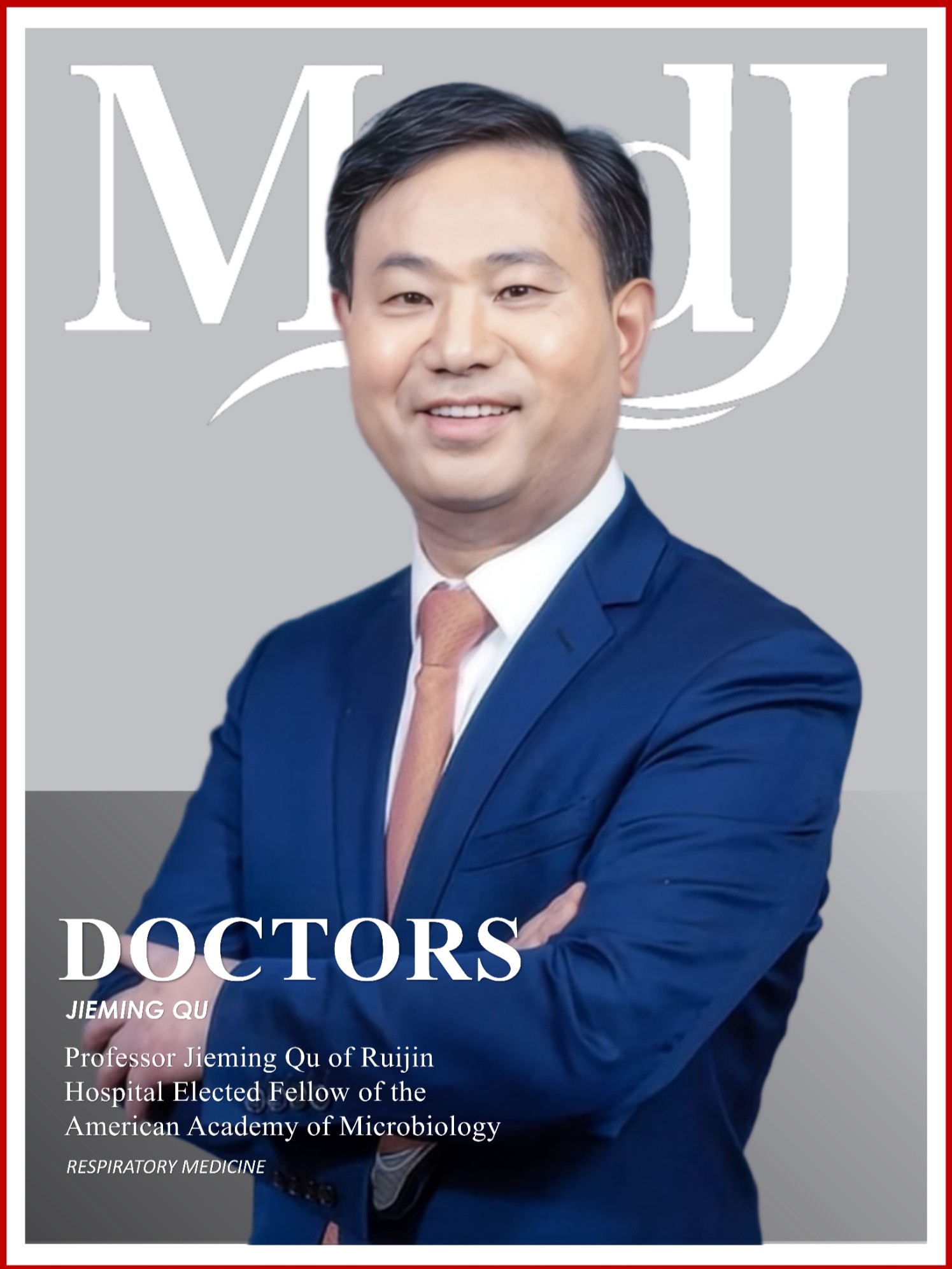
In February 2026, the American Society for Microbiology announced the new class of fellows of the American Academy of Microbiology. A total of 63 scientists from 14 countries were elected, including four from China.
A review by MedJ found that Prof. Jieming Qu, director of the Department of Pulmonary and Critical Care Medicine at Ruijin Hospital, Shanghai Jiao Tong University School of Medicine, was among them. He was also the only scientist from a medical institution among the Chinese fellows elected this year.
The American Academy of Microbiology is the honorary leadership group and scientific think tank of the American Society for Microbiology, the world’s longest-standing academic organization in the life sciences. Each year it selects fellows worldwide through a rigorous peer-review process. Over the past more than half century, more than 2,700 scientists have received this honor, including winners of the Nobel Prize, the Lasker Award, and the U.S. National Medal of Science.
Prof. Qu has long been dedicated to the standardized diagnosis and treatment of pulmonary infectious diseases and to research on new technologies. As corresponding author or first author, including co-first and co-corresponding authorship, he has published 156 SCI papers in leading journals such as The Lancet, BMJ, and Cell, with a combined impact factor of more than 1,200.
He has also won numerous honors, including first prize of the Shanghai Science and Technology Progress Award, second prize of the Ministry of Education Science and Technology Progress Award, and first prize of the Shanghai Medical Award as first completer. He has additionally been named a Shanghai Leading Talent, received the China Respiratory Physician Award, and won the 2024 Asia-Pacific Clinical Medicine Award from the Asia Pacific Medical and Biological Immunology Society.
His election this time is a high-level recognition by the international academic community of his more than 30 years of scientific contributions.
Prof. Qu’s major research contributions cover the following three areas:
First, Establishing New Accurate, Rapid, and Feasible Approaches to Pathogen Diagnosis in Severe Pneumonia
He led a national multicenter prospective clinical study that, for the first time, used bronchoscopic sampling and novel pathogen detection technologies to accurately reveal the distribution characteristics of pathogens in severe pneumonia in China, avoiding blind implementation of initial empirical anti-infective therapy based on foreign guidelines.
He proposed a targeted-open collaborative diagnostic model integrating multiple detection methods, improving pathogen detection rates in severe pneumonia and reducing mortality.
He independently developed a rapid loop-mediated isothermal amplification assay for Klebsiella pneumoniae with good sensitivity and specificity.
He established an antibiotic susceptibility prediction platform based on metagenomic sequencing and artificial intelligence. Compared with traditional methods, it markedly shortens the time required while maintaining high predictive accuracy and significantly reduces the time needed to shift from empirical antibacterial therapy to targeted treatment.
Second, Building a New Early-Warning System for Progression to Severe Disease Around Key Mechanisms of Inflammatory Outcomes
He was the first to propose the theory that “functional plasticity of monocytes determines infection outcome”: excessive activation of monocytes together with blocked differentiation leads to immune escape and worsening inflammation, while inoculation with inactivated COVID-19 vaccines promotes monocyte maturation through trained innate immunity, provides immune protection, and accelerates pathogen clearance.
He identified important biomarkers that indicate different inflammatory outcomes, revealed key molecules related to monocyte activation and prevention of progression to severe pneumonia, and uncovered key signaling pathways that can reverse monocyte-macrophage-mediated immune escape and accelerate pathogen clearance.
He further established a multimodal clinical database and biobank for pneumonia and built an early-warning model for severe pneumonia consisting of four host genes and two clinical indicators. Its predictive performance is significantly superior to comparable scoring systems, enabling early recognition of severe disease and precise stratified warning.
Third, Leading the Development of New Guidelines Along the Research Line of “Pathogen–Host–Immunity”
Through multicenter prospective studies, he clarified the shortcomings and deficiencies in pneumonia diagnosis and treatment in China and updated the guidelines for community-acquired pneumonia as well as hospital-acquired and ventilator-associated pneumonia based on the realities of Chinese practice.
He established a clinical interpretation pathway for metagenomic next-generation sequencing reports in lower respiratory tract infections and organized the completion of the Chinese Expert Consensus on the Diagnosis and Treatment of Lower Respiratory Tract Infection Caused by Pseudomonas aeruginosa, the Expert Consensus on Local Application of Anti-infective Drugs in the Lower Respiratory Tract in Adults, and the Chinese Expert Consensus on Clinical Application of Nebulized Expectorants. These efforts have effectively advanced the standardization and normalization of respiratory infection practice in China.
From defining pathogen spectra in severe pneumonia to building early-warning systems, from promoting the clinical translation of cutting-edge therapies to sharing Chinese diagnostic and therapeutic experience with the world, Prof. Qu has spent more than 30 years building a line of defense against respiratory infections and emerging infectious diseases in China that combines scientific depth with clinical breadth.
Prof. Qu’s election to the American Academy of Microbiology is both recognition by the international academic community of his past contributions and a new footnote on this academic path from China to the world.
Dr. Vanessa Sperandio, chair of the Board of Governors of the American Academy of Microbiology, said: “Fellows of the American Academy of Microbiology are leaders in the field who guide the direction of scientific discovery and influence the trajectory of social development. Election as a fellow is an important professional milestone, and we are honored to welcome Prof. Qu as a member of the 2026 class.”