


Radical surgery is the core curative approach for resectable EGFR-mutant stage II–IIIB non-small cell lung cancer (NSCLC), while neoadjuvant therapy is a key step in reducing the risk of disease progression and improving surgical outcomes. The NeoADAURA study demonstrated that osimertinib monotherapy or in combination with chemotherapy significantly increased the major pathological response (MPR) rate, improved surgical outcomes, and showed a trend toward an event-free survival (EFS) benefit.
From March 25 to 28, 2026, the European Lung Cancer Congress (ELCC) was held in Copenhagen, Denmark. During the congress, an exploratory analysis of the NeoADAURA study (Abstract No. 237P) was presented, providing a new perspective for clinical efficacy evaluation. MedJ has specially compiled the key findings and invited Prof. Bo Zhang from Shanghai Chest Hospital for in-depth interpretation.
NeoADAURA Exploratory Analysis: Significant Improvement in PERCIST Response with High Correlation to MPR and MRD
Study Background
The phase III, global, randomized controlled NeoADAURA study (NCT04351555) has confirmed that in patients with resectable EGFR-mutant stage II–IIIB NSCLC, neoadjuvant osimertinib monotherapy or osimertinib combined with chemotherapy, compared with placebo plus chemotherapy, significantly improved the MPR rate, enhanced surgical outcomes, and demonstrated a trend toward EFS benefit.
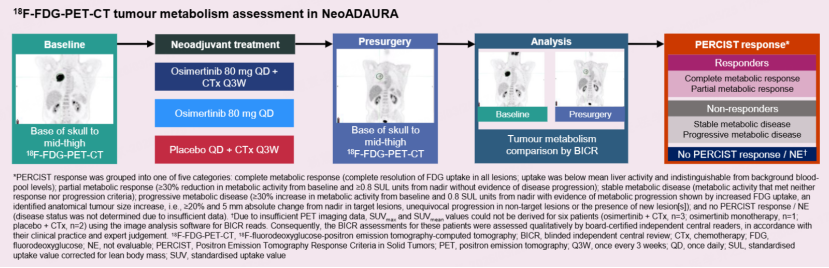
PERCIST evaluates tumor metabolic changes through 18F-fluorodeoxyglucose positron emission tomography–computed tomography (18F-FDG-PET-CT). It can complement the limitations of computed tomography (CT) in assessing the efficacy of neoadjuvant therapy and allows evaluation of lymph nodes that are not measurable by RECIST criteria. Its metabolic response can serve as a supplement to early efficacy endpoints such as MPR, thereby providing a more comprehensive basis for clinical efficacy assessment. This exploratory analysis aimed to evaluate PERCIST responses determined by blinded independent central review (BICR) and to assess their correlation with pathological response and molecular residual disease (MRD).
Methods
The study enrolled adult patients with resectable stage II–IIIB NSCLC harboring EGFR mutations (exon 19 deletion or exon 21 L858R point mutation). Patients were randomized in a 1:1:1 ratio into three groups, all receiving ≥9 weeks of treatment followed by surgery, with optional adjuvant therapy after surgery:
- Osimertinib plus chemotherapy group: osimertinib (80 mg once daily) combined with chemotherapy (every 3 weeks for 3 cycles);
- Osimertinib monotherapy group: osimertinib alone (80 mg once daily);
- Placebo plus chemotherapy group: placebo (once daily) combined with chemotherapy (every 3 weeks for 3 cycles).
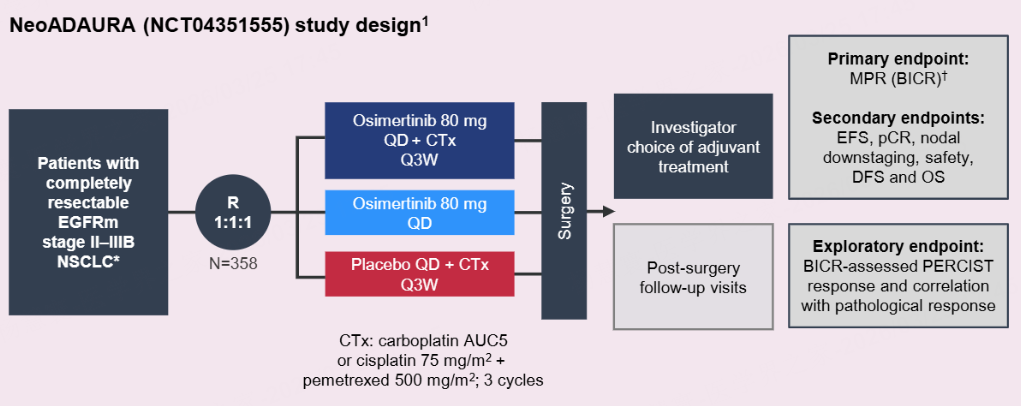
All patients underwent 18F-FDG-PET-CT scans at baseline and prior to surgery. The exploratory endpoints included PERCIST response assessed by BICR and its correlation with pathological response and MRD. PERCIST responses were categorized as complete metabolic response (CMR), partial metabolic response (PMR), stable metabolic disease, progressive metabolic disease, or not evaluable. Investigators compared these with pathological response and MRD status. The data cutoff date was October 15, 2024.
Results
A total of 349 patients were included in the PERCIST analysis set, with balanced baseline characteristics across the three groups. Overall, the proportion of PERCIST responders (CMR + PMR) was significantly higher in the osimertinib plus chemotherapy group and the osimertinib monotherapy group compared with the placebo plus chemotherapy group. The specific data were as follows: 76% (87/115) in the osimertinib plus chemotherapy group, 68% (80/117) in the osimertinib monotherapy group, and 37% (43/117) in the placebo plus chemotherapy group.
Regarding complete metabolic response (CMR), the osimertinib plus chemotherapy group (27%, 31/115) showed a higher trend compared with the osimertinib monotherapy group (20%, 23/117).
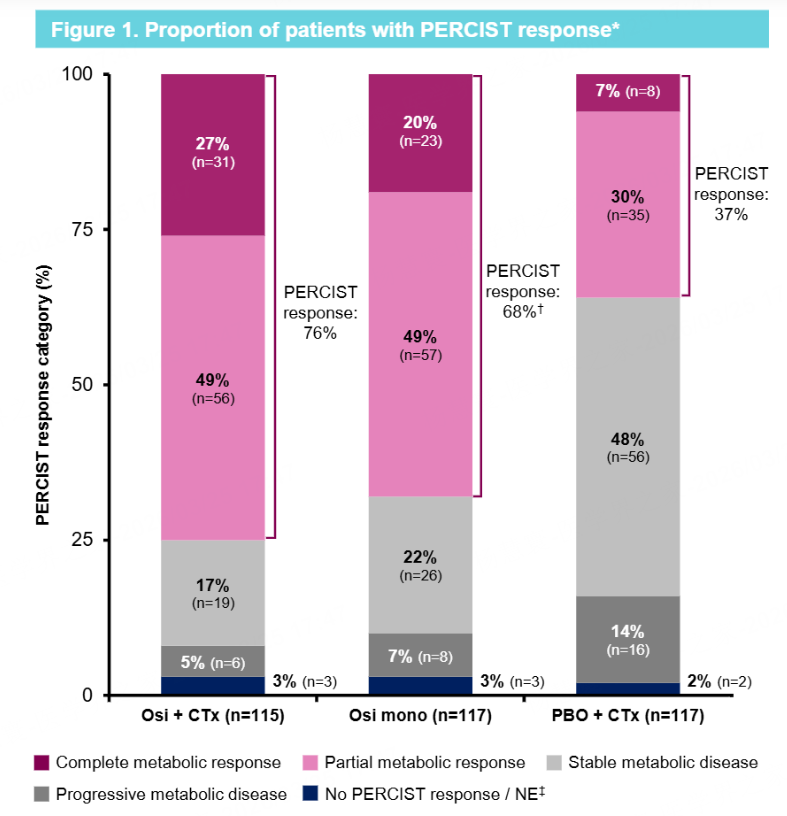
The detailed distribution of PERCIST metabolic responses in the three groups is shown in the table.
Table: Comparison of PERCIST Metabolic Responses Among the Three Groups
|
PERCIST Response, n (%) † |
Osi + CTx (n=115) |
Osi Mono (n=117) |
PBO + CTx (n=117) |
|
Complete Metabolic Response |
31 (27) |
23 (20) |
8 (7) |
|
Partial Metabolic Response |
56 (49) |
57 (49) |
35 (30) |
|
Stable Metabolic Disease |
19 (17) |
26 (22) |
56 (48) |
|
Progressive Metabolic Disease |
6 (5) |
8 (7) |
16 (14) |
|
No PERCIST Response / NE ‡ |
3 (3) |
3 (3) |
2 (2) |
Note: *Clinical data cutoff date: October 15, 2024. †Percentages were calculated based on the number of patients who completed 18F-FDG-PET-CT scans at baseline and prior to surgery. ‡Patients who underwent 18F-FDG-PET-CT but whose PERCIST response was not evaluable. 18F-FDG-PET-CT: 18F-fluorodeoxyglucose positron emission tomography–computed tomography; NE: not evaluable.
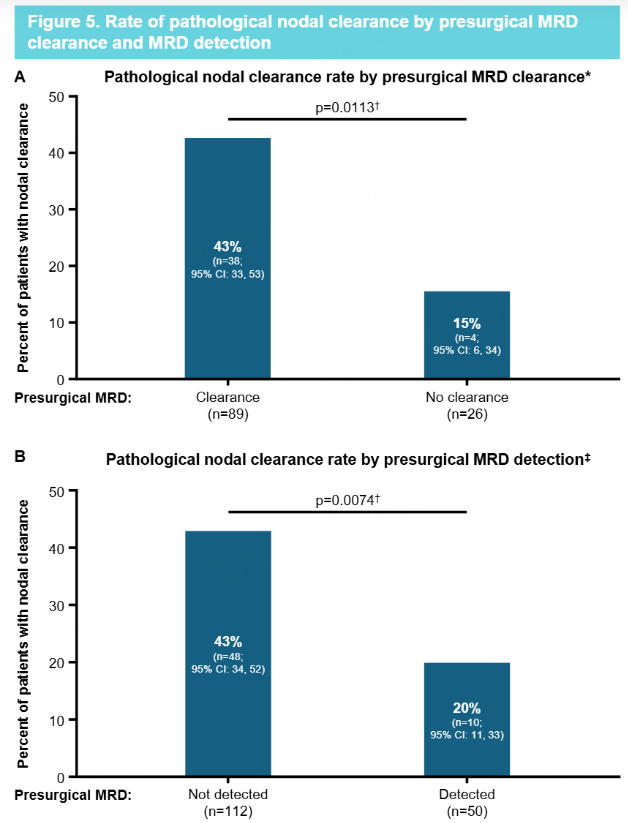
In addition, the study found a clear association between PERCIST response and pathological response as well as MRD status. Overall, 87% (54/62) of patients achieving MPR were PERCIST responders. The PERCIST response rate in patients with preoperative MRD clearance (80%, 74/93) was significantly higher than in those without MRD clearance (33%, 10/30). The association among pathological lymph node staging at surgery, preoperative PERCIST staging, and MRD is shown in the figure.
Conclusion
The PERCIST analysis further confirmed the clinical benefit of neoadjuvant osimertinib ± chemotherapy compared with placebo plus chemotherapy, complementing the previously reported improvements in MPR rate and surgical outcomes. The observed correlation between PERCIST response and MPR and MRD suggests that PERCIST may serve as a prognostic assessment tool in neoadjuvant therapy for this patient population, providing an important reference for clinical efficacy monitoring and treatment adjustment.
Clinical Interpretation: Core Value and Clinical Implications of the NeoADAURA Exploratory Analysis
In the clinical management of resectable EGFR-mutant stage II–IIIB NSCLC, the core objective of neoadjuvant therapy is to achieve tumor downstaging and improve the rate of radical resection, while the precision of efficacy evaluation directly determines the direction of treatment adjustment and patient prognosis. Based on the PERCIST analysis results from the NeoADAURA study, its core value can be examined from three progressive dimensions—tool innovation, prognostic correlation, and clinical implementation—providing more practical insights for clinical practice and breaking away from previously homogeneous interpretation frameworks.
From the perspective of innovation in efficacy evaluation tools, there is an evident inconsistency between traditional imaging assessment and pathological evaluation. With the addition of PET-CT, more information can be provided from a metabolic dimension, thereby improving the consistency between imaging and pathological assessment. For a long time, clinical evaluation of neoadjuvant therapy efficacy has relied primarily on CT combined with RECIST criteria; however, these criteria have clear limitations—responses in small lesions such as lymph nodes and subclinical lesions are difficult to capture precisely, often failing to reflect treatment effects in a timely manner and potentially leading to delayed treatment adjustment. In contrast, the metabolic assessment advantages of PERCIST based on 18F-FDG-PET-CT enable earlier and more comprehensive detection of tumor metabolic changes, particularly suitable for dynamic monitoring during the neoadjuvant phase.
A deeper analysis of the association between PERCIST response and key clinical indicators provides a “quantifiable reference basis” for prognostic evaluation, which represents the most clinically valuable breakthrough of this analysis. In clinical practice, PERCIST response can be used to preliminarily predict pathological remission and recurrence risk: for patients achieving CMR or PMR, there is a high probability of favorable pathological remission and lower recurrence risk, and the current treatment regimen can be continued; for patients without response or with progressive metabolic disease, treatment strategies should be adjusted promptly to avoid toxicity from ineffective therapy and delays in effective treatment, thereby achieving individualized prognostic stratification management.
Returning to the level of clinical implementation, this PERCIST analysis further refines the neoadjuvant management system for resectable EGFR-mutant NSCLC and promotes the upgrading of treatment models toward greater precision and closed-loop management. This analysis provides a specific monitoring pathway for the clinical application of the “osimertinib ± chemotherapy neoadjuvant therapy” regimen—incorporating PERCIST into the routine evaluation system for neoadjuvant therapy in the future to achieve closed-loop management of “treatment–monitoring–adjustment,” helping clinicians formulate more precise individualized treatment strategies. At the same time, by integrating CT examination and MRD testing, a multidimensional efficacy evaluation system can be established to further enhance the precision of treatment decision-making and maximize patients’ chances of cure.
Reference:
[1] 237P - Positron emission tomography response criteria in solid tumors (PERCIST) outcomes following neoadjuvant (neoadj) osimertinib (osi) ± chemotherapy (CTx) vs placebo (PBO) + CTx in patients (pts) with (w) resectable, EGFRm stage II–IIIB NSCLC.Posters and ePosters - ELCC 2026 Onsite and Online Congress

