


On February 7th, Massachusetts General Hospital announced that surgeons had once again used pig kidneys to save the life of a patient with end-stage renal failure.
This is the second time that the Massachusetts General Hospital team has transplanted a pig kidney into a living human. Without this procedure, doctors had previously estimated that the patient's chances of survival over the next five years would be only 35%.
Only one week after the surgery, 66-year-old patient Tim Andrews was discharged from the hospital and will no longer require dialysis.

Andrews was discharged from the hospital accompanied by his wife.
Photo credit: Massachusetts General Hospital
According to an incomplete statistic by the "Medical Community," as of now, approximately 7 patients in China and the United States have undergone porcine organ transplantation, including pig hearts, kidneys, and livers, with at least 2 still surviving. Early this month, the U.S. Food and Drug Administration (FDA) formally approved the initiation of clinical trials for pig kidney transplantation.
"Our goal is to make porcine organ transplantation a viable long-term solution for patients. Although there is still a long way to go, this transplant is a milestone," said Dr. Tatsuo Kawai, the lead surgeon and a professor of surgery at Massachusetts General Hospital.
Two Recipients of Porcine Kidneys
For Andrews, the decision to undergo porcine kidney transplantation was perhaps not difficult.
Suffering from end-stage renal disease, he had been undergoing dialysis for over two years, spending three days a week enduring the grueling process for several hours each time. Andrews also had severe diabetic complications and was in very poor health, having suffered a heart attack in 2023.
Under normal circumstances, his preferred treatment option would have been a human kidney transplant, with an average waiting time of 3-5 years for a donor kidney. However, since Andrews has type O blood, the estimated waiting time would have been extended to nearly 10 years.
"I don't have that much time. I don't want to end my life on dialysis," he said. Therefore, he readily accepted the suggestion for porcine kidney transplantation.
At the same time as Andrews' surgery, the previous porcine kidney transplant recipient, 53-year-old Towana Looney, was in good health during her latest check-up. She has been living with a pig kidney for two months, setting a world record for the longest survival time with a porcine organ.>>>The World's Only Person with a Pig Kidney, Discharged
"I now have plenty of energy. I can walk through dozens of streets in a day and often feel hungry," Looney said in an interview with "NPR Health News." Before the pig kidney transplant, "I would be short of breath, weak, nauseous, and without appetite after just a few steps."
Unlike Looney, the kidney Andrews received came from the U.S. biotech company eGenesis. This pig had undergone 69 genetic edits, 59 of which were to inactivate porcine endogenous retroviruses (PERV), with the rest aimed at preventing rejection and other issues.
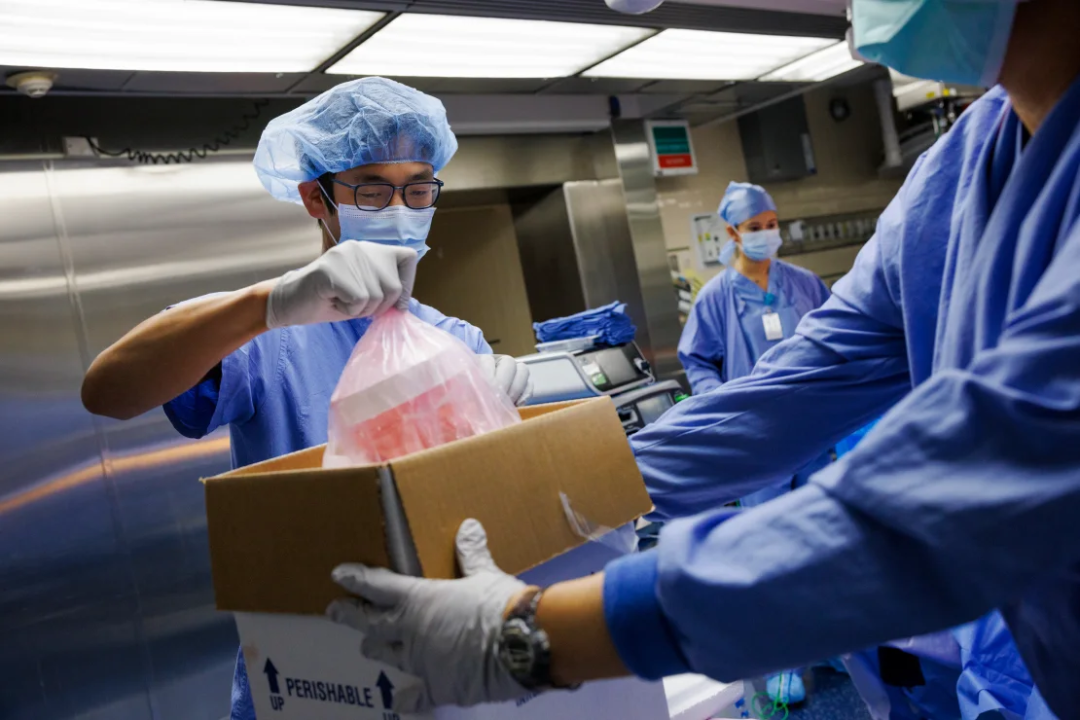
Doctors prepared the pig kidney for Andrews.
Photo credit: CNN
Looney's kidney, on the other hand, came from a pig with 10 genetic edits, one of which restricted the growth of the pig's organs. In contrast, Chinese teams mostly use pigs with 6 genetic edits.
Dr. Pan Dengke, the inventor of China's first medical transplant pig and founder of Chengdu Zhongke Aoge Biotechnology, introduced to the "MedJ," "We select small pigs without PERV-C as donors, knock out three major antigens, and overexpress human complement inhibitors and anticoagulant factors, reducing the number of genes and edits required."
Andrews' surgery took place on January 25th. Two American pharmaceutical companies also provided him with the latest drugs to suppress the immune system and minimize the risk of rejection of the xenograft.
"The surgery lasted 2.5 hours, and the transplanted pig kidney began producing urine within 10 minutes," Professor Tatsuo Kawai said. "Everything went very smoothly. He is in good condition and has not experienced any complications."
In a statement, patient Andrews said, "As soon as I woke up from the surgery, the shadow of dialysis was gone. I felt reinvigorated. I really want to thank all the medical staff; they have given me a new lease on life."
Currently, Andrews has been discharged from the hospital. For the time being, he will still need to undergo continuous medical monitoring, returning to the hospital weekly for blood tests. Additionally, he will carry various remote devices to allow the clinical team to monitor his vital signs and heart rhythm in real time.
Clinical Trials for Porcine Kidney Transplantation Set to Begin
At present, there are two people in the world living with pig kidneys: Looney and Andrews.
In fact, the surgeries they underwent were not based on formal clinical trials but were approved under the FDA's "compassionate use" clause. This clause allows the provision of unapproved treatments that may benefit patients with life-threatening diseases.
On February 3rd, the U.S. biotech company United Therapeutics announced that it had received FDA approval to fully initiate large-scale clinical trials for porcine kidney transplantation. The initial group will consist of 6 patients, with the trials expected to begin in the middle of this year.
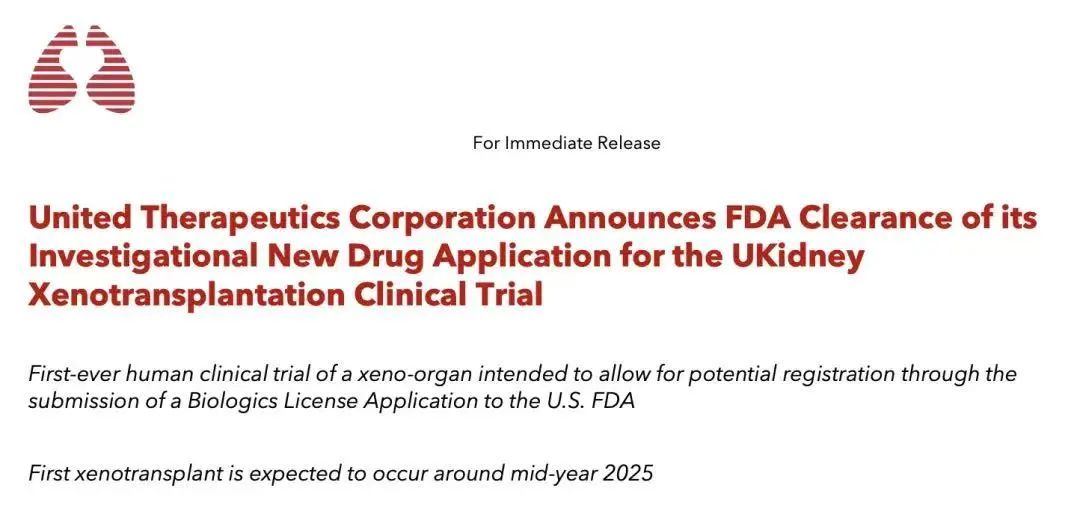
United Therapeutics announced that the FDA has approved the application
According to United Therapeutics, the trial subjects will be patients aged 55-70 with end-stage renal disease who are medically unsuitable for transplantation or unlikely to receive a kidney transplant within the next five years, but who may die while waiting.
These patients will undergo close monitoring for about half a year. Based on the safety and efficacy data collected, the FDA will then decide whether to expand the trial to 50 people.
eGenesis has also submitted an application, but the company has not yet responded regarding the approval status.
Meanwhile, Dr. Muhammad Mohiuddin, the leader of the world's first porcine heart transplant and a professor of surgery at the University of Maryland Medical Center, has also submitted a clinical trial application for porcine heart transplantation to the FDA. He emphasized, "Compared to kidneys, the heart is a more difficult organ to obtain."
Global statistics show that approximately 2 million people need organ transplants each year, but the organ supply-demand ratio is only 1:20 to 1:30. Countless patients die while waiting for organs.
To change this situation, over the past 20 years, scientists have made a series of modifications to pigs. These include eliminating porcine endogenous viruses to ensure biosafety in cross-species transplantation, editing genes to improve the biocompatibility between pigs and humans, and conducting hundreds of animal experiments.
It was not until January 2022 that 57-year-old David Bennett underwent the world's first porcine heart transplant, marking the official entry of porcine organ transplantation into the human application phase.
At the same time, China's xenotransplantation research has also made rapid progress in recent years. On January 9, 2025, Xijing Hospital announced the completion of the world's first porcine liver transplant in a brain-dead patient.
It is worth noting that compared to previous trials based on the "compassionate use" clause, the clinical trials formally approved this month are more likely to explore the potential of porcine organ transplantation.
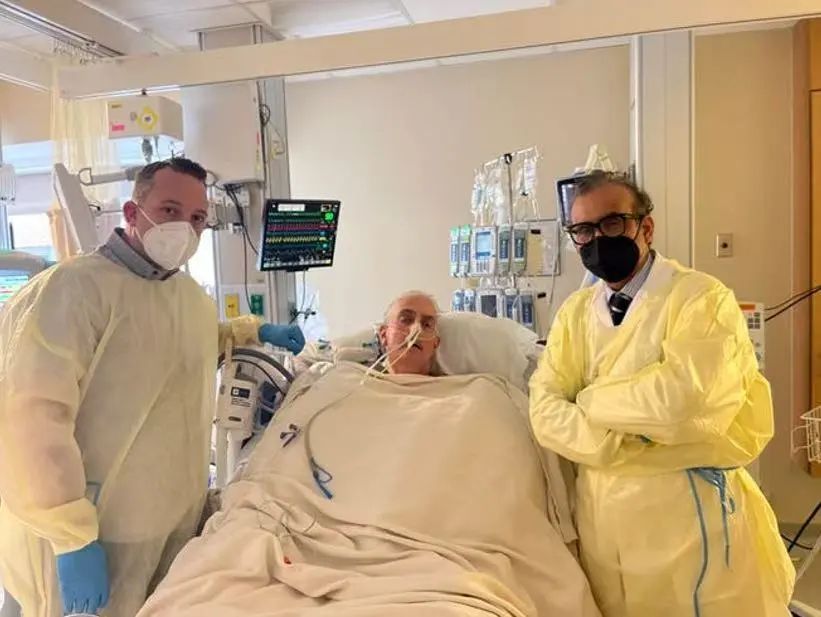
On January 12, 2022, after David Bennett received the pig heart transplant.
Photo credit: University of Maryland Medical Center
Currently, among the 7 patients worldwide who have undergone porcine organ transplantation, at least 4 have died. The causes of death are mostly attributed to the poor health conditions of the patients before transplantation, with some already in a "moribund state."
"We believe that if we conduct porcine organ transplantation trials on relatively healthier candidates, it may yield better results," said Dr. Jayme Locke, a transplant surgeon at New York University Langone Medical Center.
On the other hand, the clinical trials will also investigate the long-term feasibility of porcine organ transplantation. For example, they will test more novel immune protocols to maximize the prevention of chronic rejection.
Dr. David Cooper, an expert in xenotransplantation at Massachusetts General Hospital, also noted that "some non-human primates that received porcine kidneys have shown proteinuria. Whether this will affect humans remains to be seen, and doctors have been working hard to control this condition."
Dr. Luhan Yang, co-founder of eGenesis and CEO of Hangzhou Qihan Biotechnology, said in an interview with Nature that for decades, she has heard people say that xenotransplantation is just around the corner. She hopes that the FDA's approval will encourage regulatory agencies in Europe and China to consider initiating similar clinical trials.

