


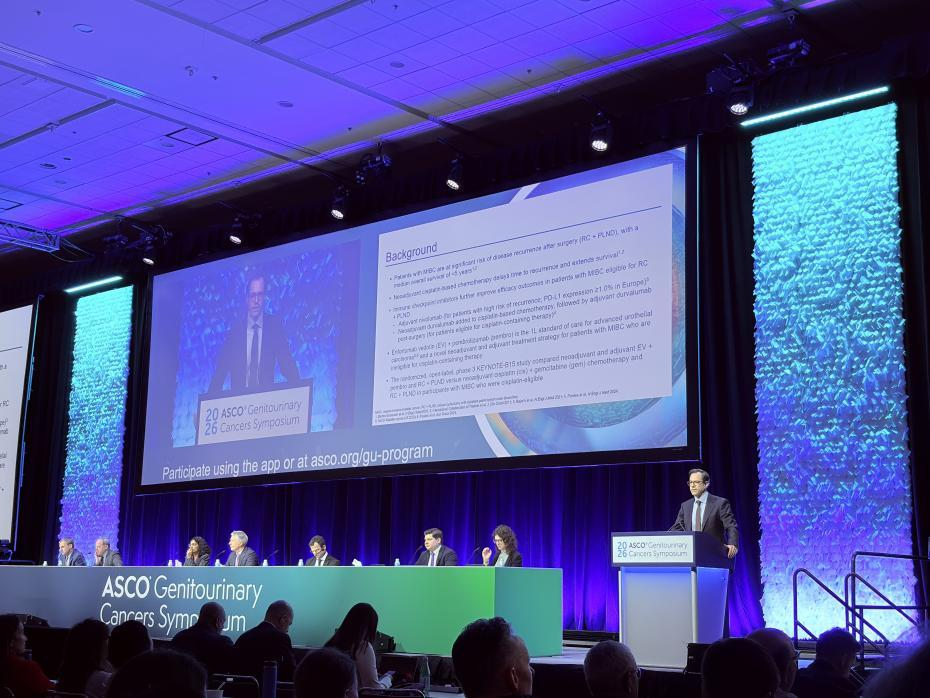
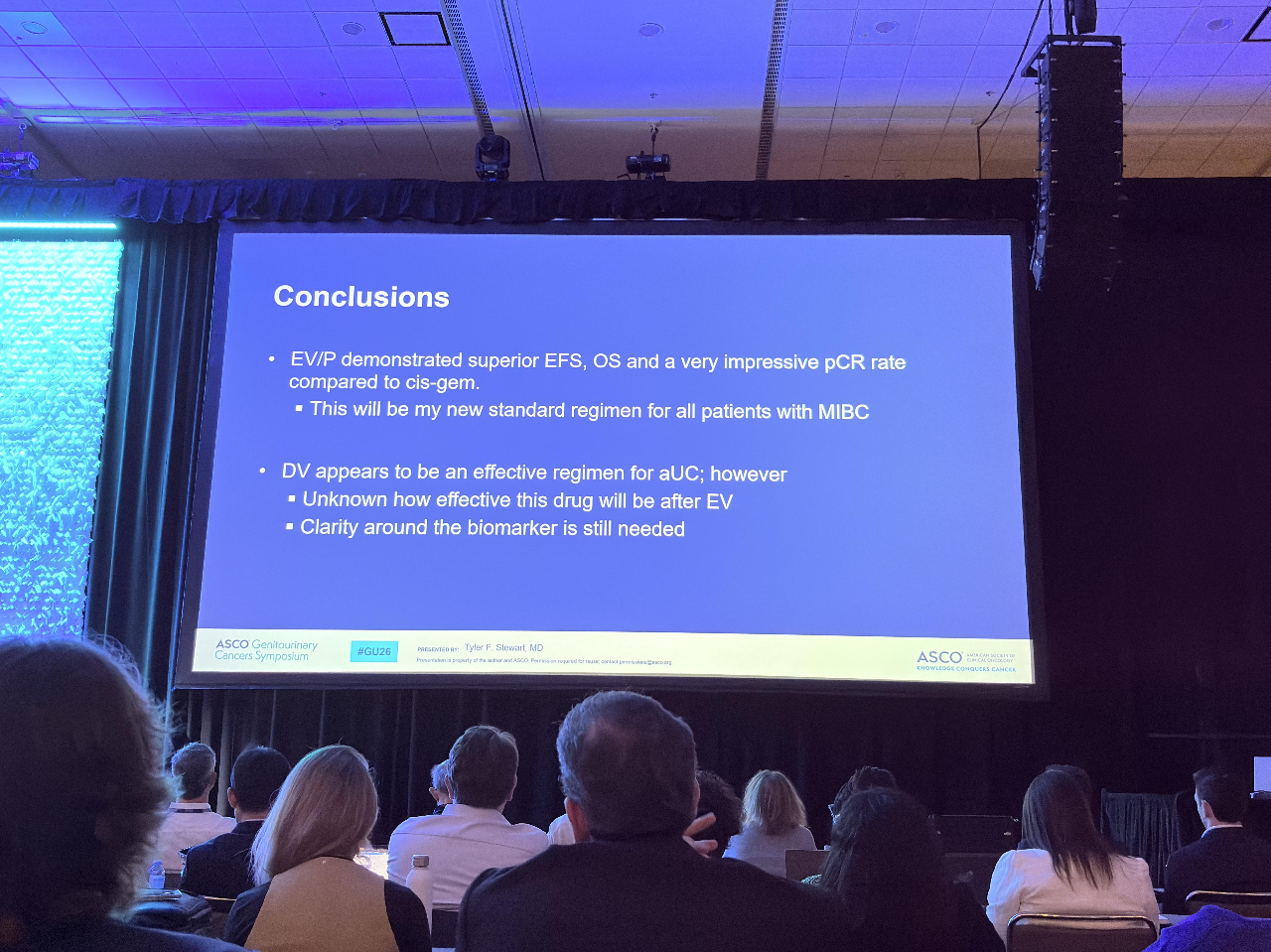
Perioperative enfortumab vedotin plus pembrolizumab significantly improved event-free survival, overall survival, and pathologic complete response compared with standard neoadjuvant gemcitabine-cisplatin in cisplatin-eligible muscle-invasive bladder cancer, according to phase 3 KEYNOTE-B15 data presented at the 2026 ASCO Genitourinary Cancers Symposium.
Cisplatin-Based Standard Faces a New Challenger
For patients with muscle-invasive bladder cancer (MIBC) who are fit for cisplatin, neoadjuvant cisplatin-based chemotherapy followed by radical cystectomy and pelvic lymph node dissection has remained the standard perioperative approach for decades. Although this strategy improved outcomes over surgery alone, recurrence rates have remained substantial and toxicity has limited broader gains, leaving a clear need for more effective systemic treatment before and after surgery.
The antibody-drug conjugate enfortumab vedotin and the PD-1 inhibitor pembrolizumab have already reshaped first-line treatment for locally advanced or metastatic urothelial carcinoma. KEYNOTE-B15, also known as EV-304, asked whether the same combination could improve outcomes when moved earlier, into the curative-intent perioperative setting for cisplatin-eligible disease.
Study Design: Head-to-Head Comparison on Hard End Points
KEYNOTE-B15 is a global, multicenter, open-label phase 3 trial in patients with centrally confirmed cT2-T4aN0M0 or cT1-T4aN1M0 MIBC who were eligible for both cisplatin-based chemotherapy and radical cystectomy plus pelvic lymph node dissection. A total of 808 patients were randomly assigned 1:1 to receive perioperative enfortumab vedotin plus pembrolizumab or standard neoadjuvant gemcitabine plus cisplatin followed by surgery.
In the experimental group, patients received 4 neoadjuvant cycles of enfortumab vedotin 1.25 mg/kg on days 1 and 8 plus pembrolizumab 200 mg on day 1 every 3 weeks, followed by surgery, then 5 adjuvant cycles of enfortumab vedotin and 13 adjuvant cycles of pembrolizumab. The control group received 4 cycles of gemcitabine 1000 mg/m² on days 1 and 8 plus cisplatin 70 mg/m² on day 1 every 3 weeks before surgery, with no adjuvant systemic therapy.
The primary end point was event-free survival by blinded independent central review. Key secondary end points were overall survival and pathologic complete response, with safety assessed in parallel.
Results: Significant Benefit Across Three Major Outcomes
At a median follow-up of 33.6 months, perioperative enfortumab vedotin plus pembrolizumab met the primary end point and both key secondary end points. Median event-free survival was not reached in the combination arm versus 48.5 months with neoadjuvant chemotherapy and surgery, translating to a 47% reduction in the risk of recurrence, progression, or death (hazard ratio [HR], 0.53). Estimated 24-month event-free survival rates were 79.4% and 66.2%, respectively.
Overall survival also favored the experimental regimen. Median overall survival had not yet been reached in either group at the time of analysis, but the combination reduced the risk of death by 35% (HR, 0.65). Estimated 24-month overall survival rates were 86.9% with enfortumab vedotin plus pembrolizumab and 81.3% with gemcitabine-cisplatin followed by surgery.
The pathologic complete response rate, a commonly used marker of depth of response to neoadjuvant treatment, was 55.8% with the combination and 32.5% with standard chemotherapy, an absolute difference of 23.4 percentage points. In practical terms, more than half of patients who received the experimental neoadjuvant regimen had no residual viable tumor identified in the cystectomy specimen.
Surgery completion appeared comparable between the two groups, suggesting that intensification with the antibody-drug conjugate and immunotherapy did not compromise operability in this trial population.
Safety Profile Consistent With Prior Experience
Grade 3 or higher treatment-related adverse events occurred in 75.7% of patients in the enfortumab vedotin-pembrolizumab arm and 67.2% in the chemotherapy arm. Investigators reported no new safety signals, and treatment-related deaths were uncommon. Among adverse events of special interest, severe skin reactions were the most frequent high-grade events associated with both enfortumab vedotin and pembrolizumab.
The higher rate of high-grade toxicity with the combination is clinically relevant, but the overall safety profile was described as manageable and in line with established experience for the two agents. That balance between efficacy and toxicity is likely to be central to treatment discussions if the regimen moves into routine care.
Expert Perspective: Practice-Changing, but Questions Remain
Commenting for MedJ, Prof. Weiwei Shi said the trial provides unusually strong evidence because the regimen improved event-free survival, overall survival, and pathologic complete response simultaneously against a long-standing cisplatin-based comparator. In his view, the findings support the combination as a likely new perioperative benchmark for cisplatin-eligible MIBC.
Prof. Shi also cautioned that broader implementation will depend on access, cost, and patient selection. He noted that conventional gemcitabine-cisplatin may still retain a role in resource-limited settings or in lower-risk patients, and said a key future question will be how to sequence therapy if patients exposed to enfortumab vedotin in the perioperative setting later relapse.

