


At a late-breaking oral session in San Francisco, Prof. Karim Fizazi of Centre Oscar Lambret and Paris-Saclay University presented the first results of PEACE-2, a randomized phase III study designed to test whether earlier systemic intensification could improve outcomes in a population considered at particularly high risk for relapse despite standard local therapy.
Can Upfront Cabazitaxel Improve on Standard Therapy?
For men with locally advanced or otherwise high-risk nonmetastatic prostate cancer, long-term androgen deprivation therapy (ADT) plus radiotherapy is an established standard of care. Yet patients categorized as “very high risk” continue to face substantial rates of biochemical relapse, local progression, or distant spread, which has fueled interest in adding active systemic therapy earlier in the disease course.
Cabazitaxel, a taxane chemotherapy already used in metastatic castration-resistant prostate cancer, provided the rationale for this strategy. Investigators hypothesized that introducing the drug before clinically overt metastases emerge might eradicate occult micrometastatic disease and delay recurrence or death. PEACE-2 was designed to test that hypothesis in a definitive setting.
Trial Design Focused on a Very High-Risk Population
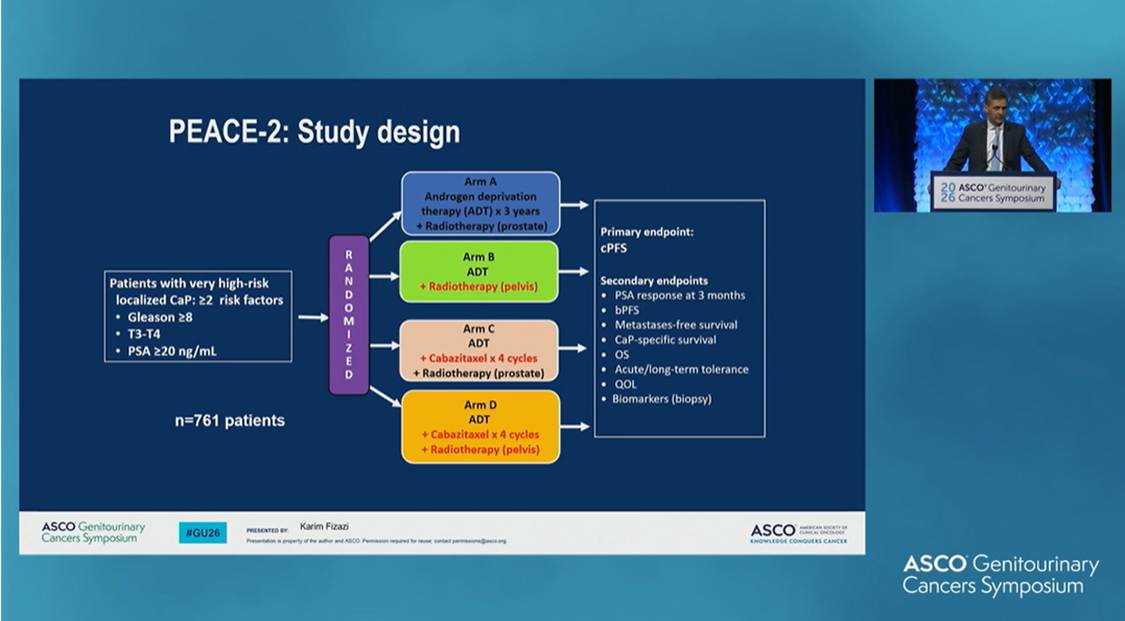
PEACE-2 (NCT01952223) was a 2×2 factorial, randomized phase III trial that enrolled 761 men with very high-risk localized prostate cancer. Eligibility required at least 2 of 3 adverse features: Gleason score 8 to 10, clinical stage T3 or T4 disease, or a prostate-specific antigen level greater than 20 ng/mL at diagnosis. Conventional imaging, including bone scanning and computed tomography, showed no distant metastases at baseline.
All patients received definitive prostate radiotherapy at 74 to 78 Gy plus 3 years of ADT. Within that standard backbone, patients were randomly assigned to standard therapy alone, standard therapy plus elective pelvic nodal irradiation, standard therapy plus 4 cycles of cabazitaxel given before radiotherapy, or the combination of pelvic nodal irradiation and cabazitaxel. The primary endpoint was clinical progression-free survival, defined as time from randomization to death, metastasis, or local recurrence; overall survival and safety were secondary endpoints.
Negative Efficacy Result, With More Toxicity
The trial enrolled patients between 2013 and 2021. Median age was 67 years; 79% of participants had 2 very high-risk features and 21% had all 3. Cabazitaxel-based treatment was assigned to 381 patients and no cabazitaxel to 380. Notably, 18% of patients underwent choline PET at baseline. With a median follow-up of 85 months, the data were considered mature for analysis.
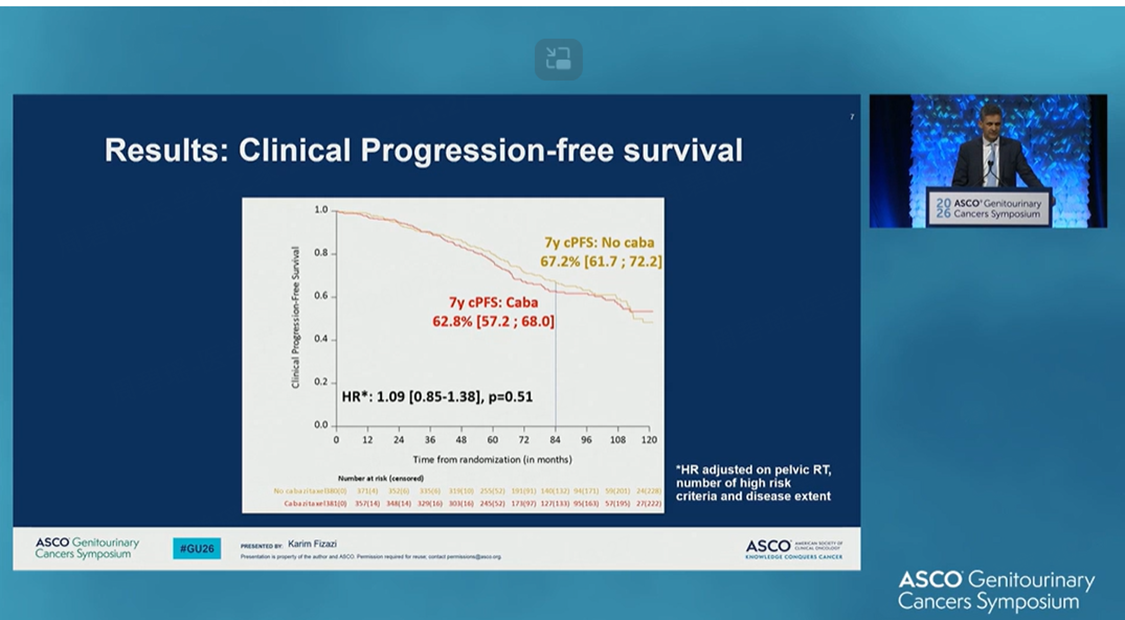
Investigators found no interaction between cabazitaxel and pelvic radiotherapy. In the main efficacy analysis, upfront cabazitaxel did not improve clinical progression-free survival: hazard ratio 1.11 (95% CI, 0.87-1.41). Six-year clinical progression-free survival rates were 67.2% with cabazitaxel and 71.4% without it, showing no statistically significant advantage for early chemotherapy intensification.
Overall survival results also failed to suggest benefit. Across treatment groups, 10-year overall survival exceeded 85%, and prostate cancer-specific deaths were rare during the first decade of follow-up. Safety moved in the opposite direction: grade 2 or higher adverse events occurred in 65% of patients receiving cabazitaxel versus 47% of those who did not, with expected hematologic and gastrointestinal toxicities contributing to the excess burden.
A Challenge to Current Risk Definitions
“Adding cabazitaxel to standard radiotherapy and long-term ADT did not improve clinical progression-free survival or overall survival, but did increase toxicity,” Prof. Fizazi said during the presentation. That finding directly addresses the central clinical question of whether taxane intensification should be used routinely at the outset of treatment in conventionally staged very high-risk disease.
The more provocative implication may be what PEACE-2 says about the population itself. The definition of very high-risk localized disease in the trial relied largely on conventional clinical factors and standard imaging. Yet the unexpectedly favorable long-term outcomes seen with ADT plus prostate radiotherapy alone raise the possibility that this definition is too broad in the era of more sensitive molecular imaging.
Prof. Fizazi noted that prostate cancer-related deaths during the first decade were “very low,” and said the data challenge current definitions of very high-risk localized prostate cancer, especially when modern imaging is used. Because 18% of patients had baseline choline PET, some men with otherwise occult metastatic disease may already have been excluded. In practice, that means the remaining study population may have had a better underlying prognosis than expected from conventional criteria alone.
The study therefore reinforces standard radiotherapy plus long-term ADT as the treatment backbone for patients meeting PEACE-2 criteria and argues against routine addition of upfront cabazitaxel. At the same time, it shifts attention toward better selection of the minority of patients who remain at genuine risk for progression despite current local therapy. More sensitive staging approaches, including PSMA PET, may ultimately be needed to identify those candidates for future intensification strategies such as radioligand therapy or other combination approaches.
Takeaway
PEACE-2 is a mature, methodologically rigorous study that does not change current standard practice in favor of intensification, but it does provide clinically useful negative evidence. The results suggest that moving an active drug earlier in the disease course cannot be assumed to improve outcomes, even in patients labeled very high risk. They also expose a key limitation: present-day risk stratification may be insufficiently precise for selecting who truly needs more treatment. That question—rather than routine use of cabazitaxel—now appears to be the more important next step for this field.

